

Giri vs Firouzja 2026 – A Strategic Masterclass with a Brutal Endgame Finish
Super Chess Classic 2026-This game is a perfect example of how calm positional play can slowly destroy even the most dangerous attacking players. Anish Giri, known for his solid and precise style, takes on Alireza Firouzja, one of the most aggressive and creative players in modern chess.
At first glance, the opening looks normal. But as the game progresses, Giri slowly takes control, simplifies the position, and converts a long endgame with excellent technique.
Let’s break it down in very simple words so you can understand every phase.
Opening Phase (Moves 1–10) – King’s Indian Defense
The game starts with:
- d4 Nf6 2. c4 g6 3. Nc3 Bg7 4. e4 d6
This is the famous King’s Indian Defense. Firouzja chooses a fighting setup, aiming for counterattack instead of symmetry.
After castling, we reach a typical structure. But then:
8… exd4
Black opens the center early. This is slightly risky because it gives White space and easier development.
By move 10:
10… Nd5
Firouzja tries to create activity, but this move leads to exchanges that actually help Giri.
Early Middlegame (Moves 11–20) – Giri Takes Control
After:
- cxd5 Nxd4 12. Qd2
White stabilizes everything. Then:
13… Re8 14. Nc3
Giri calmly improves his pieces. No rush. No attack. Just better positioning.
A key moment:
16… c5
17. dxc6 bxc6
Now the structure becomes weak for Black. He gets doubled pawns and long-term weaknesses.
Then comes a strong move:
- Bf6
This is very important. Giri places his bishop actively and starts targeting weaknesses.
By move 20:
- Ne2
White prepares to improve further, while Black starts running low on time and ideas.
Middlegame Turning Point (Moves 21–30)
This is where the game really shifts.

23… Rf6
24. Bxf6 Qxf6
Giri forces exchanges and simplifies into a better position.
Then:
25… Qxf3
26. gxf3
White accepts doubled pawns, but in return:
- He gets a strong center
- Open files
- Better control
This is a classic strong player decision.
Then comes:
- e5
This is a powerful break. It opens the position at the right time.
After:
- Nxc5
White wins a pawn and enters a clearly better endgame.
Endgame Phase (Moves 31–50) – Pure Technique
Now the game becomes a lesson in endgame play.
Giri activates his rook:
- Rd8+
He keeps pushing Black’s king back.
Then slowly:
- White improves piece activity
- Black becomes passive
- Weak pawns start falling
Moves like:
- Nd6
- Nc4
- Ne3
These are not flashy moves, but they are very strong. Giri is slowly tightening the position.
Firouzja tries to defend, but his pieces are not coordinated.
Final Phase (Moves 50–72) – Conversion
Now comes the finishing phase.
Giri centralizes his king:
- Ke4
- Kd4
- Kc4
This is textbook endgame play. The king becomes an attacking piece.
Then:
- Re3+
- Nh6+
White creates constant pressure.
Finally, Black’s position collapses:
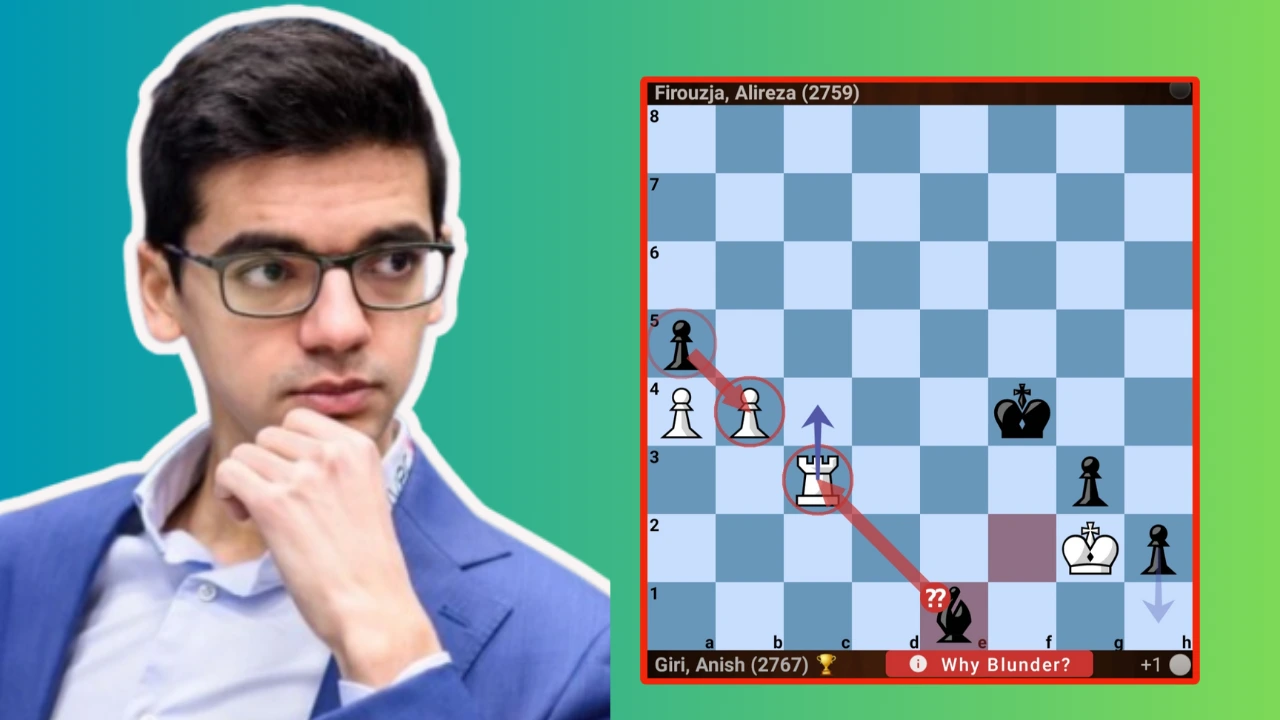
58… Rxh3
59. Rxh3 Kxg4
Material becomes equal for a moment, but White’s position is much better.
The key moment:
70… h1=Q+
71. Kxh1
Black promotes, but it doesn’t help. White’s coordination is too strong.
After:
72… Kf4
Black resigns. The position is completely lost.
Super Chess Classic 2026 Key Lessons from This Game
1. Patience Wins Games
Giri never rushed. He improved step by step.
2. Structure is More Important Than Material
Even with doubled pawns, White had a better position.
3. Simplify When You Are Better
Giri exchanged pieces at the right time to enter a winning endgame.
4. King Activity is Everything in Endgames
Giri’s king marched into the center and dominated.
5. Small Advantages Matter
No big tactics. Just small improvements again and again.
Giri vs Firouzja | Super Chess Classic Romania 2026
Q1: Why is this game considered a strategic masterclass by Anish Giri?
This game is often described as a strategic masterclass because Giri never relied on tactical tricks or direct attacks to win. Instead, he gradually improved his position move after move until Firouzja’s position became impossible to defend.
What makes the game impressive is that Giri identified small positional advantages early and never allowed Black any meaningful counterplay. Rather than searching for flashy combinations, he focused on better pawn structure, active pieces, and long-term planning.
Many amateur players believe that brilliant chess always involves sacrifices and attacks. This game shows the opposite. Giri demonstrated how patience, precision, and understanding can be just as powerful as tactical fireworks.
By the time the endgame arrived, White’s advantage was already deeply rooted in the position, making the final conversion look almost effortless.
Q2: Did Firouzja’s early decision to open the center help White?
Yes, this was one of the key strategic themes of the game.
When Firouzja played an early central exchange with …exd4, he aimed to create activity and avoid a cramped position. However, the decision also gave White easier development and more space.
In many King’s Indian structures, Black is willing to accept less space temporarily because dynamic counterplay often arrives later. By simplifying too early, Firouzja allowed Giri to develop comfortably without facing the usual complications associated with the opening.
As the game progressed, White’s pieces found natural squares while Black struggled to generate active play.
This did not lose the game immediately, but it gave Giri the type of position he excels in: stable, strategic, and free from unnecessary risks.
Q3: Why was 16…c5 followed by 17.dxc6 so important?
This sequence fundamentally changed the pawn structure of the game.
After the exchanges, Black was left with structural weaknesses that remained targets for the rest of the battle. The doubled pawns and weakened pawn islands limited Black’s flexibility and created long-term defensive problems.
Strong players often evaluate positions not only by material count but also by pawn structure. Weak pawns require constant protection, and pieces tied to defense cannot participate actively elsewhere.
Giri immediately recognized that these weaknesses would become valuable targets in the future. Rather than attacking them right away, he slowly increased pressure until Black’s position became increasingly difficult to hold together.
This transformation of the pawn structure may have looked harmless at first, but it played a major role in White’s eventual victory.
Q4: Why was Giri’s bishop placement so effective in the middlegame?
One of the most underrated aspects of the game was Giri’s bishop activity.
When White placed the bishop aggressively and targeted Black’s weaknesses, it became a permanent source of pressure. The bishop controlled important diagonals, restricted Black’s pieces, and helped create favorable exchanges.
Strong bishops often influence positions even when they are not directly attacking anything. Their ability to control long diagonals forces opponents into passive setups.
Throughout the game, Giri’s bishop consistently contributed to White’s strategic plan. It supported pawn breaks, controlled key squares, and helped limit Black’s counterplay.
This is a good reminder that active pieces often create advantages even when they are not delivering immediate tactical threats.
Q5: Why did Giri willingly accept doubled pawns after 26.gxf3?
Many beginners see doubled pawns and immediately assume the position has become worse. Giri understood that the position was much more complex than that.
By accepting doubled pawns, White gained several important benefits:
-
Greater central control.
-
Open files for the rooks.
-
Improved piece activity.
-
Better long-term prospects.
The doubled pawns looked ugly visually, but they did not create significant weaknesses. Meanwhile, White’s pieces became much more active.
This decision reflects a common grandmaster principle: activity often matters more than appearance.
Giri evaluated the position based on what his pieces could do, not simply on the shape of his pawns. That deeper understanding allowed him to accept structural imperfections in exchange for dynamic advantages.
Q6: Why was 29.e5 considered the turning point of the game?
The move 29.e5 was arguably the most important strategic decision of the entire game.
Until that point, White had a slightly better position but still needed a concrete way to increase the advantage. The pawn break changed the nature of the position completely.
The move achieved several goals:
-
Opened important lines.
-
Increased the activity of White’s pieces.
-
Created tactical opportunities.
-
Exposed weaknesses in Black’s camp.
Timing is everything in chess. If White had played e5 too early, Black might have found counterplay. If played too late, the opportunity could have disappeared.
Giri chose the perfect moment. The pawn break transformed a pleasant advantage into a position where White could actively play for a win.
Many strong players consider the ability to recognize the right moment for a pawn break one of the most important strategic skills in chess.
Q7: Why was Firouzja unable to generate counterplay after the middlegame?
One of the biggest reasons Firouzja lost was his inability to create active counterplay.
Throughout the game, Giri systematically restricted Black’s options. Every time Firouzja looked for activity, White either neutralized the threat or exchanged pieces under favorable circumstances.
As more pieces came off the board, Black’s structural weaknesses became increasingly important. Without active piece play, those weaknesses could not be compensated for.
This is one of the most difficult situations in chess. A passive position often becomes worse over time because the opponent can improve freely while you are limited to defensive moves.
By the time the endgame arrived, Firouzja was essentially defending rather than creating threats.
Q8: Why was Giri’s king activity so important in the endgame?
One of the defining features of the endgame was the active role played by White’s king.
Many club players treat the king as a piece that must always stay protected. In endgames, however, the king becomes one of the strongest pieces on the board.
Giri understood this perfectly.
His king advanced confidently through the center:
-
Supporting pawns.
-
Controlling important squares.
-
Assisting the rooks and knights.
-
Restricting Black’s king.
The march of the king was not merely cosmetic. It directly contributed to White’s winning chances by increasing pressure on Black’s position.
Endgame experts often say that king activity can be worth an extra pawn. This game provides a textbook example of that principle in action.
Q9: What was Firouzja’s biggest strategic mistake in the game?
Rather than a single blunder, Firouzja’s biggest problem was allowing White to dictate the pace of the game.
Throughout the middlegame, Giri was able to choose when to exchange pieces, when to open the position, and when to transition into the endgame.
Firouzja never found a moment to seize the initiative.
This is often how elite players lose strategic battles. The game remains balanced for a long time, but one player gradually loses control over the direction of the position.
Eventually, every important decision favored White.
The loss was not caused by one tactical oversight but by a series of positional concessions that accumulated over many moves.
Q10: Was the endgame already winning before Black promoted a pawn?
Yes, the endgame was already heavily favorable for White long before the promotion occurred.
Although Black eventually managed to create a passed pawn and promote it, the promotion came too late to change the evaluation.
White’s pieces were significantly more active, and Black’s king remained under pressure.
Strong endgame players understand that promotions do not automatically save a game. What matters is the overall coordination of the pieces and the quality of the position.
Even after Black achieved promotion, White’s superior activity and coordination ensured that the result was never in serious doubt.
The promotion was dramatic, but it did not alter the underlying reality of the position.
Q11: Why is this game likely to be remembered as one of Giri’s finest positional wins of 2026?
This victory showcased everything that makes Giri such a respected grandmaster.
He neutralized an aggressive opponent, exploited structural weaknesses, timed his pawn break perfectly, dominated the endgame, and converted with exceptional precision.
What makes the game particularly impressive is the opponent. Firouzja is one of the most dangerous attacking players in the world and thrives in dynamic positions. Yet Giri completely prevented him from creating the complications he wanted.
Instead of winning through tactics, Giri won through understanding.
For students of chess, this game serves as a model example of how strategic advantages accumulate over time. It demonstrates that controlling the position, improving pieces, and maintaining patience can be every bit as powerful as a spectacular attack.
That combination of positional mastery and technical excellence is why this game will likely be remembered as one of Giri’s most instructive victories of the 2026 season.
SUPER CHESS CLASSIC 2026 | HMFLIX