

Super chess Classic 2026 Keymer’s Strategic Domination: How He Crushed MVL in a Sharp Sicilian Battle!”
This game from the Super Chess Classic 2026 Romania shows a brilliant mix of strategy, patience, and tactical timing.
Keymer (White) plays a solid but flexible setup, while MVL (Black), known for his aggressive Sicilian style, tries to create kingside counterplay.
But in the end, Keymer slowly takes control and finishes the game with a powerful attack.
♟️ Opening Phase (Moves 1–10)
The game begins with the Sicilian Defense:
-
- e4 c5
- Nf3 d6
- d4 cxd4
- Nxd4 Nf6
- Nc3 a6
This is the famous Najdorf Variation, one of the most aggressive openings in chess.
Keymer plays:
- 6. f3 → A flexible move. It supports e4 and prepares a strong center.
- Nb3 → The knight avoids being attacked and stays flexible.
MVL responds actively:
- 6… e5 → Gains space but weakens some squares.
- 9… h5 → A very aggressive idea to attack early on the kingside.
Simple idea:
White builds a strong center. Black tries to attack early.
Middlegame Setup (Moves 11–20)
-
- Nd5 → A strong move! White puts pressure immediately.
- 11… Bxd5 12. exd5 → White gets a strong pawn center.
Now the position becomes strategic.
Keymer plays:
- 13. c4 → Gains space
- Rd1 → Controls the center
- O-O → King safety
MVL tries to counter:
- 14… h4 → Pushes attack on kingside
- 16… Nh5 → Preparing f5
- 17… f5 → Aggressive pawn push
Simple idea:
Black attacks on the kingside, White stays calm and builds slowly.
Strategic Battle (Moves 21–30)
Keymer shows amazing patience here.
-
- Bc2 → Keeps pieces flexible
- Kh1 → Avoids tactics
- Ng1 → Re-routing knight (very deep idea!)
- Nh3 → Bringing it back into the game

This is high-level chess thinking.
Meanwhile MVL continues:
- 21… Qg6 → Targeting kingside
- 23… Nc5 → Strong central square
- 24… Bf6 → Preparing attack
Then comes a critical moment:
- 27… a4 → Black expands on queenside
- b4 → White blocks it perfectly
Key insight:
Keymer stops Black’s play on both sides. This is elite-level control.
Turning Point (Moves 30–34)
This is where the game explodes.
- 30… e4 → MVL goes all-in!
- fxe4 Rxe4 → Black sacrifices for attack
Now things get sharp.
-
- Bg1 → Calm defense
- 32… Rcxc4 → Black grabs material
But then:
-
- Rxe4 Rxe4
- Qb5 → Strong counterattack!
Simple idea:
Black attacks first, but White defends and then strikes back.
Final Attack (Moves 35–38)
Now Keymer takes over completely.
-
- Bxe4 fxe4 → Simplifies position
- Be3 → Brings pieces into attack
- Qxa4 → Wins material
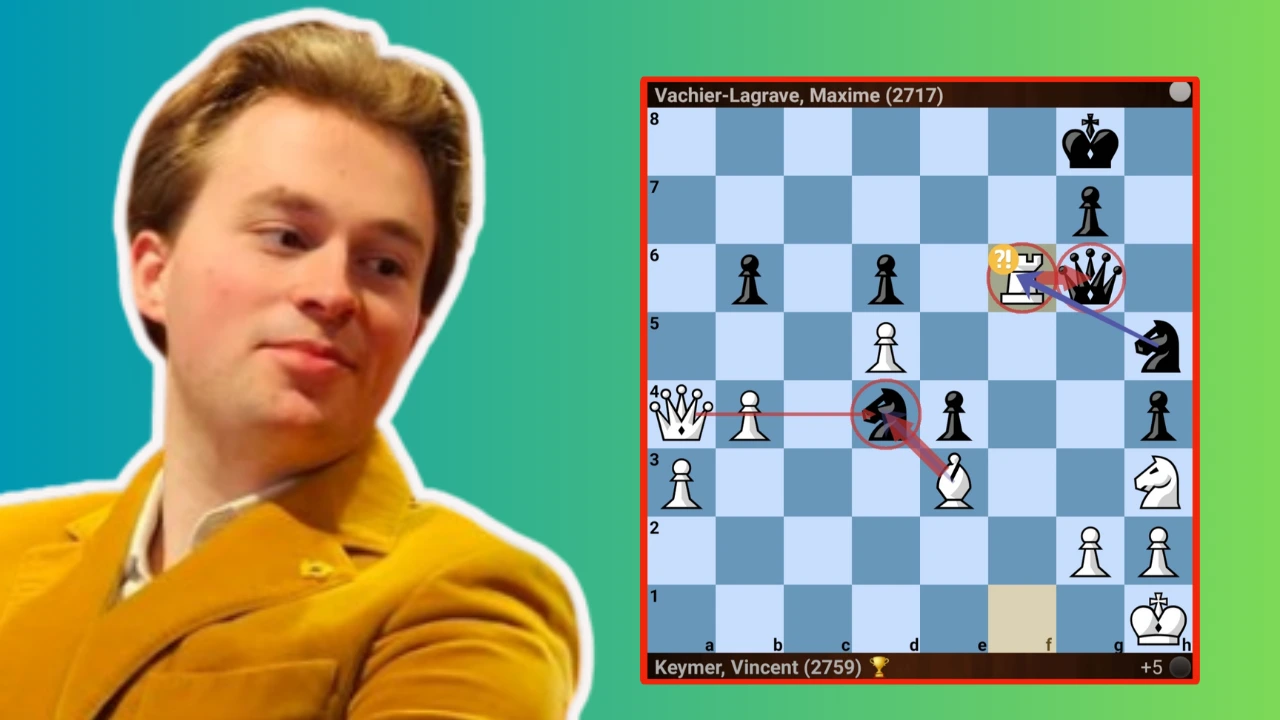
- 37… Nd4 → Last try by Black
And then the killer move:
- 38. Rxf6! 💥
This is the winning blow.
Black resigns.
Why it works:
- White destroys Black’s king defense
- Material advantage + attack = game over
Key Lessons from the Game
1. Patience beats aggression
MVL attacked early, but Keymer stayed calm and waited.
2. Piece coordination is everything
Keymer improved all his pieces before attacking.
3. Defense can become attack
Keymer first defended perfectly, then counterattacked.
4. Timing is key
The move Rxf6 came at the perfect moment.
Keymer vs MVL | Super Chess Classic Romania 2026
Q1: Why was Vincent Keymer willing to allow MVL’s kingside attack in the opening?
One of the most interesting aspects of this game is that Keymer never tried to stop Black’s attack immediately. Instead, he accepted that MVL would gain space on the kingside and focused on building a stronger overall position.
Many players panic when they see pawns moving toward their king. Keymer understood that every attacking move comes with a cost. While MVL gained attacking chances with moves like h5 and f5, he also weakened important defensive squares around his own king.
Rather than reacting emotionally, Keymer trusted his position. He concentrated on piece development, king safety, and central control. This patient approach eventually allowed him to absorb the attack and exploit the weaknesses Black had created.
The game teaches a valuable lesson: sometimes the best response to aggression is not immediate counter-aggression, but calm improvement of your own position.
Q2: What was the purpose of Keymer’s Nd5 move, and why was it so important?
The move Nd5 was one of the first signs that White intended to take control of the game strategically.
By placing the knight on d5, Keymer occupied a powerful central outpost and immediately challenged Black’s position. The knight created pressure on important squares and forced Black to make decisions.
After Black exchanged the knight with Bxd5, White recaptured with the pawn, creating a strong pawn center that would influence the rest of the game.
This exchange may seem small, but it shaped the entire middlegame. White gained space, central control, and long-term strategic advantages. Strong central pawns also limited Black’s piece activity and gave White more freedom to maneuver.
Many grandmaster games are decided by such positional decisions long before tactical combinations appear on the board.
Q3: Why was the pawn structure after 12.exd5 favorable for White?
When White recaptured on d5 with the e-pawn, the resulting structure looked simple, but it contained several hidden advantages.
The pawn on d5 controlled key central squares and restricted Black’s pieces. It also provided White with more space, making it easier to reposition pieces and coordinate future plans.
Meanwhile, Black’s position became slightly cramped. Black still had attacking chances, but White enjoyed greater flexibility.
One of the reasons Keymer’s strategy worked so well was that he consistently improved his position while Black was focused primarily on attacking. Over time, these small positional advantages accumulated and became significant.
This demonstrates why strong pawn structures often play a crucial role in elite-level chess.
Q4: Why is the Ng1–h3 maneuver considered a grandmaster-level idea?
The knight retreat to g1 surprised many spectators because moving backward appears counterintuitive.
However, elite players understand that the goal is not to move forward but to improve piece effectiveness.
The knight on g1 was temporarily stepping back so it could eventually reach better squares. From h3, it could support key defensive and attacking operations, potentially jumping to f4 or g5.
This maneuver reflects deep strategic thinking. Instead of looking for immediate tactical threats, Keymer focused on long-term piece optimization.
Many club players lose games because they refuse to reposition pieces. Grandmasters, however, constantly evaluate whether their pieces are performing useful functions.
The Ng1–h3 plan is a perfect example of how patience and piece coordination can be more important than direct aggression.
Q5: Did MVL overestimate his kingside attack?
To some extent, yes.
MVL followed a logical attacking plan and created genuine threats. However, he invested heavily in the attack while Keymer continued improving his overall position.
The problem was that Black’s attack required precise execution. Once White successfully neutralized the main threats, the weaknesses created by Black’s pawn advances became permanent.
Aggressive players often face this risk. If the attack succeeds, they may win brilliantly. If it fails, their position can quickly become vulnerable.
In this game, Keymer’s defensive accuracy prevented Black from achieving the breakthrough he needed. As a result, White gradually took control of the position.
The game illustrates the fine balance between aggression and overextension.
Q6: Why was 30…e4 considered the critical mistake or turning point?
The move 30…e4 was a bold attempt by MVL to seize the initiative and force complications.
The idea behind the move was understandable. Black wanted to open lines, activate pieces, and generate immediate attacking chances. However, opening the center also increases the importance of piece coordination.
At this moment, White’s pieces were actually better prepared for an open position than Black’s.
Once the center opened, Keymer’s active pieces gained new opportunities, while Black’s king became increasingly vulnerable. The move effectively transformed the game from a strategic battle into a tactical fight—and White was better positioned for that transition.
Many chess games are decided by the timing of pawn breaks. In this case, Black’s ambitious attempt to create activity ultimately accelerated his own downfall.
Q7: How did Keymer transform defense into attack?
One of the most impressive aspects of the game was the way Keymer switched from defending to attacking.
Throughout the middlegame, he focused on stopping Black’s threats rather than creating his own. However, once MVL’s attack lost momentum, White’s better piece placement became a decisive factor.
The transition happened gradually:
-
White neutralized Black’s kingside pressure.
-
White improved piece coordination.
-
White identified weaknesses in Black’s position.
-
White began creating tactical threats.
By the time Black realized the initiative had changed hands, it was already too late.
This is a classic example of high-level counterattacking chess. The defender patiently absorbs pressure, waits for the right moment, and then strikes when the opponent’s position becomes overextended.
Q8: Was MVL already losing before the final combination?
Not necessarily.
Although White held the superior position, Black still had practical chances for resistance. The position remained complex and required accurate play from both sides.
However, several factors favored White:
-
Better piece coordination.
-
Fewer weaknesses.
-
Greater control of key squares.
-
More active long-term plans.
These advantages made White’s position easier to play.
At the grandmaster level, even small positional edges can become decisive because elite players know how to convert them. While Black was not immediately lost, the balance had clearly shifted in White’s favor.
The final tactical sequence simply confirmed an advantage that had been growing for many moves.
Q9: Why was 38.Rxf6 such a devastating tactical blow?
The move 38.Rxf6 was the culmination of everything Keymer had been building throughout the game.
This sacrifice worked because Black’s defensive structure had already been weakened by earlier decisions. The move removed critical defenders and exposed the king to direct threats.
What makes the move particularly impressive is its timing.
Keymer did not rush into tactics earlier. Instead, he patiently improved his position until the sacrifice became completely justified.
This highlights an important chess principle:
Most successful combinations are created by strategic preparation.
The move may look like a sudden tactical explosion, but it was actually the result of many earlier positional improvements.
Q10: What was MVL’s biggest strategic mistake in the game?
MVL’s biggest strategic mistake was committing too heavily to an attack without securing enough long-term compensation.
His aggressive pawn advances created dynamic opportunities, but they also weakened critical squares and reduced the flexibility of his position.
When Keymer successfully defended, those weaknesses became increasingly important.
A successful attack usually requires:
-
Active pieces.
-
Strong coordination.
-
Limited weaknesses.
-
Accurate timing.
Black had attacking chances but failed to generate a decisive breakthrough. As a result, White was able to exploit the positional concessions that had accumulated during the attack.
This game serves as a reminder that every aggressive move carries strategic consequences.
Q11: What can ambitious club players learn from Keymer’s performance?
This game contains numerous lessons for players seeking improvement.
First, it demonstrates the importance of patience. Keymer never rushed his plans and trusted his position even when facing pressure.
Second, it highlights the value of piece coordination. Every White piece eventually found an effective role in the game.
Third, it shows how strong defense can become the foundation for a winning attack.
Finally, the game teaches that timing matters. Keymer did not launch his decisive combination until every piece was ready to contribute.
Players who study this game carefully will gain valuable insights into positional play, defensive technique, and strategic planning.
Q12: Why might this be remembered as one of Keymer’s best games of 2026?
This game showcased nearly every aspect of elite chess.
Keymer demonstrated excellent opening preparation, deep strategic understanding, patient maneuvering, accurate defense, and tactical precision.
What makes the victory particularly impressive is that it came against one of the world’s most dangerous attacking players. MVL is famous for creating complications and putting opponents under pressure, especially in Sicilian positions.
Instead of being intimidated, Keymer remained calm and gradually outplayed his opponent.
The game is likely to be remembered not because of a single spectacular move, but because of the complete quality of White’s play from beginning to end. It is a model example of how a modern grandmaster can neutralize aggression, seize control, and convert an advantage with remarkable precision.
SUPER CHESS CLASSIC 2026 | HMFLIX