

Grand Chess Tour 2026- Sindarov vs Fedoseev
This chess game is a perfect example of modern attacking chess. White (Sindarov) plays aggressively from the start, sacrifices material at the right moment, and then calmly converts the advantage in the endgame.
It starts like a normal Italian Game, but quickly turns into chaos when both kings become unsafe. The key moment comes when Sindarov sacrifices a knight to open up Black’s king.
Let’s go step by step.
♟️ Opening Phase – Slow Start, Hidden Fire (Moves 1–10)
1. e4 e5 2. Nf3 Nc6 3. Bc4 Bc5
This is the Italian Game. Both players develop pieces normally.
4. c3 Nf6 5. d3 d6
White chooses a slow and flexible setup. No early attack yet.
6. b4 Bb6 7. a4 a6
White starts expanding on the queenside. Black stays solid.
8. Bg5 h6 9. Bh4 g5 10. Bg3 Nh5
Now things get interesting.
Black pushes pawns (g5, h6) to attack the bishop.
But this weakens Black’s king position.
This is the first critical idea:
When you push pawns near your king, you create weaknesses.
The Turning Point – Tactical Explosion (Moves 11–14)
11. Nxe5!!
BOOM! This is the key move.
White sacrifices a knight to open lines toward Black’s king.
11… Nxg3 12. Bxf7+!
Another powerful move!
White gives a check and pulls the king into danger.
12… Kf8 13. Ng6+ Kxf7 14. Nxh8+
Let’s understand what happened:
- White sacrificed one knight
- Then wins a rook in return
Material becomes roughly equal, but Black’s king is exposed.

This is the core lesson:
In fast chess, king safety is more important than material.
Middle Game – Control and Stability (Moves 15–23)
15. hxg3 Qf6 16. Qf3 Qxf3 17. gxf3
Queens are exchanged.
This reduces immediate danger
But White has a better pawn structure for attack
17… Ne5 18. Ke2 Be6 19. Nd2 Rxh8
Black finally recovers material balance.
Now both sides reset:
- White has active pieces
- Black has a slightly safer king now
20. f4 Nf7 21. a5 Ba7 22. d4
White takes space and prepares for the endgame.
23. Kd3 Bd7
White’s king becomes active early — very important idea.
Transition Phase – Small Advantages Grow (Moves 24–30)
24. f3 c5 25. bxc5 dxc5
The center opens.
Open positions favor active pieces — and White has them.
26. Rab1 Nd6 27. d5 c4+
Black tries counterplay, but it’s not enough.
28. Nxc4 Bb5 29. Rxb5!
Another strong move!
White sacrifices exchange temporarily to destroy Black’s structure.
29… Nxb5 30. e5
Now White pushes forward.
Pawns become dangerous weapons
Black starts falling behind
Time Pressure Madness – Critical Phase (Moves 31–36)
31. Ne3 Bxe3 32. Kxe3 Nxc3
Both players are low on time now.
Mistakes are possible — but Sindarov stays calm.
33. d6 Kg6 34. Rc1 Nb5 35. d7 Rd8
White creates a passed pawn.
Passed pawns = future queens
36. e6!
Brilliant move.
Now White has TWO dangerous passed pawns
Black is struggling to stop both
Endgame Domination – Clean Finish (Moves 37–44)
37. Kd4 Kf6 38. Kd5 Ke7
White’s king becomes very strong.
In endgames, the king is an attacking piece.
39. fxg5 Rf8 40. g4 h5
White continues pushing.
41. g6 h4 42. g7 Rg8 43. g5
Now it’s unstoppable.
White has multiple passed pawns
Black cannot stop all of them
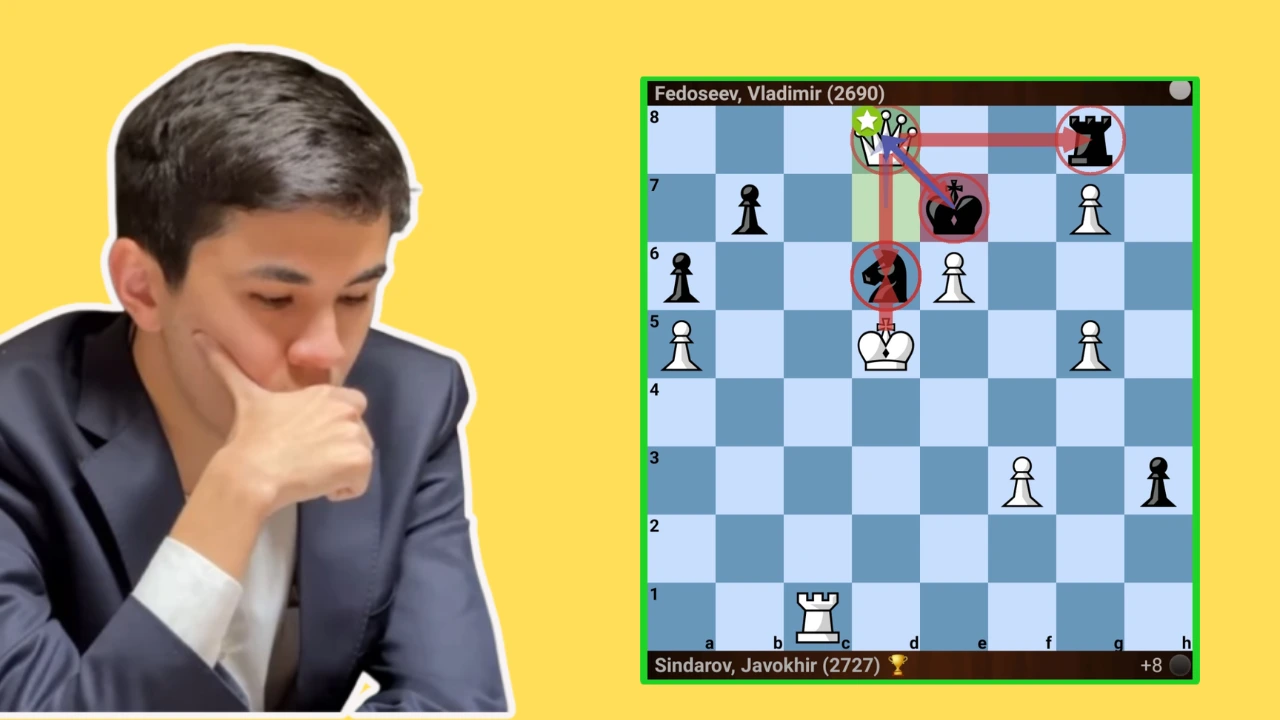
44. d8=Q+
Promotion! Game over.
Black resigns.
Key Lessons from This Game
1. Attack Weak Kings
When Black played g5 and h6, the king became weak. Sindarov punished it perfectly.
2. Sacrifice with Purpose
Nxe5 was not random — it opened lines and created chaos.
3. Activity Over Material
Even when material was equal, White’s pieces were more active.
4. Passed Pawns Decide Games
In the end, pawns became stronger than pieces.
5. King Activity Wins Endgames
Sindarov’s king walked into the center and dominated.
Q1: Why is Sindarov vs Fedoseev considered one of the most exciting games of Grand Chess Tour 2026?
This game is considered one of the most exciting battles of the tournament because it contained everything that chess fans love: a brilliant sacrifice, king attacks, tactical combinations, strategic play, and a technically impressive endgame. Many games start aggressively but lose momentum later. In this game, however, the action continued from the opening all the way to the final promotion.
Javokhir Sindarov demonstrated a complete understanding of chess. He attacked when the position demanded aggression, simplified when necessary, and converted his advantage in the endgame with remarkable precision. Vladimir Fedoseev also fought back strongly, which made the struggle even more entertaining.
The game serves as an excellent example of modern chess where dynamic play, piece activity, and king safety are often more important than material count.
Q2: What opening was played in the game?
The game began with the Italian Game, one of the oldest and most respected chess openings in history.
The opening moves were:
1.e4 e5
2.Nf3 Nc6
3.Bc4 Bc5
The Italian Game focuses on rapid development, king safety, and control of the center. Although the opening appears calm and positional, it often leads to sharp attacking opportunities.
Sindarov chose a flexible setup with c3 and d3 rather than immediately opening the center. This allowed him to slowly build his position before launching a powerful attack later in the game.
Many club players can learn from this approach because it shows how patient preparation can create attacking chances without forcing complications too early.
Q3: Why did Black’s pawn moves h6 and g5 become a problem?
The moves h6 and g5 were played to chase White’s bishop and gain space on the kingside. While these moves appear active, they also create weaknesses around the king.
When pawns move forward, they can no longer protect the squares they previously controlled. This often leaves holes in the position that an opponent can exploit.
In this game, Fedoseev gained some temporary space but weakened the dark squares around his king. Sindarov immediately recognized these weaknesses and began looking for tactical opportunities.
One of the most important principles in chess is that every pawn move creates strengths and weaknesses. Strong players constantly evaluate whether the advantages gained are worth the weaknesses created.
Sindarov’s attack became possible largely because Black’s kingside pawn structure was no longer secure.
Q4: Why was 11.Nxe5 such an important move?
Move 11.Nxe5 was the critical turning point of the game.
At first glance, it appears that White simply sacrifices a knight. However, the move was based on deep tactical calculation rather than hope or speculation.
The sacrifice worked because:
- Black’s king position was already weakened.
- White’s pieces were actively developed.
- Tactical threats could be created immediately.
- Open lines would benefit White’s attack.
This move transformed the game from a quiet positional battle into a tactical fight where king safety became the most important factor.
Many amateur players avoid sacrifices because they fear losing material. Sindarov showed that when a sacrifice creates lasting positional and tactical advantages, it can be completely justified.
The move demonstrated excellent understanding of initiative and attacking play.
Q5: Was the knight sacrifice completely sound?
Yes, the sacrifice was strategically justified and practically very effective.
Although White initially gave up material, the compensation came in several forms:
- Black’s king was exposed.
- White gained active piece play.
- White’s pieces coordinated perfectly.
- Black was forced into defensive positions.
- White eventually won material back.
Chess is not only about counting pieces. Position, activity, coordination, and king safety often outweigh simple material considerations.
Even if a sacrifice is not mathematically perfect according to an engine, it can still be highly effective in practical play if it creates difficult problems for the opponent.
Sindarov’s sacrifice is a wonderful example of dynamic compensation.
Q6: Why did White play Bxf7+ after sacrificing the knight?
The move Bxf7+ was designed to drag Black’s king into an uncomfortable position.
Checks are forcing moves because the opponent must respond immediately. By sacrificing the bishop on f7, Sindarov forced the king away from safety and increased the pressure.
The move served several purposes:
- It exposed the king.
- It disrupted Black’s coordination.
- It created tactical opportunities.
- It helped White recover material later.
Strong attackers often use forcing moves such as checks, captures, and threats to maintain momentum. Sindarov’s sequence was an excellent demonstration of this principle.
Once the king became exposed, every move became difficult for Black.
Q7: Why were the queen exchanges beneficial for White?
Many beginners think that attacking players should avoid exchanging queens. However, strong players understand when simplification benefits their position.
After the queens were exchanged, White still retained important advantages:
- Better piece activity.
- More space.
- Easier plans.
- Better long-term pawn prospects.
By removing queens, Sindarov reduced Black’s counterattacking chances while preserving his strategic edge.
This decision showed maturity and confidence. Instead of searching for immediate tactics, he trusted his superior position and transitioned into a favorable endgame.
Understanding when to simplify is a key skill for improving chess players.
Q8: Why did Sindarov activate his king so early?
One of the most impressive aspects of the game was Sindarov’s king activity.
During the opening and middlegame, the king must usually stay protected. However, in endgames the king becomes a powerful fighting piece.
Sindarov recognized that queens were gone and major attacking threats had disappeared. This allowed him to centralize his king and support his pawns.
An active king can:
- Support passed pawns.
- Attack enemy pawns.
- Control important squares.
- Assist other pieces.
Many club players leave their king passive in endgames. This game demonstrates why king activity is often the deciding factor once the queens are exchanged.
Q9: Why are passed pawns so powerful in endgames?
Passed pawns are among the strongest assets in chess.
A passed pawn has no opposing pawn directly in front of it or on adjacent files that can stop its advance. Because of this, it constantly threatens promotion.
In this game, Sindarov gradually created multiple passed pawns.
The advantages of passed pawns include:
- Forcing enemy pieces into defensive roles.
- Creating promotion threats.
- Distracting the opponent’s king.
- Restricting enemy activity.
As the game progressed, Fedoseev’s pieces became tied down trying to stop the advancing pawns. This allowed White to improve his position further.
Eventually the pawns became too strong to contain.
Q10: What was the significance of 36.e6?
The move 36.e6 was one of the most powerful strategic moves of the game.
Instead of defending passively, Sindarov created another dangerous passed pawn. This forced Black to divide his attention between multiple threats.
Defending against one passed pawn can be difficult. Defending against two connected threats is often impossible.
The move highlighted an important chess lesson:
When you have an advantage, create new threats rather than simply protecting existing ones.
By constantly increasing the pressure, Sindarov ensured that Black never had time to organize an effective defense.
Q11: How did the game finally end?
The game concluded through the strength of White’s passed pawns.
After steadily improving his position, Sindarov advanced his pawns deeper into Black’s territory. The black pieces could no longer stop every threat simultaneously.
The decisive moment came with:
44.d8=Q+
The pawn reached the eighth rank and promoted to a queen.
Promotion is one of the most powerful concepts in chess because a simple pawn can transform into the strongest piece on the board. Once White promoted, the position became completely winning.
Recognizing the hopelessness of the situation, Fedoseev resigned.