

Norway Chess 2026 Round 4 | Wesley So vs Gukesh Domaraju
In Round 4 of Norway Chess 2026, Wesley So (White) defeated Gukesh Dommaraju (Black) in a fast 10-minute game. But when you go through the moves, you realize this game is all about control, patience, and one explosive moment that decided everything.
Let’s break it down in very simple terms so you can understand not just what happened, but why it happened.
Opening Phase: Quiet but Clever Setup
1. e4 e5 2. Nc3 Nf6 3. g3
Instead of playing the usual Italian or Ruy Lopez, Wesley So goes for a flexible setup. The move g3 shows that he wants to fianchetto his bishop (place it on g2). This setup is very solid and gives long-term pressure.
3… Bc5 4. Bg2 O-O 5. Nge2 c6
Gukesh responds normally. His idea with c6 and d5 is to strike in the center. This is a standard plan.
6. O-O d5
Now Black challenges the center immediately. This is a critical moment.
7. exd5 cxd5 8. d4 exd4 9. Nxd4
This sequence simplifies the center. After these exchanges, both sides have equal material, but White has slightly better piece activity.
Early Middlegame: Small Imbalances Start
9… Bg4 10. Nde2 Nc6 11. h3 Bf5
Gukesh tries to develop actively. But here’s the first small issue: he moves the same bishop multiple times. This costs time.
12. Bg5 Be7 13. Bxf6 Bxf6
White gives up the bishop pair, but in return, he weakens Black’s structure slightly and removes a defender.
14. Nxd5
This is a strong move. White jumps into the center and attacks.
14… Bxb2
This looks tempting. Gukesh grabs a pawn. But this is a risky decision. Taking pawns on the edge often leads to problems if your king is not fully safe.
This is the first big turning point.
The Game Heats Up: Activity Over Material
15. Rb1 Be5 16. Rxb7
Now Wesley So takes the pawn back. More importantly, his rook becomes very active on the 7th rank.
16… Qc8 17. Rb5 Bd7 18. Rc5
Look at White’s rooks. They are extremely active. Black’s pieces, on the other hand, are a bit uncoordinated.
At this point, even though material is equal, White has the easier position to play.
Critical Moment: Time Trouble and Pressure
18… Qe8 19. Re1 Rd8 20. f4
This is a very important move. White starts an attack on the king side.
20… Bd6
Black tries to defend, but things are already getting difficult.
Now comes the move that changes everything.
The Breakthrough: A Tactical Explosion
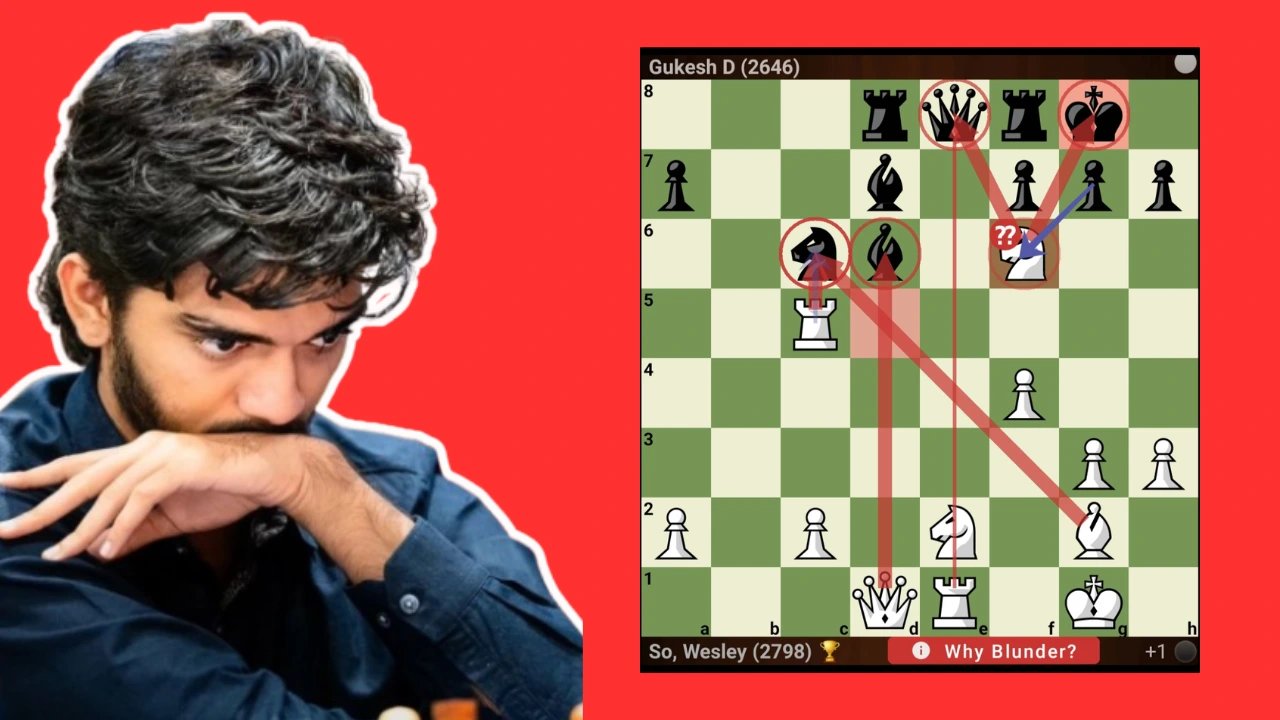
21. Nf6+
This is a brilliant move.
White sacrifices a knight to open up Black’s king.
21… gxf6 22. Qxd6
Now White wins material back and completely opens the position. Black’s king is exposed, and his pieces are not coordinated.
This is the second and biggest turning point of the game.
Attack Phase: Black King in Trouble
22… Qe3+ 23. Kh2 Bxh3
Gukesh tries to counterattack. He goes after White’s king.
24. Qxc6
But Wesley stays calm. Instead of panicking, he continues grabbing important material and keeping control.
24… Bxg2 25. Kxg2
White’s king is safe enough. Black’s attack is not strong.
25… Rd2 26. Kf1 Re8 27. Rc3
At this point, Black resigns.
Why?
Because White is completely winning:
- He has more material
- His pieces are more active
- Black’s king is still unsafe
- There is no real counterplay
Key Movement In These Match
1. Activity is More Important Than Pawns
When Gukesh played 14…Bxb2, he won a pawn. But in return, he gave White:
- Active rooks
- Open lines
- Better coordination
In chess, activity often matters more than material.
2. Punishing Slow Moves
Black wasted time moving the same bishop multiple times. At top level, even one wasted move can be dangerous.
Wesley So used that time to:
- Improve his pieces
- Take control of open files
- Prepare an attack
3. The Power of Open Lines
After 21. Nf6+, the position opened up. This helped White because:
- His pieces were already active
- Black’s king became exposed
When the position opens, the better-prepared player benefits.
4. Calm Under Pressure
Even when Black tried counterplay with Qe3+ and Bxh3, Wesley did not panic. He:
- Defended calmly
- Took material when needed
- Kept control of the position
This is a key skill in fast chess.
5. Timing is Everything
The move Nf6+ was not played randomly. It worked because:
- White’s pieces were ready
- Black’s king was slightly weak
- Black had no good defense
Good tactics come from good positions.
What You Can Learn From This Game
If you are a beginner or intermediate player, here are simple lessons:
- Do not grab pawns without thinking about safety
- Try to develop all your pieces quickly
- Active pieces are more valuable than extra pawns
- When attacking, open lines toward the enemy king
- Stay calm when your opponent attacks
Frequently Asked Questions (FAQ)
1. Why was 14…Bxb2 a mistake?
It was not a direct blunder, but it was risky. Black took a pawn but allowed White to activate his rook on the 7th rank. This gave White strong pressure and long-term advantage.
2. What made Nf6+ so strong?
Nf6+ was powerful because it opened Black’s king. It forced gxf6, which destroyed the pawn structure and exposed the king. After that, White’s attack became unstoppable.
3. Could Gukesh defend better?
Yes, instead of taking on b2, he could have played safer moves and focused on development. Also, avoiding time trouble would have helped him find better defensive ideas.
4. Was this game decided by tactics or strategy?
Both. Strategy gave White a better position (active pieces), and tactics (Nf6+) finished the game.
5. What is the biggest takeaway from this game?
The biggest lesson is simple: don’t be greedy, be active. Gukesh took a pawn, but Wesley So took control of the entire board.
Final Thoughts
This game from Norway Chess 2026 shows why Wesley So is one of the most solid and dangerous players in the world. He didn’t rush. He didn’t overcomplicate things. He just slowly improved his position and wait for the right moment.
And when that moment came, he struck hard.
For Gukesh Dommaraju, this game is a reminder that even small decisions—like grabbing a pawn—can have big mistake at the highest level.
If you study this game carefully, you will improve your understanding of:
- piece activity
- timing in attacks
- and how to punish mistakes
That’s what makes this game so valuable.
Table of Contents
Toggle