

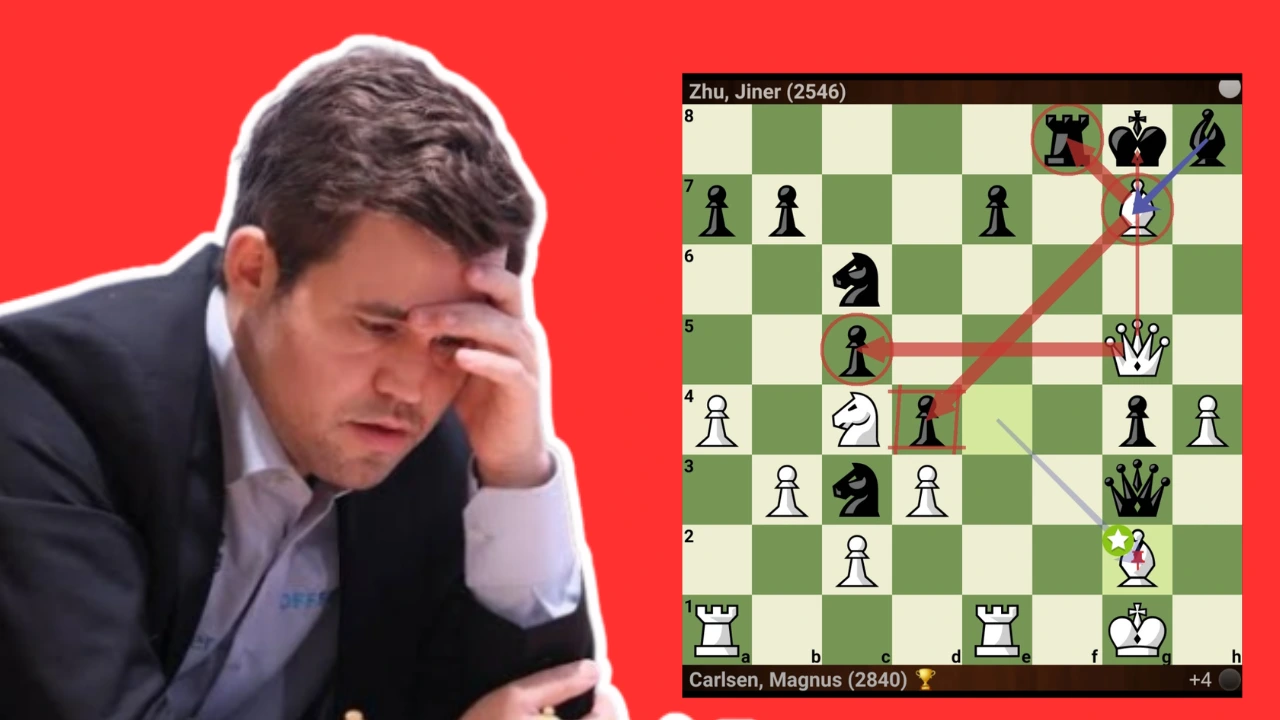
Magnus Carlsen vs Zhu Jiner — A Calm Attack That Turned Deadly
This game is a great example of how Magnus Carlsen slowly builds pressure, even from a quiet opening, and then strikes at the right moment. If you’re learning chess, this game is very instructive because it shows simple ideas, not complicated theory.
Opening Phase: Quiet Start with Hidden Ideas
1. Nf3 d5 2. g3 Nf6 3. Bg2 c5 4. O-O g6
Carlsen starts with a flexible setup. Instead of going directly for the center, he prepares to control it from a distance using his bishop on g2. This is a calm and positional approach.
5. d3 Bg7 6. Nbd2 Nc6 7. e4 O-O
Now White slowly builds a strong center. The move e4 shows Carlsen is ready to fight for space.
8. Re1 d4 9. e5 Nd5
This is important. Carlsen pushes e5, gaining space and forcing Zhu’s knight backward. This gives White more control.
Middle Game: Strategic Movement
10. a4 h6 11. Nc4 Be6 12. Bd2 Nb6 13. b3 Nd5
Carlsen improves his pieces step by step. Moves like a4 and b3 may look slow, but they prevent Zhu from expanding on the queenside.

14. Nh4 g5 15. Nf3 Qd7
This is a key moment. Zhu plays g5, trying to attack, but it weakens the king’s position. Carlsen immediately reacts by repositioning his knight.
16. h4 g4 17. Nh2 h5
Now the position becomes sharp. Zhu pushes pawns aggressively, but this creates weaknesses around the king.
Turning Point: Carlsen Opens the Position
18. Qc1 f6 19. Bh6 Rf7 20. f3
This is classic Carlsen. He waits for the right moment and then plays f3, attacking the pawn chain.
21. exf6 Bxf6 22. fxg4 hxg4
The position opens up. Carlsen sacrifices structure to open lines toward the king. This is a very important lesson: sometimes you must break the position open to attack.
Attack Begins: Piece Activity Over Material
23. Bg5 Bh8 24. Nf1 Nc3 25. Nfd2 Bd5
Carlsen improves his pieces again. His knights and bishops are now very active.
26. Ne4 Bxe4 27. Bxe4 Raf8
Zhu tries to defend, but Carlsen’s pieces are more coordinated.
28. Bh6 Qc7 29. Qg5+ Rg7
Now the attack becomes direct. Carlsen brings his queen into the game with check.
Tactical Explosion
30. Bxg7 Qxg3+ 31. Bg2 Bxg7
This is a critical moment. Material is being exchanged, but Carlsen keeps the initiative. His pieces are more active, which matters more than material.
32. Kh1 Rf2 33. Rg1 e6
Zhu tries to defend, but the pressure is too strong.
Endgame Transition: Precision Wins
34. Raf1 Ne2 35. Rxf2 Qxf2
Now the position simplifies, but Carlsen is still better because of better piece placement.
36. Ra1 Ng3+ 37. Kh2 Nf5
Black tries to create counterplay, but it’s too late.
38. Qxg4 Qxc2 39. Re1 Nd8 40. Re2 Qxd3
Even though Zhu grabs pawns, Carlsen keeps control.
Final Blow
41. Be4 1-0
At this point, Black resigns. Why?
- White’s pieces dominate the board
- Zhu’s king is unsafe
- White is ready to launch decisive threats
This is a clean positional win converted into a tactical finish.
Key Lessons from This Game
1. Slow Play Can Be Powerful
Carlsen didn’t rush. He improved his pieces step by step before attacking.
2. Pawn Moves Create Weaknesses
Black’s moves like g5 and h5 looked aggressive but weakened the king.
3. Timing Matters
The move f3 was played at the perfect moment to open the position.
4. Activity Over Material
Carlsen gave up structure but gained active pieces, which is more important.
5. King Safety is Everything
Black’s king became exposed, and that decided the game.
Frequently Asked Questions (FAQ)
1. Why did Carlsen play such a slow opening instead of attacking early?
Carlsen understands that not every position needs immediate aggression. By playing slowly with moves like Nf3, g3, and d3, he keeps flexibility. This allows him to react based on what Black does. Once Black created weaknesses, Carlsen was ready to attack.
2. Was Black wrong to play g5 and h5?
Not completely wrong, but risky. These moves try to gain space and attack, but they weaken the king’s position. Against a player like Carlsen, such weaknesses are dangerous because he will patiently wait and then exploit them.
3. What was the most important move in the game?
The move 20. f3 was very important. It broke open the center and allowed Carlsen to activate his pieces. Without this move, the position would remain closed, and the attack would not work.
4. Why did Carlsen allow material exchanges during the attack?
Carlsen focuses on piece activity rather than material. Even after exchanges, his pieces were better placed than Black’s. This gave him a long-term advantage.
5. Could Black have defended better?
Yes, Black could have played more solidly and avoided pushing too many pawns near the king. Keeping the position closed and not creating weaknesses would have made it harder for Carlsen to attack.
6. What can beginners learn from this game?
Beginners can learn several simple but powerful ideas:
- Develop pieces before attacking
- Don’t push pawns carelessly near your king
- Look for the right moment to open the position
- Active pieces are more important than material
7. Why did Zhu Jiner resign at move 41?
After 41. Be4, White’s position is clearly winning:
- The bishop and queen are very strong
- Black’s king is exposed
- White is ready to create unstoppable threats
Instead of continuing in a lost position, Black chose to resign.
My Thoughts on these game
This game shows why Magnus Carlsen is one of the greatest players in chess history. He doesn’t rely on flashy moves or tricks. Instead, he builds pressure slowly, waits for mistakes, and then finishes the game with precision.
For improving players, this is a perfect model game. It teaches patience, timing, and the importance of understanding positions rather than memorizing moves.
TEPE SIGEMAN 2026 | HMFLIX