

Wesley So Stuns Magnus Carlsen at Norway Chess 2026: Complete Game Analysis Move by Move
The final round of Norway Chess 2026 gave chess fans a huge surprise. World number one and home favorite Magnus Carlsen lost an important classical game to Wesley So.
Many fans expected Carlsen to finish strongly in front of his home crowd. Instead, Wesley So played a calm and powerful game. He slowly built pressure, defended accurately, and then converted a small advantage into a winning endgame.
This game is a great example of how patience, accurate calculation, and strong endgame technique can defeat even the strongest players in the world.
Let’s analyze the entire game in simple words.
Opening Phase: Italian Game Setup
The game began with:
- e4 e5
- Nf3 Nc6
- Bc4 Nf6
- d3 Bc5
Both players entered the Italian Game. This opening is one of the oldest and most respected openings in chess.
Instead of choosing sharp attacking lines, Carlsen selected a slower setup with d3. This usually leads to strategic battles where both players try to improve their pieces gradually.
After:
- Bg5 h6
- Bh4 d6
- c3 a5
- O-O O-O
Both sides completed development and prepared for a long middlegame fight.
At this point the position was balanced.
Wesley So Starts an Aggressive Kingside Plan
The first major moment came with:
10…g5
This move showed Wesley’s intentions immediately.
Most players would continue normal development, but Wesley decided to attack the bishop and gain space on the kingside.
After:
- Bg3 Kg7
- Re1 g4
Black pushed another pawn forward.
The idea was simple:
- Gain space
- Push White’s pieces backward
- Create attacking chances near the king
Carlsen’s knight was forced into awkward positions.
After:
- Nh4 Nh5
- Nf1 Qg5
Black’s pieces became very active.
Wesley was not attacking immediately. Instead, he was improving every piece before launching anything serious.
This is one of the key lessons from the game.
Strong players often prepare attacks carefully rather than rushing.
Middlegame Battle Begins
The position became more complicated after:
- Ne3 Bxe3
- Rxe3 Nf4
Wesley exchanged pieces and placed a knight on the powerful f4 square.
This knight became one of Black’s strongest pieces.
Carlsen tried to challenge Black’s setup:
- Qe1 Be6
- f3
White attempted to break Black’s kingside pressure.
However, Wesley responded perfectly:
18…h5
Instead of retreating, he increased the attack.
Soon both sides had clear plans:
White’s plan
- Break the center
- Activate rooks
- Use the bishop pair
Black’s plan
- Maintain kingside pressure
- Improve piece activity
- Create weaknesses around White’s king
After:
- d4
20…f6

Black secured the center and prepared future attacking operations.
Wesley So Improves Every Piece
One impressive feature of this game was Wesley’s patience.
After:
- Rd1 Neg6
- Rd2 Rf7
- Kh1 Kh7
Black did not rush.
Every move improved coordination.
The rook moved to f7.
The king stepped away from potential checks.
The knight became more active.
This kind of play is often seen in elite-level chess.
Rather than searching for immediate tactics, top players slowly increase the strength of their position.
Carlsen Tries to Fight Back
Carlsen pushed:
- d5
This move gained space and attempted to limit Black’s pieces.
The game continued:
24…Bd7
25. Bxd7 Rxd7
The dark-squared bishops were exchanged.
This reduced some attacking chances but also simplified the position.
After:
- Nf5
Carlsen placed his knight on an active square.
For a moment White looked comfortable.
However, Wesley continued to find strong defensive moves.
The Critical Strategic Moment
The game reached a very important phase:
- Bh4 Qg6
- Ng3 Qh6
Black’s queen moved to a better attacking position.
Then:
- c4 Rf8
- Rb3 Nfg6
Black’s pieces became fully coordinated.
At this point Wesley’s position was easier to play.
All of his pieces were active.
Meanwhile White still struggled to find a concrete plan.
Wesley Wins the Bishop Pair Battle
The next important move was:
31…Nxh4
Black exchanged the bishop on h4.
After:
- Qxh4
White recaptured.
Now Wesley launched the most important idea of the game.
32…f5
This move opened lines and increased activity.
Soon:
33…fxe4
The center began to open.
When attacking, opening lines is often the correct strategy.
Wesley understood this perfectly.
The Tactical Breakthrough
The decisive sequence started with:
35…Rdf7
Both rooks entered active positions.
Then came:
36…Qc1
A strong queen move.
Black increased pressure against White’s king.
The key breakthrough followed:
37…Rxf3
This exchange sacrifice completely changed the game.
Why was it strong?
Because Black’s pieces became extremely active.
After:
- Rbxf3 gxf3+
Black created a dangerous passed pawn and opened important lines.
White’s king became exposed.
Even though material looked balanced, Black’s activity was much stronger.
This is a classic example of dynamic chess.
Queen Trade Favors Wesley So
The game continued:
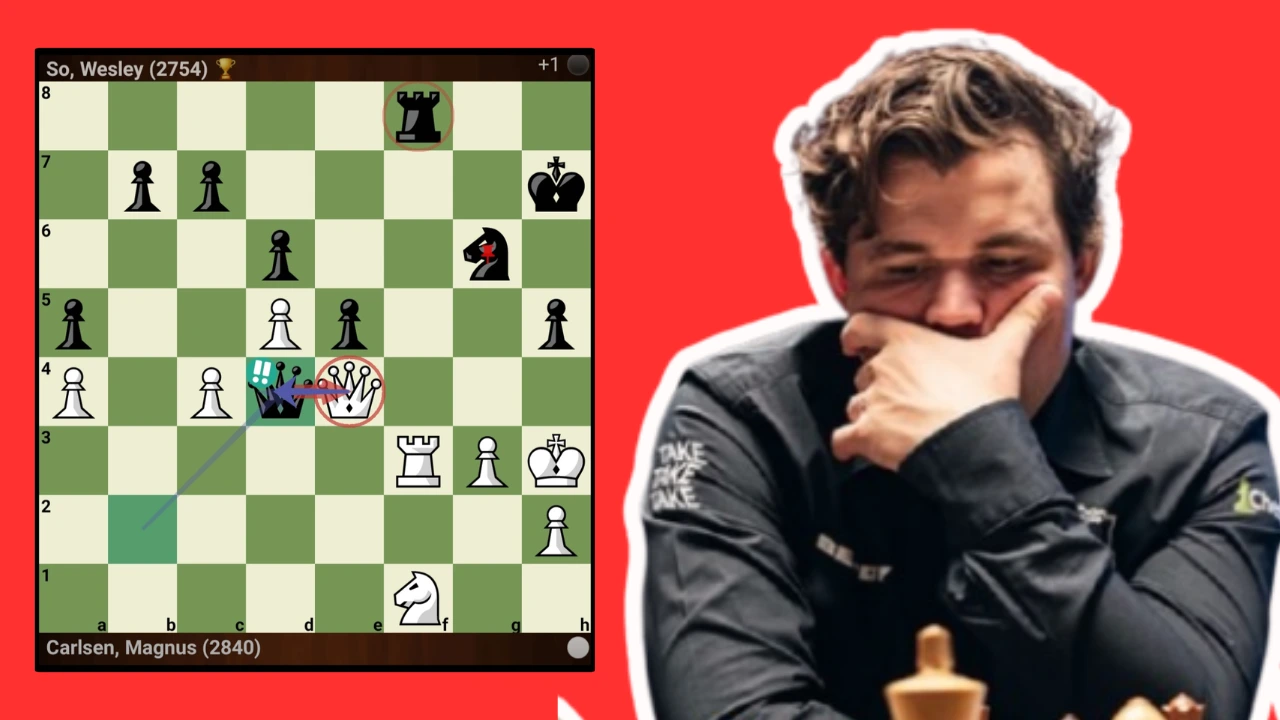
39…Qxb2+
40…Qd4
Black’s queen entered White’s position.
Then:
- Qxd4 exd4
The queens were exchanged.
Many casual players might think this would help White.
In reality, it favored Black.
Why?
Because the resulting endgame was easier for Black to play.
Black had:
- Better king activity
- Better knight
- Strong pawn structure
- More active pieces
This advantage would soon become decisive.
Endgame Masterclass by Wesley So
After:
- Rxf8 Nxf8
Black entered a knight endgame.
The position looked close to equal at first glance.
However, Wesley gradually improved every piece.
After:
43…Nd7
44…Ne5
The knight became extremely powerful.
The knight controlled key squares and restricted White’s king.
Meanwhile Black’s king became more active:
45…Kg6
46…Kg5
47…Kf6
This is an important endgame principle.
The king becomes a fighting piece.
Wesley’s king marched toward the center and helped the pawns.
Time Pressure Hurts Carlsen
A major factor in the game was the clock.
Carlsen had very little time during the final phase.
Several moves were played with less than one minute remaining.
Meanwhile Wesley still had plenty of time.
This allowed him to calculate calmly and avoid mistakes.
Time management is critical at the highest level.
Even elite players can struggle when under severe time pressure.
The Winning Knight Movement
The decisive sequence began with:
48…Nd3+
49…Nb2
The knight invaded White’s position.
Then:
50…Ke5
The king moved deeper into enemy territory.
Black’s king and knight worked together perfectly.
Soon White’s queenside collapsed.
After:
55…Nxc4+
Black won another important pawn.
Then:
56…d2
The passed pawn became unstoppable.
This was the moment when the game was effectively over.
Final Conversion
The last moves showed Wesley’s excellent technique.
After:
57…Kxd5
Black won another pawn.
Then:
58…Ke5
The king remained active and supported the passed pawn.
White’s position had no hope.
Carlsen resigned because Black’s extra pawns and active king guaranteed victory.
Why Wesley So Won This Game
Several factors helped Wesley So defeat Magnus Carlsen.
1. Better Piece Activity
Throughout the game Black’s pieces were more active.
The knight on f4, the queen on h6, and the rooks on the f-file created constant pressure.
2. Excellent Patience
Wesley never rushed his attack.
He slowly improved every piece before looking for tactical opportunities.
3. Strong Exchange Sacrifice
The move 37…Rxf3 was the turning point.
It transformed positional pressure into a winning endgame.
4. Superior Endgame Play
Once queens were exchanged, Wesley’s king and knight became dominant.
His endgame technique was nearly flawless.
5. Better Time Management
Carlsen entered severe time trouble while Wesley remained comfortable.
This gave Black a practical advantage during critical moments.
What Chess Players Can Learn From This Game
This game teaches several valuable lessons.
Improve Pieces Before Attacking
Wesley spent many moves improving his position before launching tactics.
Active Pieces Matter More Than Material
The exchange sacrifice worked because activity was more important than material balance.
Use Your King in the Endgame
Wesley’s king became one of his strongest pieces after the queens were exchanged.
Stay Patient
Not every attack needs to happen immediately.
Building pressure often produces better results.
Manage Your Clock
Strong positions can still be lost if time pressure becomes too severe.
Conclusion
Wesley So’s victory over Magnus Carlsen in the final round of Norway Chess 2026 was one of the tournament’s biggest surprises.
The game was not decided by a single blunder. Instead, it was won through steady improvement, strong strategic decisions, an excellent exchange sacrifice, and outstanding endgame technique.
Carlsen fought hard throughout the game, but Wesley remained in control during the critical moments and converted his advantage with impressive precision.
For club players, this game is a perfect lesson in patience, piece activity, and endgame mastery. It shows that even against the strongest players in the world, accurate and disciplined chess can bring success.
Frequently Asked Questions (FAQ)
Who won the game between Magnus Carlsen and Wesley So at Norway Chess 2026?
Wesley So defeated Magnus Carlsen with the black pieces in Round 9 of Norway Chess 2026. It was one of the most notable results of the event because Carlsen was playing on home soil and entered the game as the favorite.
What opening was played in the game?
The players entered the Italian Game. Both sides developed naturally before the game transformed into a strategic middlegame with kingside attacks and positional maneuvering.
What was the turning point of the game?
The turning point came with Black’s exchange sacrifice 37…Rxf3. This move increased piece activity, exposed White’s king, and led to a favorable endgame for Wesley So.
Why did Magnus Carlsen lose?
Carlsen lost because Black gradually gained better piece activity, created constant kingside pressure, and converted the resulting endgame advantage. Time pressure also made the defense more difficult for Carlsen.
How important was the endgame in this match?
The endgame was extremely important. Wesley So demonstrated excellent king activity, strong knight play, and precise pawn management. His endgame technique transformed a small advantage into a completely winning position.
What lesson can amateur players learn from this game?
Amateur players can learn the value of patience, active pieces, king activity in endgames, and proper time management. The game shows that good positional play often creates tactical opportunities later in the game.