

Magnus Carlsen’s Quiet Storm – Complete Game Breakdown .
This game between Magnus Carlsen and Nils Grandelius is a perfect example of how small positional mistakes slowly turn into a losing position. There was no sudden attack in the beginning. Instead, Carlsen built pressure step by step and took over when it mattered most.
Let’s go through the game in very simple terms.
Opening Phase: A Flexible Benoni Structure
1. d4 Nf6 2. c4 e6 3. Nc3 c5 4. d5 exd5 5. cxd5 d6 6. e4 g6
This is a Benoni-type structure. Black allows White to build a strong center, but plans to attack it later. Carlsen chooses a flexible setup instead of immediate confrontation.
7. Be2 Bg7 8. Be3 O-O 9. Nf3 Bg4
Magnus Carlsen pins the knight on f3. This is a useful move because it puts pressure on White’s center and delays White’s development.
10. Nd2 Bxe2 11. Qxe2 Nbd7 12. O-O Ne8
Carlsen plays …Ne8, which looks strange, but it has a clear idea: he wants to push …f5 and challenge the center.
Middle Game: The Turning Point Begins
13. f4 f5 14. exf5 gxf5
White captures, but this actually helps Black open the g-file and gain activity. Magnus Carlsen is happy with this structure.
15. Bf2 Nc7 16. Nf3 Nf6 17. Qd3 b5
Now Carlsen starts expanding on the queenside with …b5. This is a typical Benoni idea. He gains space and prepares to open lines.
18. Nxb5 Nxb5 19. Qxb5 Rb8 20. Qd3 Ne4
White takes a pawn, but this is risky. Carlsen immediately activates his pieces. The knight on e4 becomes very strong.
At this point, you can already see Carlsen’s plan:
- Activate pieces
- Target weak squares
- Create pressure everywhere
Critical Phase: Carlsen Takes Control
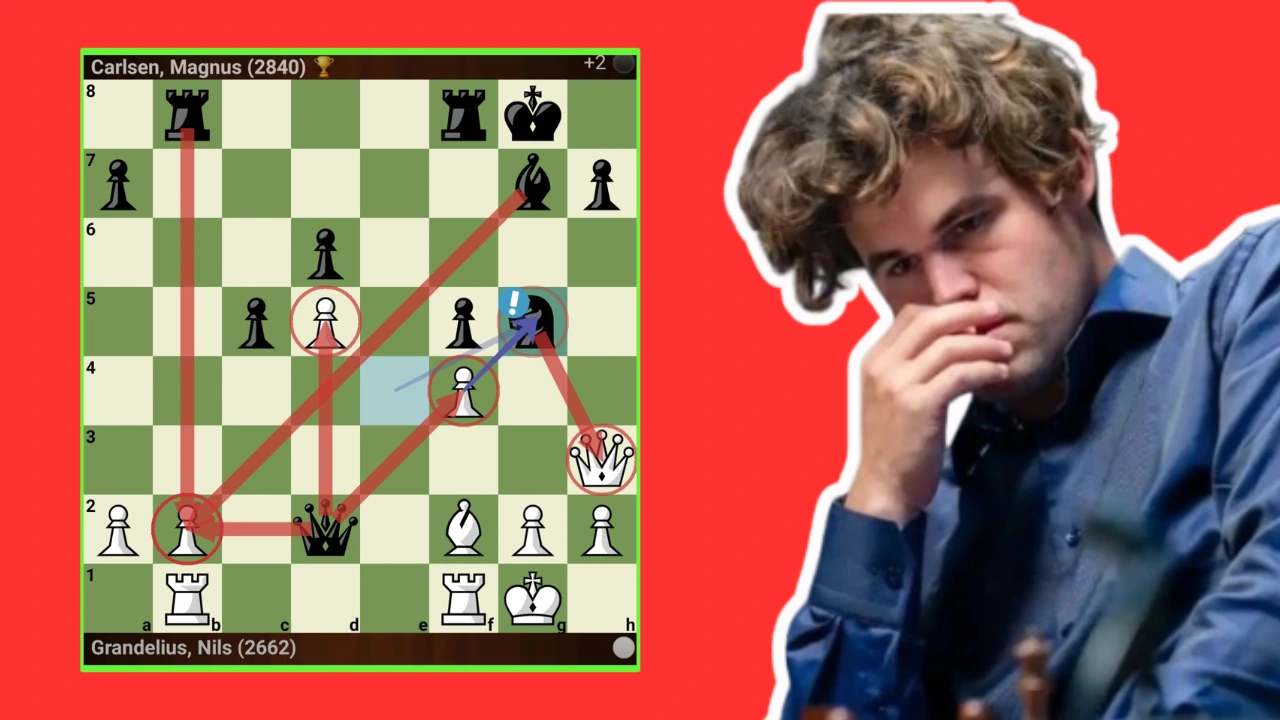
21. Rab1 Qa5 22. Ng5 Qd2
Carlsen’s queen enters the game aggressively. He is now targeting multiple squares at once.
23. Qh3 Nxg5 24. fxg5 Rxb2
This is the key moment. Carlsen sacrifices nothing but wins material through tactics. The rook enters on b2 and destroys White’s structure.
25. Rxb2 Qxb2 26. Qh5 Qxa2
Carlsen wins another pawn. Now Black is clearly better:
- More active pieces
- Better pawn structure
- White king is exposed
Endgame Transition: Simple and Strong
27. g6 h6 28. Qf3 a5 29. h4 a4 30. Qf4 a3
Carlsen pushes his passed pawn. This is very important. Passed pawns create constant pressure.

31. Qxd6 Qb2 32. Bxc5 a2
Even though White wins some pawns, Carlsen’s passed pawn becomes very dangerous.
33. Qe6+ Kh8 34. Kh2 Qe5+
Carlsen calmly defends and keeps control. No panic, no rush.
35. Qxe5 Bxe5+ 36. Kh3 Rd8
At this point, White is completely lost. Carlsen has:
- Better coordination
- Strong passed pawn
- Safer king
White resigns.
Key Lessons from This Game
1. Do Not Grab Pawns Without Thinking
Move 18. Nxb5 looked good, but it allowed Carlsen to activate all his pieces. In chess, activity is often more important than material.
2. Piece Activity Wins Games
Carlsen improved every piece:
- Knight to e4
- Queen to d2
- Rook to b2
This created unstoppable pressure.
3. Passed Pawns Are Very Powerful
The pawn on a-file decided the game. Even when material was equal, this pawn gave Black a winning advantage.
4. Stay Calm Under Pressure
Carlsen never rushed. Even in complex positions, he played simple and strong moves.
Frequently Asked Questions (FAQ)
1. Why did Magnus Carlsen play 12…Ne8 instead of developing another piece?
At first glance, 12…Ne8 looks strange because the knight moves away from the center. However, Carlsen had a clear long-term plan.
The knight moved to e8 to support the important pawn break …f5. In many Benoni positions, Black cannot simply sit and defend because White has more space. Black must challenge the center at the right moment.
By playing …Ne8, Carlsen prepared:
-
…f5 to attack White’s center
-
Kingside activity
-
Better coordination between pieces
This move showed Carlsen’s patience. Instead of looking for immediate tactics, he improved his position first and waited for the right opportunity.
2. Did White help Black by playing 14.exf5?
Yes, this exchange actually benefited Black more than White.
After:
-
f4 f5
-
exf5 gxf5
Black gained several advantages:
-
The g-file became semi-open
-
The rook could potentially become active on the kingside
-
Black’s pieces received more freedom
White removed central tension, but in return allowed Carlsen to obtain active piece play. Against a player like Carlsen, giving away activity can be very dangerous.
3. Why was 17…b5 an important move?
The move 17…b5 was one of the most important strategic moments of the game.
Carlsen understood that he needed play on the queenside. The pawn advance:
-
Gained space
-
Challenged White’s queenside structure
-
Created future attacking opportunities
This move also forced White to make a decision about the pawn on b5.
Rather than defending passively, Carlsen expanded his territory and increased the pressure.
4. Was 18.Nxb5 the moment White’s position started to become difficult?
Yes, this was the beginning of White’s problems.
After:
-
Nxb5 Nxb5
-
Qxb5
White won a pawn, but there was a hidden cost.
The pawn grab allowed:
-
Black’s rook to become active on the b-file
-
Black’s knight to jump into strong central squares
-
White’s queen to move away from defending important areas
The position looked good materially for White, but Carlsen immediately gained compensation through active pieces.
This is a classic example of how a pawn can be less important than piece activity.
5. Why was 20…Ne4 such a powerful move?
The knight move to e4 completely changed the character of the game.
From e4, the knight:
-
Controlled central squares
-
Attacked important targets
-
Supported future queen activity
-
Restricted White’s pieces
Most importantly, White had no easy way to remove it.
Strong players often look for permanent squares where a piece can dominate the board. Carlsen found exactly such a square for his knight.
Once the knight reached e4, Black’s position became much easier to play.
6. What was the idea behind 22…Qd2?
This move was a perfect example of active queen play.
Instead of defending, Carlsen invaded White’s position.
The queen on d2:
-
Created multiple threats
-
Forced White into defensive moves
-
Supported tactical ideas on b2
-
Increased pressure on White’s pieces
A common mistake among club players is moving the queen too many times without purpose.
Carlsen’s queen moves were different. Every move created new threats and improved coordination with the rest of his army.
7. Why couldn’t White stop 24…Rxb2?
By the time Carlsen played:
24…Rxb2
all his pieces were perfectly placed.
The rook invasion worked because:
-
The queen supported the rook
-
The knight controlled key squares
-
White’s pieces lacked coordination
This wasn’t a random tactical trick.
Carlsen had spent many moves preparing this moment. When the rook finally entered on b2, it was the result of strategic pressure built over the entire middlegame.
8. What made 26…Qxa2 so strong?
After winning material on the queenside, Carlsen continued collecting weaknesses.
The move:
26…Qxa2
achieved two important goals:
-
Won another pawn
-
Cleared the path for the a-pawn
Many players focus only on immediate material gains.
Carlsen saw something deeper. Every pawn he captured helped create a dangerous passed pawn that would later become the deciding factor.
9. Why was the a-pawn more dangerous than White’s attacking chances?
Many spectators focus on attacks against the king, but passed pawns often become even stronger weapons.
After:
28…a5
29…a4
30…a3
the pawn became a serious threat.
White now had two problems:
-
Defending against Black’s active pieces
-
Stopping the advancing pawn
It is extremely difficult to handle both tasks at the same time.
Carlsen understood that the farther the pawn advanced, the more tied down White’s pieces would become.
10. Did White have any realistic chances after 32…a2?
Not really.
When the pawn reached a2, Black’s advantage became overwhelming.
The pawn was only one step away from promotion.
This forced White to focus entirely on stopping it, while Carlsen’s bishop, rook, and king enjoyed complete freedom.
Even though White won some pawns elsewhere, those pawns could not compare to the strength of Black’s advanced passer.
11. Why did Carlsen choose the calm move 34…Qe5+ instead of looking for something flashy?
This move shows one of Carlsen’s greatest strengths.
Many players would search for a spectacular combination.
Carlsen chose the simplest move that maintained complete control.
The check:
34…Qe5+
-
Improved queen activity
-
Forced White’s king into a passive position
-
Prevented counterplay
-
Simplified the position
World-class players often win not because they find brilliant sacrifices, but because they consistently choose the safest and strongest continuation.
12. What is the biggest lesson from this entire game?
The biggest lesson is that activity is often more important than material.
White won a pawn early and appeared comfortable.
However, Carlsen gradually improved:
-
His knight
-
His queen
-
His rook
-
His pawn structure
Every move increased pressure.
By the time tactics appeared, the game was already strategically won.
This is why Magnus Carlsen is so difficult to play against. He rarely relies on one big combination. Instead, he slowly improves every piece until the opponent’s position collapses under pressure.
Final Takeaway
This game was a masterclass in positional chess. Magnus Carlsen did not launch a quick attack or sacrifice pieces for a spectacular finish. Instead, he built pressure one move at a time, activated every piece, invaded with his queen and rook, and then used a powerful passed a-pawn to convert his advantage. The victory demonstrates one of Carlsen’s greatest strengths: turning small positional edges into winning endgames through patience, precision, and perfect timing.