

Niemann Crushes Fedoseev in a Sharp Attacking Battle
Grand Chess Tour 2026-This was a very exciting and aggressive game where Niemann slowly built pressure and then finished with a powerful attack. Even though it started quietly, it turned into a tactical fight where time pressure also played a big role.
Let’s understand the game step by step in simple words.
Opening Phase: Calm Italian Setup
1. e4 e5 2. Nf3 Nc6 3. Bc4 Bc5
This is the Italian Game. Both players develop pieces normally and control the center.
4. d3 Nf6 5. c3 h6 6. O-O d6 7. Re1 Bb6
White plays a slow and solid setup. The move c3 prepares d4 later. Black plays safely too.
8. Nbd2 O-O 9. Nf1 Re8
Niemann is preparing a typical plan: bring the knight to g3 and support central play.
Middlegame Begins: Space and Structure Fight
10. a4 Be6 11. Bxe6 Rxe6
White exchanges the bishop, slightly weakening Black’s coordination. Black now has doubled rooks but loses bishop pair.
12. b4 a5 13. b5 Nb8
White gains space on the queenside. Black’s knight goes back, which is a bit passive.
14. Ng3 Nbd7 15. d4 c6
Now the center opens. This is where the real fight starts.
16. bxc6 bxc6
White opens the position. Black gets a central pawn but also weaknesses.
Key Moment: Central Tension and Activity
17. Rb1 Qc7 18. Be3 exd4 19. Bxd4 Rae8
Both sides develop and prepare for tactics. Black tries to activate rooks.
20. Bxb6 Nxb6
White removes an important defender. This gives Niemann more control.
21. Nd4 Re5
Very important move. White centralizes the knight. Black tries to stay active.
Turning Point: Niemann Starts the Attack
22. f4 Rc5 23. Ndf5 Re6
White becomes aggressive. The knight on f5 is very strong and dangerous.

24. Qd4 h5
Black tries to stop attack, but this weakens the kingside.
25. e5
This is the critical move. Niemann opens the center when Black’s king is vulnerable.
This shows great understanding: attack when opponent is not fully ready.
Tactical Explosion
25… Rc4 26. Qxb6 Qxb6+ 27. Rxb6
White wins material and keeps pressure.
27… dxe5 28. fxe5 Nd7 29. Rb7
White doubles attack on weak pawns and targets.
29… Nxe5 30. Re7
Very strong move. White invades the 7th rank.
Decisive Combination
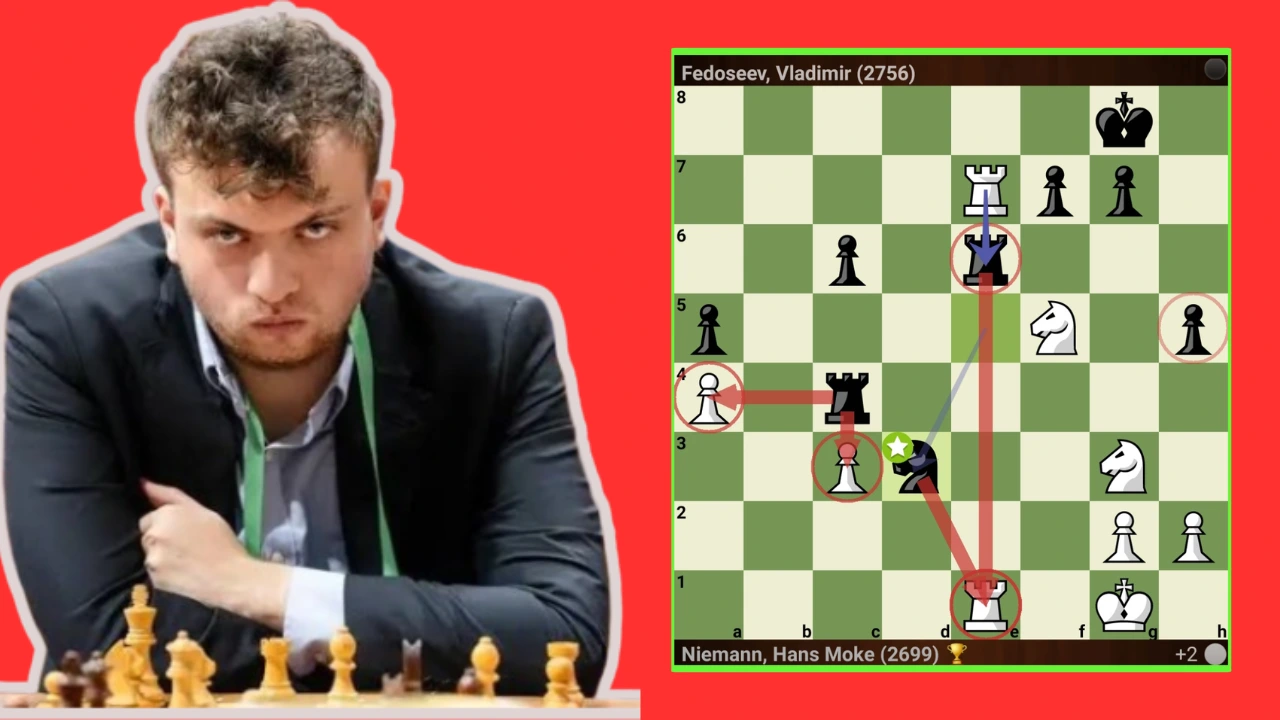
30… Nd3 31. R1xe6 fxe6
Now comes the key idea. Niemann sacrifices to open lines.
32. Rxg7+ Kf8 33. Rf7+ Kg8 34. Nh6+ Kh8
Beautiful attacking sequence. The king is exposed and under heavy pressure.
White uses checks to control the game.
Final Phase: Clean Conversion
35. h3 Nf4 36. Ra7 Rxa4
Even though material looks equal, White’s pieces are much more active.
37. Kf2 h4 38. Nf1 Nd5 39. c4 Rxc4
At this point, Black is completely out of time and position is lost.
Black resigns because White’s attack and control are too strong.
Key Lessons from This Game
1. Patience in the Opening
Niemann did not rush. He built his position slowly and waited for the right moment.
2. Timing of e5 Break
The move e5 was perfectly timed. Opening the center when opponent’s king is weak is very important.
3. Active Pieces Matter More Than Material
Even when material was equal, White’s pieces were much stronger and more active.
4. Use of Tactical Ideas
The combination starting with Re7 and Rxe6 showed deep calculation and attacking skill.
5. Time Pressure Impact
Fedoseev was low on time, which caused mistakes. In rapid games, time is a big factor.
Frequently Asked Questions (FAQ)
1. Why is the move 25. e5 so strong?
Because it opens the center at the right moment. Black’s king was not fully safe, and opening lines allowed White to attack quickly. Timing is everything in chess.
2. What was Black’s main mistake?
Black played too passively and allowed White to build strong central control. Moves like Nb8 and Rc5 didn’t help coordination.
3. Why is Nd4–f5 plan powerful?
The knight on f5 attacks key squares near the king and creates threats. It is a typical attacking idea in Italian structures.
4. Could Black defend better?
Possibly, but it was difficult in time pressure. Black needed more active defense instead of reacting passively.
5. What can beginners learn from this game?
Focus on piece activity, control the center, and attack only when your pieces are ready. Also, learn how to open the position at the right time.
Conclusion
This game is a great example of modern attacking chess. Hans Moke Niemann showed excellent timing, strong positional understanding, and precise calculation.
On the other hand, Vladimir Fedoseev struggled with coordination and time pressure, which made things worse in a sharp position.
If you study this game carefully, you will understand how strong players combine strategy and tactics together.