
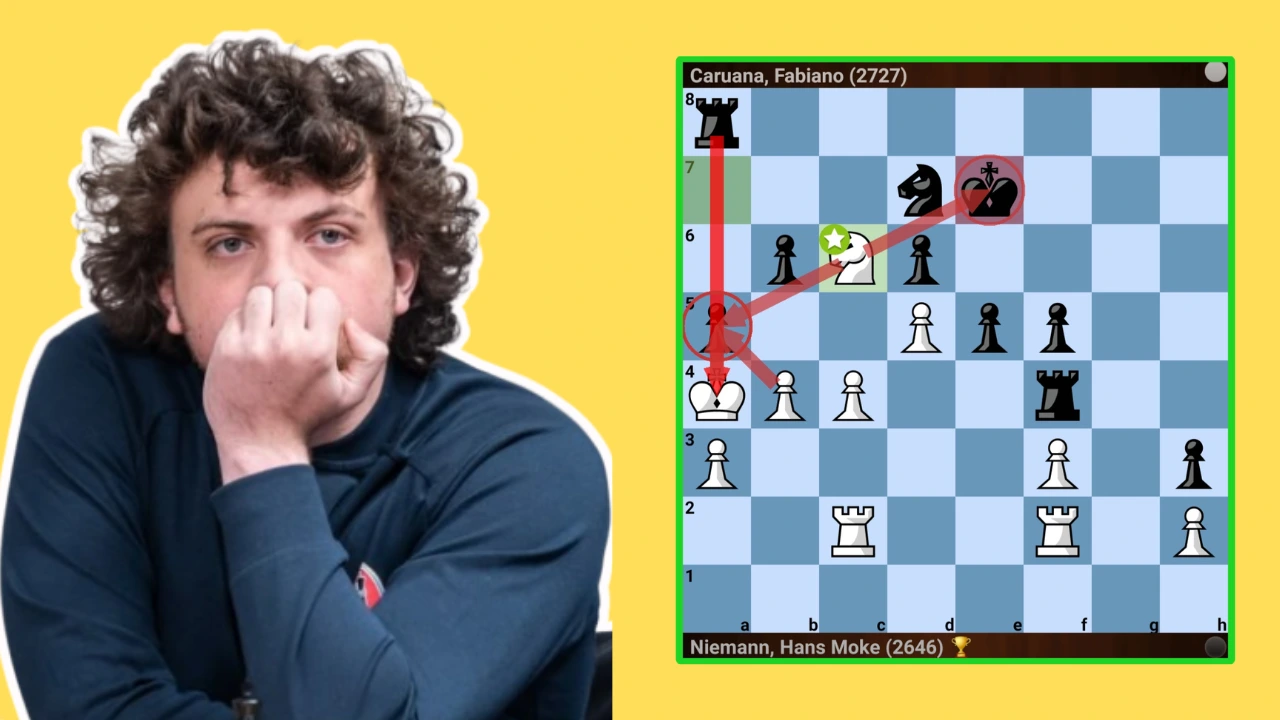
Grand chess tour 2026 – Niemann vs Caruana a Powerful Endgame Masterclass!
This game from the Grand Chess Tour 2026 is a very interesting battle. It starts as a typical Sicilian Defense, but slowly turns into a deep positional fight and then a sharp endgame. In the end, Niemann shows great control and wins beautifully.
Let’s understand the game step by step in very simple words.
♟️ Opening Phase (Moves 1–10)
1. e4 c5 2. Nf3 d6 3. d4 cxd4 4. Nxd4 Nf6 5. Nc3 a6
This is the Sicilian Defense – Najdorf Variation, one of the most popular openings in chess. Caruana chooses a very strong and aggressive system.
6. Be2 e5 7. Nb3 Be6 8. Be3 Be7
- Black takes space in the center with e5
- White moves knight back to b3, preparing future plans
9. Nd5 Nbd7 10. Qd3 Bxd5 11. exd5
- Niemann plays Nd5, a strong move
- Caruana exchanges the knight to reduce pressure
- White gets a strong pawn on d5
👉 At this point:
- White has space advantage
- Black has a solid structure
♟️ Middlegame Build-Up (Moves 11–24)
11… O-O 12. O-O Rc8 13. c4 b6
Both players develop normally.

14. Nd2 Nc5 15. Qc2 a5
- Caruana expands on the queenside
- Niemann stays flexible
16. Rad1 Nfd7 17. Bg4 g6
- White improves pieces
- Black prepares kingside defense
18. Bxd7 Nxd7 19. Nb1 f5
This is important:
- Caruana plays f5 → starting kingside attack
- Niemann prepares to reorganize pieces
20. f3 Bg5 21. Bxg5 Qxg5
- Pieces get exchanged
- Position becomes simpler
22. Na3 Qe3+ 23. Qf2 Qxf2+ 24. Kxf2
👉 Big moment:
- Queens are exchanged
- Game moves toward endgame
Now the real battle begins!
♟️Grand chess tour 2026- Endgame Strategy Begins (Moves 24–35)
24… Kf7 25. Nb5 Ke7 26. b3 Nc5
- Both kings move toward center
- Knights become very important
27. Rfe1 Kd7 28. Nc3 g5 29. Ke3 h5
Caruana starts pawn attack on kingside:
- g5
- h5
30. Kd2 g4 31. Kc2 Rg8
- Black is pushing aggressively
- White stays calm and solid
32. Re2 gxf3 33. gxf3 h4
Now we see:
- Black has strong pawn push
- But White has control
👉 Important idea:
Niemann allows pawn structure damage but gets activity
♟️ Critical Middlegame-Endgame Transition (Moves 34–45)
34. a3 Ke7 35. b4 Nd7 36. Kb3 h3
- Caruana pushes pawn to h3
- Looks dangerous!
37. Rd4 Rh8 38. Nb5 Rcg8
White improves position:
- Knight becomes very strong
39. Rdd2 Rh4 40. Rf2 Rf4
- Black doubles pressure
- But something is missing…
👉 Caruana is attacking, but not creating a clear breakthrough.
41. Rc2 Rg1 42. Na7 Rg8 43. Ka4 Ra8
- Niemann plays very smart
- Moves king actively
44. Nc6+ Kf6 45. Kb5
Now White takes control of the position!
♟️ Turning Point (Moves 45–52)
45… axb4 46. axb4 Ra3 47. Ra2 Rxa2 48. Rxa2 Rxf3
- Black wins a pawn
- But opens position for White
👉 This is risky from Caruana.
49. Ra7 Nf8 50. Nd8 Kg6 51. Ne6 e4
- White knight becomes very powerful
- Caruana tries counterplay with e4
52. Nxf8+ Kf6
Big moment:
- White removes a key defender
- Endgame becomes winning for White
♟️ Final Winning Technique (Moves 53–64)
53. c5 bxc5 54. bxc5 dxc5
- Niemann creates passed pawns
- This is very important in endgames
55. d6 Rd3 56. Nd7+ Kg5 57. Ne5 Rd1
- White knights dominate
- Black is struggling
58. d7 Kf4 59. Nf7 e3
- Pawn is almost promoting!
60. d8=Q Rxd8 61. Nxd8
- White gets strong position even after exchange
62. Ne6 e2 63. Ra3+ Kf2 64. Nf4 1-0
Caruana resigns.
👉 Why?
- White controls everything
- Knight + rook dominate
- Black cannot stop threats
🧠 Key Lessons from This Game
1. Strong Center Control
Niemann used d5 pawn very well to control space.
2. Calm Defense
Even when Caruana attacked with pawns, White stayed calm.
3. Piece Activity is More Important
White allowed pawn weaknesses but got better piece play.
4. Knight Power in Endgame
Knights on d8, e6, f4 were extremely strong.
5. Passed Pawns Win Games
Moves like c5 and d6 created winning chances.
⚡ Final Thoughts
This game shows how strong endgame understanding can defeat even top players like Caruana.
Hans Moke Niemann played very smart chess:
- Calm under pressure
- Strong positioning
- Perfect timing in attack
Fabiano Caruana tried to attack, but could not break through.
In the end, Niemann slowly took control and converted the advantage like a true master.
1. Why was Hans Niemann’s performance so impressive in this game?
Hans Niemann’s victory was impressive because he showed excellent positional understanding and endgame technique against one of the world’s strongest players, Fabiano Caruana. Many players become uncomfortable when facing aggressive pawn storms, but Niemann remained calm throughout the game.
Instead of reacting emotionally to Black’s kingside attack, he focused on improving his pieces and creating long-term advantages. He understood that active pieces are often more important than a perfect pawn structure.
As the game progressed, Niemann slowly improved his knight positions, activated his king, and prepared passed pawns. These strategic decisions allowed him to take control when the position simplified.
What makes this game especially instructive is that Niemann did not rely on flashy tactics or sacrifices. He won through patience, calculation, and strong endgame play. This is the type of chess that strong grandmasters use consistently in top tournaments.
For club players, this game is a great example of how calm decision-making and positional understanding can defeat even the strongest opponents.
2. Why was the pawn on d5 so important for White?
The pawn on d5 became the foundation of White’s entire strategy.
After the opening exchanges, Niemann established a strong pawn on d5 that controlled important central squares and restricted Black’s pieces. A pawn in the center often provides more space and creates opportunities for future expansion.
The pawn also gave White a long-term strategic advantage. While Caruana was trying to create activity on the kingside, Niemann used the central pawn to maintain control of the position.
Later in the game, this pawn advanced to d6 and eventually became a dangerous passed pawn. Once a pawn reaches the sixth or seventh rank, it often becomes a major threat because promotion is getting closer.
The d-pawn forced Black to spend time and resources defending against promotion threats. This allowed White’s other pieces to become more active.
This game demonstrates how a single central pawn can influence an entire game when it is supported correctly.
3. Why did the queen exchange on move 24 help Niemann?
The queen exchange was a very important moment because it transformed the game into an endgame where White’s positional advantages became more significant.
When queens remain on the board, attacks against the king are often possible. Caruana was attempting to create kingside pressure, and keeping queens could have increased his attacking chances.
By exchanging queens, Niemann reduced Black’s opportunities for tactical complications. The position became more strategic and technical, which suited White’s strengths.
The queen exchange also increased the importance of king activity. In endgames, kings become fighting pieces rather than pieces that need protection. Niemann quickly activated his king and moved it toward important areas of the board.
Strong players often exchange queens when they believe the resulting endgame favors them. In this game, Niemann correctly evaluated that the simplified position would give him better long-term winning chances.
The queen trade was not simply an exchange of pieces—it was a strategic decision that shaped the remainder of the game.
4. Did Caruana’s kingside pawn attack work?
Caruana’s kingside attack created pressure, but it ultimately failed to produce a decisive breakthrough.
Moves such as …g5, …h5, and …g4 looked aggressive and gained space on the kingside. These pawn advances forced White to make careful defensive decisions.
However, there is an important principle in chess: an attack must create concrete threats. Although Caruana gained territory, he struggled to generate direct tactical opportunities against White’s king.
Meanwhile, Niemann focused on activity and coordination. He allowed certain structural weaknesses because he understood that active pieces would compensate for them.
As the game moved deeper into the endgame, Black’s advanced pawns became less dangerous than White’s active knight and passed pawns.
The attack was not a complete mistake, but it never achieved the breakthrough that Black needed. Eventually, White’s superior piece activity became the more important factor.
This game teaches that aggressive pawn pushes must be supported by active pieces and clear plans.
5. Why were White’s knights so powerful in the endgame?
The knight was arguably White’s most important piece during the final phase of the game.
Throughout the endgame, Niemann found excellent squares for his knight, including d8, e6, and f4. From these positions, the knight controlled key squares, attacked important targets, and supported White’s passed pawns.
Knights are particularly powerful when they have stable outposts and cannot easily be chased away by enemy pawns. In this game, Caruana struggled to challenge the knight’s position.
The knight also worked perfectly with White’s rook and king. Together, these pieces dominated the board and restricted Black’s options.
Many players underestimate the strength of a centralized knight in endgames. A well-placed knight can often outperform a rook or bishop if it controls critical squares.
Niemann’s knight play was a masterclass in endgame technique and demonstrates how important piece placement is in simplified positions.
6. What was the turning point of the game?
The turning point came when Black won a pawn but opened the position in White’s favor.
After 48…Rxf3, Caruana gained material, but the resulting position allowed White’s pieces to become significantly more active.
Sometimes winning a pawn can be risky if it gives the opponent stronger piece activity. In this case, Niemann’s knight and rook suddenly became very powerful.
Another critical moment occurred after 52.Nxf8+. White removed an important defender and increased control over the position. From that point forward, Black’s position became increasingly difficult to hold.
The combination of active pieces and dangerous passed pawns gave White a clear strategic advantage.
Many chess games are decided not by a single blunder but by a sequence of decisions that gradually shift the balance. This game is a perfect example of that process.
7. Why are passed pawns so important in endgames?
Passed pawns are often the most valuable asset in an endgame.
A passed pawn has no opposing pawn blocking its path to promotion. Because promotion can create a new queen, passed pawns force the opponent to react.
In this game, Niemann created passed pawns with moves such as 53.c5 and 55.d6. These pawns became increasingly dangerous as they advanced.
The closer a passed pawn gets to promotion, the more attention it demands. Opposing pieces often become tied down trying to stop it.
This creates opportunities elsewhere on the board. While Black focused on preventing promotion, White’s pieces gained freedom and activity.
The pawn on d7 became particularly powerful because it was only one step away from becoming a queen. Even before promotion, it restricted Black’s options and created constant pressure.
This game is an excellent demonstration of why passed pawns are often called the “soul of the endgame.”
8. What can we learn from this game?
Beginners can learn several valuable lessons from Niemann’s victory.
First, they can learn the importance of central control. White’s pawn on d5 provided space and long-term strategic advantages.
Second, they can study how to defend calmly. Caruana launched a kingside attack, but Niemann did not panic. Instead, he improved his pieces and waited for the right moment to counterattack.
Third, they can learn the value of active pieces. Throughout the game, White prioritized activity over pawn structure. This decision paid off in the endgame.
Fourth, they can learn how powerful passed pawns can become when supported properly.
Finally, they can learn the importance of king activity. In endgames, an active king is often a major strength. Niemann moved his king toward the center and used it effectively.
These lessons appear frequently in practical tournament games and can help players improve at every level.
9. Why did Caruana resign after 64.Nf4?
After 64.Nf4, Black’s position had become extremely difficult to save.
White’s knight was dominating the board, the rook was active, and Black’s remaining pawns were vulnerable. More importantly, White controlled the critical squares needed to stop Black’s counterplay.
Even though material was relatively close, the quality of White’s position was far superior. White’s pieces worked together perfectly, while Black struggled to create meaningful threats.
Strong grandmasters often resign before checkmate when they recognize that the position is strategically lost. Continuing would only prolong an inevitable defeat.
Caruana understood that White’s coordinated pieces and superior endgame position would eventually convert into a full point.
The resignation was a recognition of Niemann’s excellent technique and complete control of the position.
10. What is the biggest lesson from Niemann vs Caruana at Grand Chess Tour 2026?
The biggest lesson from this game is that piece activity often matters more than material or pawn structure.
Throughout the game, Niemann consistently prioritized active pieces, strong squares, and long-term plans. Even when Black appeared active on the kingside, White maintained control through superior coordination.
The game also highlights the importance of patience. Niemann did not rush to attack or force tactics. Instead, he gradually improved his position until winning opportunities appeared naturally.
Strong central control, active knights, passed pawns, and king activity all combined to create a winning endgame.
For chess players looking to improve, this game is a reminder that victories are often built through small strategic decisions rather than dramatic tactical combinations.
Niemann’s performance showed exactly how a top grandmaster converts a balanced position into a winning endgame through precision, patience, and outstanding positional understanding.