

Grand chess tour 2026 : Gukesh Domaraju vs Javokhir Sindarov
Grand Chess Tour 2026-In this thrilling round 5 game, Gukesh showed why he is one of the most dangerous young players in the world. Playing with the black pieces, he defeated Sindarov in a complex and tactical battle. The game had everything—sharp opening ideas, middle-game attacks, and a powerful endgame finish.
If you are searching for “Gukesh vs Sindarov 2026 analysis”, “best chess games 2026”, or “how Gukesh wins games”, this game is a perfect example.
♟️ Opening Phase (Moves 1–10)
The game started with:
1. e4 c6
This is the Caro-Kann Defense, a very solid opening.
- White played 3. d3, a calm and flexible move.
- Gukesh responded with …Qc7, preparing a strong pawn center.
After:
5. c4 Nf6 6. Nc3 e6 7. g3 Bb4
👉 Black develops actively and pins the knight.
Then came an important moment:
8… dxc4
- Gukesh captures and opens the center.
- He is ready to create imbalance early.
After:
10… Bxc3+ 11… Qxc3+
🔥 This is very strong!
- Black damages White’s pawn structure.
- White loses coordination early.
👉 Key idea: Gukesh sacrifices structure for activity and control.
⚔️ Middle Game Battle (Moves 11–25)
After:

12. Nd2 e5
- Gukesh builds a strong center.
- Controls important squares.
14… Bg4
👉 A powerful move!
- Pins the queen.
- Creates pressure.
Then:
18. Bxf6 gxf6
This looks risky because:
- Black’s king structure is weak.
- But black gets a semi-open g-file for attack.
👉 This is modern chess thinking—weakness + activity = strength
🔥 Critical Moment
20. f4 f5 21. Ng5 e4
This is the turning point!
- Gukesh pushes forward aggressively.
- He doesn’t defend—he attacks.
Then:
22. Qb2+ Kg8 23. Kh2 Qb6
- Black stays calm under pressure.
- Slowly improves position.
💥 Tactical Explosion (Moves 25–35)
25. Nxe4 fxe4
- White sacrifices to attack.
- But he defends perfectly.
Then:
26. f5 Bc8
👉 Calm and precise.
- Protects everything.
- Prepares counterattack.
28… Rd8
- Black activates rook.
- Targets central files.
⚡ Powerful Sequence
29. Rxd8+ Nxd8 30. Qe8+ Kg7
- Black avoids danger calmly.
Then:
31… h5
🔥 Very important move!
- Stops attack on kingside.
- Creates luft (escape square).
🧠 Endgame Domination (Moves 36–52)
Now comes Gukesh’s real strength—endgame.
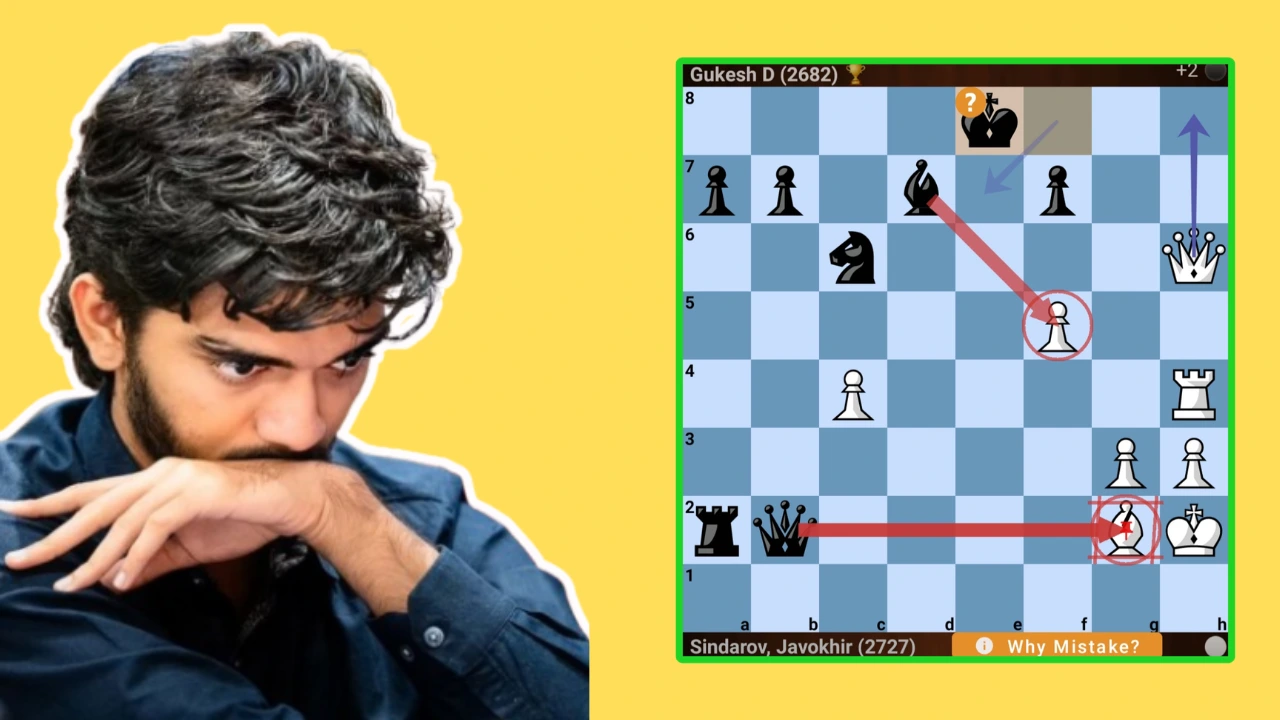
36… Re2
👉 Activates rook aggressively.
37… Rxa2
- Wins a pawn.
- Creates advantage.
Then:
38… Qb2
- Targets weaknesses.
- Keeps pressure.
👑 Transition to Winning Endgame
After:
40… Qxh8 41. Rxh8+ Ke7
- Queens are gone.
- Black has better structure and activity.
🚀 Passed Pawn Strategy
42… a5 43… a4 44… a3
🔥 Brilliant!
- Gukesh pushes passed pawns.
- Creates unstoppable pressure.
💣 Final Blow
49… Rg1+ 50… f6
- Cuts off king.
- Controls board.
Then:
51… Rxg4+
- Wins material.
- Completely winning position.
Finally:
52… Nf7
👉 White resigns.
🏆 Why Gukesh Won This Game
Here are the key reasons:
✅ 1. Strong Opening Strategy
- Created imbalance early.
- Damaged White’s structure.
✅ 2. Fearless Play
- Accepted weak pawns.
- Focused on activity.
✅ 3. Perfect Defense
- Handled attack calmly.
- No panic under pressure.
✅ 4. Endgame Masterclass
- Activated pieces.
- Used passed pawns perfectly.
1. Who won the Grand Chess Tour 2026 game between Gukesh Dommaraju and Javokhir Sindarov?
Gukesh Dommaraju won the game with the black pieces after a brilliant display of attacking, defensive, and endgame skills. The game was not an easy victory because Sindarov created several challenging moments and tried to build attacking chances during the middlegame.
What made Gukesh’s performance particularly impressive was the way he handled pressure. Instead of becoming passive when White started creating threats, he responded with active counterplay. This approach allowed him to seize the initiative and slowly take control of the game.
After surviving the tactical complications in the middlegame, Gukesh entered an endgame where his pieces were more active and his pawn majority became a major strength. From that point onward, he demonstrated excellent technique and converted the advantage without giving White any realistic chances.
This victory highlighted why many chess experts consider Gukesh one of the strongest young players in the world. His ability to combine strategy, tactics, defense, and endgame technique in a single game was remarkable.
2. What opening was played in Gukesh vs Sindarov?
The game began with the Caro-Kann Defense, one of the most respected openings in modern chess.
The Caro-Kann starts with:
1.e4 c6
This opening is known for its solid structure and long-term strategic ideas. Unlike some aggressive openings that immediately create tactical complications, the Caro-Kann often gives Black a strong pawn structure and reliable development.
However, this particular game did not remain quiet for long. Sindarov chose a flexible setup with 3.d3, while Gukesh responded energetically and aimed for active piece play.
One of the key moments came when Black played …dxc4, opening the center and creating imbalance. Later exchanges damaged White’s pawn structure and gave Black active opportunities.
This game shows that the Caro-Kann is not only a defensive opening. When played aggressively, it can lead to dynamic positions and powerful attacking chances.
For beginners, the Caro-Kann is an excellent opening because it teaches important concepts such as development, central control, and strategic planning.
3. What was the turning point of the game?
The most important turning point was the move 21…e4.
Before this move, the game was relatively balanced. White had some attacking ideas and was trying to generate pressure against Black’s position. Many players in Black’s situation would focus entirely on defense.
Gukesh chose a different approach.
Instead of defending passively, he pushed the pawn forward with …e4, creating immediate counterplay. This move gained space, restricted White’s pieces, and shifted the momentum of the game.
The move also demonstrated a key principle of modern chess: active defense is often stronger than passive defense. By creating threats of his own, Gukesh forced Sindarov to spend time dealing with new problems.
After this moment, Black’s position became easier to play. White’s attack lost some of its energy, while Black’s pieces gained more freedom and activity.
Many chess games are decided by a single strategic decision, and in this game 21…e4 was that decision.
4. Why was Gukesh willing to accept a weakened pawn structure?
One of the most interesting aspects of the game occurred after:
18.Bxf6 gxf6
At first glance, this looks like a positional mistake because Black’s pawn structure becomes damaged.
Many beginners are taught that doubled pawns and weakened kingside pawns are bad. While this is often true, chess is more complicated than simple rules.
Gukesh understood that the pawn weakness came with important compensation.
By accepting the doubled pawns, Black gained:
-
A semi-open g-file
-
Greater attacking chances
-
Active piece play
-
Dynamic counterplay
This is a common theme in modern chess. Strong players often accept structural weaknesses if they receive activity in return.
Gukesh correctly evaluated that the activity of his pieces would be more valuable than having a perfect pawn structure.
As the game progressed, this evaluation proved correct because Black’s active pieces became increasingly dangerous while White struggled to create a decisive attack.
5. How did Gukesh defend so effectively against White’s attack?
One of the most impressive parts of the game was Gukesh’s defensive technique.
When White tried to increase pressure with moves such as 20.f4 and 21.Ng5, Black faced several potential threats. Many players would become nervous and start making defensive moves without a clear plan.
Gukesh remained calm.
Instead of reacting emotionally, he focused on improving his position. Moves like …e4, …Bc8, and …Rd8 showed excellent understanding of defensive chess.
Good defense is not just about protecting pieces. It is also about reducing your opponent’s attacking chances and creating threats of your own.
By staying active and keeping his pieces coordinated, Gukesh gradually neutralized White’s initiative. Once the attack disappeared, Black’s position became superior.
This game teaches an important lesson: strong defense often begins with active play rather than passive protection.
6. Why was the move 31…h5 so important?
The move 31…h5 may not look spectacular, but it was one of the most important strategic decisions in the game.
This move served several purposes at the same time.
First, it stopped White from creating dangerous kingside attacking ideas.
Second, it created an escape square for Black’s king, reducing the risk of tactical threats.
Third, it prepared future pawn expansion and improved Black’s overall position.
Strong grandmasters often make moves that improve their position in multiple ways. The move …h5 is a perfect example.
While spectators often focus on flashy sacrifices and combinations, many games are actually won because of quiet moves that strengthen a position.
This move helped Gukesh stabilize his king position and prepare for the successful transition into the endgame.
7. Why was Gukesh’s endgame play considered a masterclass?
The endgame phase demonstrated one of Gukesh’s greatest strengths: technical precision.
After the queens were exchanged, many players would simply try to hold the position. Gukesh immediately looked for ways to improve his pieces and create winning chances.
Moves such as:
-
36…Re2
-
37…Rxa2
-
38…Qb2
allowed Black to gain activity and put pressure on White’s weaknesses.
What separated Gukesh from many players was his ability to understand the long-term requirements of the position. He recognized which pawns were weak, where his rook belonged, and how to maximize his winning chances.
Endgames are often described as the phase where small advantages become decisive. Gukesh demonstrated exactly how this process works.
His technique was patient, accurate, and highly instructive.
8. How did the passed pawns help Black win?
Passed pawns played a major role in the final result.
A passed pawn is a pawn that has no opposing pawn directly blocking its path to promotion. Such pawns often become extremely powerful in endgames.
Gukesh created dangerous passed pawns with moves such as:
-
42…a5
-
43…a4
-
44…a3
These pawns forced White to devote attention and resources to stopping them.
The closer a passed pawn gets to promotion, the stronger it becomes. Even if promotion never happens, the threat alone can create major problems.
While White was busy dealing with the advancing pawns, Black’s pieces gained additional freedom and activity.
This combination of active pieces and dangerous passed pawns is one of the most effective winning methods in endgames.
The game provides an excellent lesson in how to create and use passed pawns successfully.
9. Why did Sindarov eventually lose the game?
Sindarov lost because his attack never became strong enough to justify the risks he took.
Although White created pressure during the middlegame, Gukesh defended accurately and gradually neutralized the threats.
Several factors contributed to White’s defeat:
-
Black gained more active pieces.
-
White’s attack lost momentum.
-
Black’s passed pawns became dangerous.
-
The endgame favored Black.
-
Gukesh converted his advantage with excellent technique.
Another important factor was initiative. After 21…e4, Black increasingly dictated the direction of the game. White was often reacting rather than creating new threats.
At the highest level, losing the initiative can be very dangerous. Gukesh used his active position to build pressure and eventually take complete control.
The game shows that an attack must be supported by strong positional foundations. Without them, even promising attacking chances can disappear.
10. What was the biggest reason Gukesh won this game?
The biggest reason Gukesh won was his superior activity and decision-making during critical moments.
Whenever the position became complicated, he found practical solutions. When White attacked, he counterattacked. When the game simplified, he transitioned smoothly into a favorable endgame.
Most importantly, he never lost control of the position.
His willingness to accept structural weaknesses for activity, his accurate defense during tactical complications, and his excellent handling of passed pawns combined to create a complete performance.
This game is a perfect example of modern grandmaster chess. Gukesh showed that success does not come from a single brilliant move but from making strong decisions consistently throughout every phase of the game.
That consistency ultimately allowed him to defeat Sindarov and produce one of the most instructive games of the Grand Chess Tour 2026.
🧾 Conclusion
This game is a perfect example of modern chess. Gukesh Dommaraju showed incredible maturity, combining attack, defense, and endgame skill in one game.
If you want to improve your chess, study games like this. You will learn how top players think and win under pressure.
GRAND CHESS TOUR 2026 | HMFLIX