
hmflix

HMFlix is a chess platform where strategy meets excitement through powerful game analysis and engaging chess content.

hmflix logo

Grand Chess Tour 2026- A Clash of Giants – How Gukesh Outplayed Caruana

Grand Chess Tour 2026 – A Fighting Masterpiece Under Pressure Grand Chess Tour 2026-This game is a perfect example of modern rapid chess: sharp opening ideas, time pressure chaos, and strong fighting spirit. Gukesh showed excellent nerves and practical decision-making, especially when both players were low on time. Let’s break it down in very simple…

Grand Chess Tour 2026- A Clash of Giants – How Gukesh Outplayed Caruana

Grand Chess Tour 2026 – A Fighting Masterpiece Under Pressure

Grand Chess Tour 2026-This game is a perfect example of modern rapid chess: sharp opening ideas, time pressure chaos, and strong fighting spirit. Gukesh showed excellent nerves and practical decision-making, especially when both players were low on time.

Let’s break it down in very simple words so you can understand every phase clearly.


Opening Phase (Moves 1–10): Calm Start with a Strategic Idea

The game begins with:

1. d4 Nf6 2. c4 e6 3. g3

Gukesh plays a Catalan-style setup. This opening is very popular at top level because it gives:

  • Strong center control
  • Long diagonal pressure from the bishop
  • Safe king position

Caruana responds with …c5 and …d6, entering a structure similar to the Benoni Defense.

After 5. cxd5 exd5, we get a typical Benoni structure:

  • White has space advantage
  • Black gets dynamic counterplay

Moves like Bg2, Nc3, Nf3, O-O are very natural. Both players are developing normally.

Then comes an interesting moment:

10. Bf4 h6

Gukesh develops actively, while Caruana prepares to stop Bg5 ideas.


Early Middlegame (Moves 11–20): Tension Builds

12. Nh4 is an aggressive idea. Gukesh wants to:

  • Attack the bishop
  • Create imbalance

Caruana responds by moving the bishop back and forth (Bc8–Bf5), which looks strange but is actually a way to wait and see White’s plan.

Then comes a key moment:

14. h3 g5

Caruana pushes pawns on the kingside. This is risky but very aggressive. He wants:

  • Space
  • Initiative
  • To disturb White’s pieces

Gukesh calmly continues development with Bd2, a4, a5, gaining space on the queenside.


Critical Middlegame (Moves 16–25): The Game Explodes

16… Ne4 is a strong central move by Caruana.

ywAAAAAAQABAAACAUwAOw==

Then:

17. a5 b5 18. axb6 Nxb6

The queenside opens up. Now both sides have chances.

A very important moment happens at:

20. Nxe4 Bxe4

Gukesh exchanges pieces to reduce pressure. But then:

21… Bxd5

Caruana grabs a pawn. At first glance, this looks good for Black.

But here’s the problem:

  • His position becomes loose
  • White gets activity

Gukesh responds with calm precision:
22. Qc2 23. Qc1

He reorganizes instead of panicking.


Time Pressure Phase (Moves 24–35): Chaos Begins

From move 24 onward, both players are almost out of time.

24. Ra5 is a very practical move:

  • Attacks weaknesses
  • Creates pressure

Caruana plays …Rac8 and …d5, trying to stabilize.

Then Gukesh strikes:

26. Bxg7 Kxg7 27. Qa1

Now White is targeting Black’s king and weak squares.

28. Rxa7

This is a very important move:

  • Gukesh wins a pawn
  • Activates the rook

After exchanges:
30. Rxa8 Rxa8

The position simplifies, but it becomes very tactical.


Endgame Fight (Moves 31–49): Gukesh Takes Control

Now we reach a messy position where both sides have chances.

Key moment:

34. b4

Gukesh pushes forward, gaining space and opening lines.

Caruana tries:
34… Bxf3 35. Bxf3 Nxb4

He wins a pawn, but his position becomes unstable.

Then comes a powerful idea:

36. Bg4

This move is very strong:

  • Targets weaknesses
  • Keeps pressure

Caruana plays …f5, but this weakens his king even more.


Final Attack (Moves 38–49): Clean Finish

38. Qa7

Gukesh activates the queen. Now everything is aimed at Black’s king.

Caruana tries counterplay with …g4, but it backfires.

39. hxg4 fxg4

The position opens, and White’s pieces become very active.

Then a beautiful sequence:

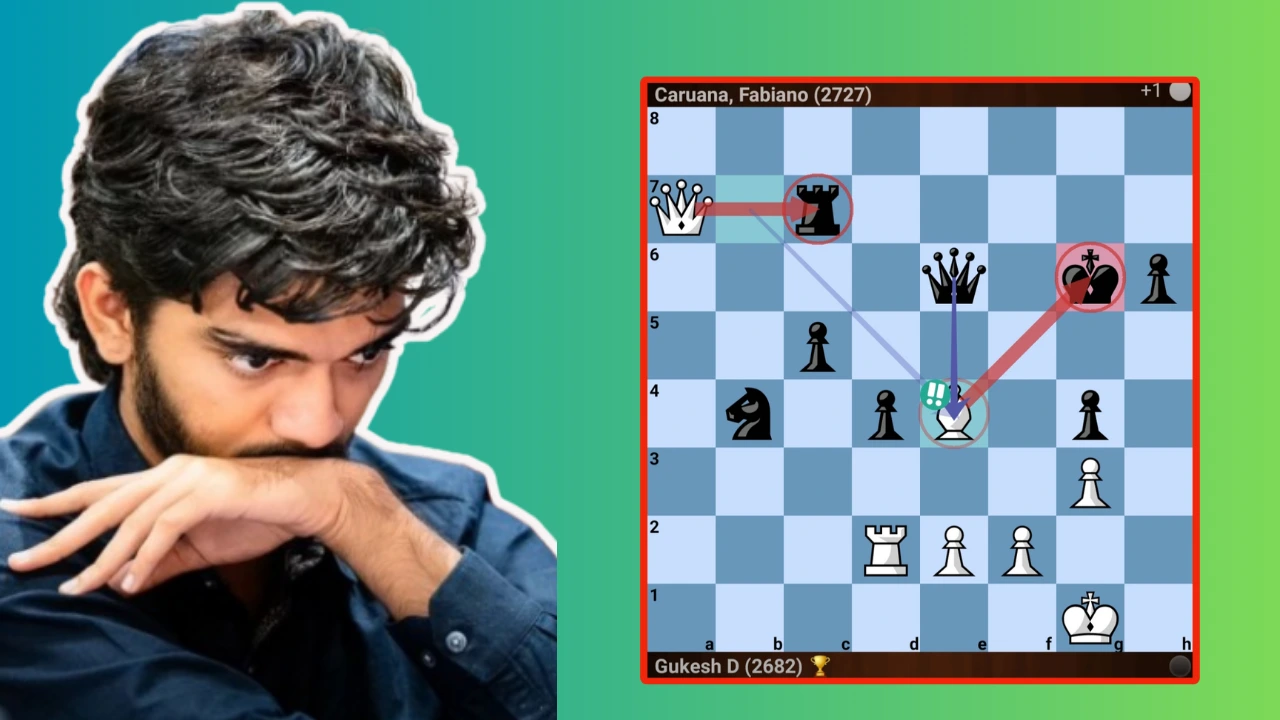
40. Bb7 Rc7 41. Be4+

This is a key moment:

  • White forces the king into danger
  • Gains tempo

After:
41… Qxe4 42. Qxc7

ywAAAAAAQABAAACAUwAOw==

Gukesh wins material and takes control.

ywAAAAAAQABAAACAUwAOw==

The final phase:

  • Continuous checks
  • King pushed into the open
  • Pawn and material advantage

Finally:

49. Qxc5 1-0

Caruana resigns because:

  • White is clearly winning
  • Black cannot stop further material loss

Key Lessons from This Game

  1. Stay calm under pressure
    Gukesh didn’t panic even when Caruana played aggressively.
  2. Activity is more important than material
    Even when Black won a pawn, White’s active pieces gave better chances.
  3. Time management matters
    Both players were low on time, but Gukesh handled it better.
  4. Weak king = big problem
    Caruana’s king became exposed after pawn pushes like …g5 and …f5.
1. Why was Gukesh’s Catalan Opening choice so effective against Caruana?

Gukesh’s decision to play the Catalan Opening was one of the key strategic choices of the game.

The Catalan combines the positional strengths of 1.d4 openings with the long-range power of the kingside bishop on g2. Instead of seeking immediate tactical complications, White focuses on:

  • Long-term pressure
  • Piece activity
  • Central control
  • Flexible pawn structures

Against a player like Fabiano Caruana, who is known for deep opening preparation, choosing the Catalan can be very practical because it often leads to rich middlegame positions where understanding matters more than memorization.

Throughout the game, Gukesh used the Catalan setup to maintain a stable position while slowly increasing pressure. This allowed him to remain comfortable even when Caruana launched aggressive pawn advances on the kingside.


2. What was Caruana’s biggest strategic mistake in the game?

Caruana’s most important strategic error was not a single blunder but a series of overly ambitious pawn advances.

Moves such as:

  • …g5
  • …f5

gave Black additional space and attacking chances.

However, every pawn move creates weaknesses.

By advancing his kingside pawns, Caruana weakened:

  • The dark squares around his king
  • The coordination of his defensive pieces
  • Potential escape squares for the king

Initially these weaknesses were not visible. But as pieces were exchanged and the position opened, Gukesh’s active queen and bishop began targeting those vulnerable squares.

In modern chess, especially rapid chess, king safety often becomes more important than small material advantages.


3. Why didn’t Gukesh panic after losing material?

One of the most impressive aspects of this game was Gukesh’s psychological resilience.

Many club players become worried after losing a pawn because they focus only on material count.

Strong grandmasters evaluate positions differently.

Instead of asking:

“Am I down a pawn?”

they ask:

  • Who has the better activity?
  • Which king is safer?
  • Which pieces are stronger?
  • Who controls key squares?

Even when Caruana won a pawn, Gukesh had:

  • Better piece coordination
  • More active rooks
  • Better attacking chances
  • A safer king

Because of these advantages, Gukesh understood that the position remained favorable despite the temporary material deficit.


4. How important was time pressure in deciding the outcome?

Time pressure played a huge role.

Rapid chess is often described as a battle of both chess strength and clock management.

During the critical phase of the game, both players had very little time remaining.

When players are under severe time pressure:

  • Calculation becomes harder
  • Tactical mistakes increase
  • Strategic planning becomes limited

Gukesh showed remarkable composure during this phase.

Instead of forcing complications, he chose practical moves that improved his position naturally.

Caruana, meanwhile, had to defend an increasingly difficult position while managing the clock.

This combination of positional pressure and limited time eventually tilted the game in Gukesh’s favor.


5. Why was 36.Bg4 considered such a strong move?

At first glance, 36.Bg4 looks like a simple bishop move.

However, strong chess is often about improving pieces rather than making flashy sacrifices.

The move achieved several goals simultaneously:

  • Increased pressure on Black’s position
  • Targeted weakened kingside squares
  • Improved piece coordination
  • Restricted Black’s defensive options

One of the hallmarks of elite players is their ability to find moves that strengthen every aspect of their position.

Bg4 was exactly that kind of move.

It prepared future attacking ideas while making Black’s defense more difficult.


6. What does this game teach about activity versus material?

This game is an excellent example of a classic chess principle:

Active pieces are often worth more than extra pawns.

Many beginners focus almost entirely on material.

However, chess masters understand that activity can outweigh material advantages.

Throughout the game:

  • Caruana occasionally had extra pawns
  • Gukesh had better piece placement

As the position became more open, Gukesh’s active pieces generated threats faster than Caruana could coordinate his defense.

Eventually, Black’s extra material became irrelevant because White’s attack and activity dominated the board.

This is a valuable lesson for improving players.


7. How did Gukesh exploit Caruana’s weakened king position?

The final phase of the game demonstrates excellent attacking technique.

Rather than launching a reckless attack, Gukesh gradually improved:

  • Queen placement
  • Bishop activity
  • Rook coordination

Every move increased pressure.

Once the queen reached active squares and the bishop gained strong diagonals, Black’s king became increasingly exposed.

The key idea was not a single tactical combination.

Instead, it was the cumulative effect of:

  • Better piece activity
  • Better king safety
  • Stronger coordination

This type of attack is often more difficult to defend against because there is no single threat to stop.


8. Why are rapid chess games often more exciting than classical games?

Rapid chess creates unique challenges that produce exciting battles.

Unlike classical chess, players have much less time to calculate.

As a result:

  • Positions become sharper
  • Players take more practical decisions
  • Psychological factors become more important

This game perfectly illustrates those characteristics.

Both Gukesh and Caruana were forced to balance:

  • Strategic planning
  • Tactical awareness
  • Time management

The result was a fighting game full of momentum shifts and practical decision-making.


9. What can club players learn from Gukesh’s approach?

Club players can learn several important lessons from this game:

Stay Patient

Gukesh never rushed his attack.

He improved his position step by step before creating threats.

Prioritize Piece Activity

Active pieces often matter more than grabbing pawns.

Keep the King Safe

Most of Black’s problems came from weakened king protection.

Remain Calm Under Pressure

Even during the time scramble, Gukesh continued making practical decisions.

Improve Your Worst Piece

Many of Gukesh’s strongest moves simply improved the placement of underperforming pieces.

These principles are useful for players of every rating level.


10. Was this one of Gukesh’s best rapid games of 2026?

While Gukesh has played many outstanding games in 2026, this victory stands out because it showcases multiple strengths simultaneously.

The game featured:

  • Strong opening preparation
  • Excellent positional understanding
  • Calm defense against aggression
  • Effective time management
  • Precise conversion of advantages

Defeating a world-class player like Fabiano Caruana under pressure is never easy.

What makes this game particularly impressive is the maturity of Gukesh’s decision-making throughout all phases of the game.

Instead of relying on tactical tricks or lucky mistakes, he gradually built pressure and converted his advantages with remarkable confidence.


Conclusion: Why This Game Matters

Gukesh’s victory over Fabiano Caruana in the Grand Chess Tour 2026 is much more than a single result. It is a masterclass in modern rapid chess, demonstrating how strong positional play, active pieces, and calm decision-making can overcome even the toughest opposition.

The game highlights several timeless chess lessons:

  • King safety remains critical.
  • Piece activity often outweighs material.
  • Patience is a powerful weapon.
  • Time management can decide elite-level games.
  • Strategic understanding is just as important as tactical skill.

For improving players, this encounter offers valuable insights into how today’s top grandmasters handle pressure and convert small advantages into winning positions. Studying games like this can help chess enthusiasts improve their own decision-making and better understand the practical realities of high-level competitive chess.


Leave a Reply

Your email address will not be published. Required fields are marked *