

Grand Chess Tour 2026-This is a very instructive rapid game between Radoslaw Wojtaszek and Gukesh D from the Grand Chess Tour. It’s a great example of how one small imbalance in the middlegame can grow into a powerful attack—especially in fast time controls.
Let’s go through it step by step in simple language.
Opening Phase (Moves 1–10): A flexible start
The game begins with 1. d4 c5, which is a slightly unusual reply from Gukesh. Instead of classical setups, Black goes for a dynamic structure similar to a Benoni.
After 2. d5 d6 3. e4 g6, Black prepares to fianchetto the bishop on g7. This setup aims for long-term counterplay rather than immediate central control.
Wojtaszek plays solidly with Nc3, Nf3, Bb5+, developing pieces and slightly annoying Black with the check. The move 7. a4 is important—it stops Black from easily expanding with …b5.
By move 10 (Bg5), White has a comfortable position:
- Strong center (pawns on d5 and e4)
- Active pieces
- No weaknesses
Black, on the other hand, is still organizing.
Middlegame Build-up (Moves 11–20): Tension rises
Moves like Qd2, Rfe1, Rad1 show that White is preparing for central and kingside play.
Gukesh plays 13…Ng4, trying to create some activity. But after 14. h3 Nge5 15. Nxe5 Bxe5, White simplifies slightly and keeps control.
A key moment comes with 17. Bh6. This is a strong idea:
- White wants to exchange Black’s powerful g7 bishop
- That bishop is Black’s main defender of the king
Black plays 17…Bh8, saving it, but this is passive.
Then comes 18. f4—a very important move. White starts expanding and gaining space on the kingside.
Critical Turning Point (Moves 18–27): Black under pressure

Black plays 18…b5, trying counterplay on the queenside. But this is risky because:
- Black’s king is not fully safe
- White is already stronger in the center
After 19. axb5 Nb6 20. Bf1 axb5 21. Bxb5, White wins a pawn and keeps pressure.
Then comes a very important sequence:
- 22. Ra1
- 23. Qe2
- 24. Kh2
These are calm, improving moves. White is not rushing—just preparing.
After 25. Bxd7 Qxd7, the position simplifies, but White still has:
- Better structure
- More active pieces
Then 27. Rxa8 Nxa8 removes one rook and slightly reduces Black’s coordination.
Breakthrough Moment (Moves 28–33): The attack begins
Now comes the key idea:
28. e5
This is a powerful pawn break. White opens the position when:
- Black’s king is slightly weak
- Black pieces are not well coordinated
After 29. e6 fxe6 30. dxe6, White creates a dangerous passed pawn on e6.
This pawn is extremely important:
- It restricts Black’s pieces
- It becomes a long-term attacking weapon
Black tries to defend with 30…Qe8, but it’s already difficult.
Then 31. b3 and 32. Nd5 improve White’s position further.
After 32…Nxd5 33. Qxd5, White has:
- Strong central control
- Active queen
- Dangerous pawn on e6
Tactical Phase (Moves 34–44): Precise attacking play
Now things get sharp.
After 34. c3 Bxc3, Black grabs a pawn, but this is risky—it opens lines.
White responds with 35. Rf1, bringing the rook into attack.
Then:
- 36. Bxg7 Kxg7
- 37. f5
This is a strong attacking idea. White starts opening lines toward Black’s king.
After 38. Rf3, White prepares to swing the rook across (Rf3–g3 or h3).
Then comes a powerful sequence:
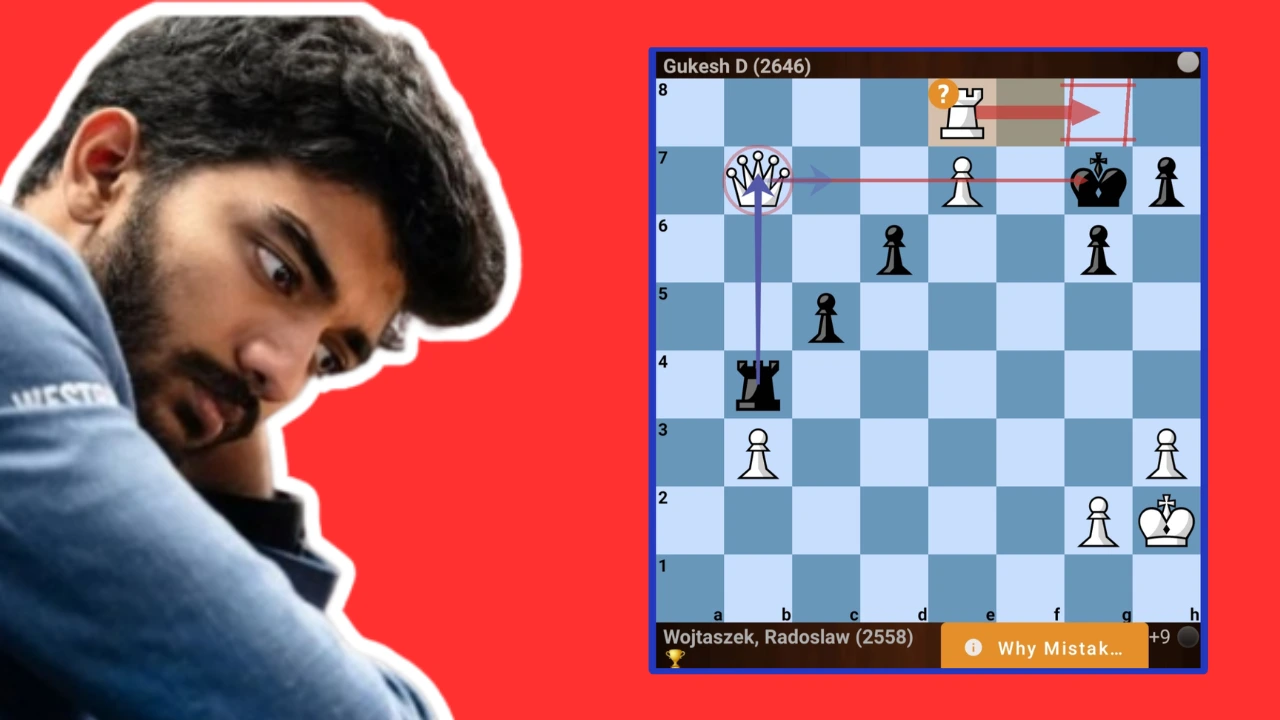
- 39. f6+ exf6
- 40. Qb7+ Kg8
- 41. e7
Now the pawn reaches e7—very dangerous.
Black is under severe pressure with very little time.
The decisive moment:
- 42. Rxf6
- 43. Rf8+
- 44. Rxe8
White wins major material and completely breaks Black’s position.
Endgame Conversion (Moves 45–54): Clean finish
After 44…Rxb7 45. Rg8+ Kxg8, material is simplified.
Then:
- 46. e8=Q+ (promotion!)
- White gets a new queen
From here, it’s technically winning.
Wojtaszek calmly brings his king forward:
- 48. Kg3, 49. Kf3, 50. Ke3
Finally, after 53. Qxd4 cxd4+ 54. Kxd4, Black resigns.
1. Why did Gukesh choose 1…c5 against 1.d4?
Gukesh’s choice of 1…c5 immediately created an unbalanced position. Instead of entering more traditional Queen’s Gambit or King’s Indian structures, he steered the game into Benoni-like territory where Black accepts a space disadvantage in exchange for active counterplay later.
This opening choice suited rapid chess because it creates complex middlegame positions where both sides have chances. However, it also meant that Black had less space from the start and needed accurate play to avoid being squeezed.
Throughout the game, Wojtaszek used his extra space very effectively, making it difficult for Black to coordinate all of his pieces.
2. Why was 17.Bh6 one of White’s most important strategic moves?
At first glance, 17.Bh6 looks like a simple bishop move, but it had a very deep purpose.
Black’s bishop on g7 was the most important defensive piece in the position. It controlled long diagonals, protected key dark squares around the king, and supported potential counterplay on the queenside.
By playing Bh6, Wojtaszek forced Gukesh to make a decision:
- Exchange the bishop and lose a key defender.
- Retreat and become passive.
Gukesh chose 17…Bh8, preserving the bishop but placing it on a less active square.
Although White did not immediately gain material, this small strategic victory became important later when the attack started. The bishop on h8 had much less influence than it would have had on g7.
3. Was 18…b5 the beginning of Black’s problems?
Many analysts consider this one of the most critical moments of the game.
The move itself is logical because Benoni-style positions often require queenside expansion with …b5. However, timing is everything in chess.
When Gukesh played 18…b5:
- White already had more space.
- White’s pieces were well developed.
- Black’s king was not completely secure.
As a result, the queenside expansion came at a moment when White was already preparing central action.
Wojtaszek reacted accurately and eventually won a pawn while maintaining the initiative. The move was not a tactical blunder, but it helped White gain momentum at a very important stage of the game.
4. Why didn’t White launch an immediate attack after winning the pawn?
One of the most instructive aspects of this game is Wojtaszek’s patience.
After obtaining a slightly better position, many players would try to force matters immediately. Instead, White played several quiet moves:
- Ra1
- Qe2
- Kh2
These moves improved piece placement and prepared future operations.
This demonstrates an important principle: before opening the position, make sure your pieces are ready.
Because Wojtaszek invested time in preparation, his later attack became much stronger than it would have been otherwise.
5. Why was 28.e5 considered the turning point of the game?
The move 28.e5 completely changed the character of the position.
Before this move, White had a pleasant advantage but Black was still defending successfully. After 28.e5, White transformed a positional edge into a direct attack.
The move achieved several goals:
- Opened central lines.
- Restricted Black’s pieces.
- Created tactical possibilities.
- Prepared the creation of a dangerous passed pawn.
Most importantly, it forced Black to solve difficult problems immediately rather than gradually improving his position.
This was the moment when White seized full control of the game.
6. How strong was the passed pawn on e6?
The pawn on e6 became the central character of the entire game.
After the sequence:
29.e6 fxe6
30.dxe6
White obtained a passed pawn deep inside Black’s position.
Such pawns are powerful because they affect the entire board.
The e6-pawn:
- Limited Black’s queen.
- Restricted Black’s knight.
- Forced defensive resources.
- Created promotion threats.
- Supported White’s attacking ideas.
Even when White’s pieces were not directly threatening checkmate, Black constantly had to worry about the pawn advancing further.
The pawn eventually reached e7 and became the main reason Black’s position collapsed.
7. Why did Gukesh capture on c3 with 34…Bxc3?
This move was a practical decision aimed at reducing White’s central control and winning material.
However, there was a hidden drawback.
By taking the pawn on c3, Black temporarily gained material but allowed White’s pieces greater freedom.
The move also distracted Black from the most urgent issue: king safety.
In many attacking positions, grabbing pawns can be dangerous because every move spent collecting material is a move not spent defending.
The game showed this clearly. While Black gained a pawn, White gained attacking chances that proved far more valuable.
8. What was the purpose of 35.Rf1 and 38.Rf3?
These rook moves were excellent examples of attacking technique.
The rook lift:
Rf1–Rf3
allowed White to transfer the rook toward the kingside without exposing it to attack.
The idea was simple:
- Support the f-pawn.
- Increase pressure against Black’s king.
- Prepare Rg3 or Rh3.
Many club players focus only on queens and bishops when attacking. This game shows how important rook activity can be.
Once the rook joined the attack, Black’s defensive resources became much more limited.
9. Why was 39.f6+ such a powerful move?
The move 39.f6+ was a breakthrough.
Instead of slowly improving his position, Wojtaszek chose to open lines around Black’s king immediately.
The move had multiple benefits:
- Opened attacking channels.
- Forced Black’s king into defensive mode.
- Increased the power of the e-pawn.
- Created tactical opportunities involving checks and discovered attacks.
After this move, Black’s position became extremely difficult to defend accurately, especially in rapid time controls.
It was the moment when White converted strategic pressure into a concrete attack.
10. Could Gukesh have stopped the pawn from reaching e7?
By the time the pawn advanced to e7, Black’s position was already under tremendous pressure.
The real problem was not the pawn itself but everything supporting it:
- Active queen.
- Active rook.
- Better piece coordination.
- Safer king.
Stopping the pawn would have required Black to dedicate several pieces to defense, which would have weakened other areas of the board.
In practical terms, once the pawn reached e7 with White’s pieces supporting it, Black’s defensive task became nearly impossible.
11. What was the decisive tactical sequence of the game?
The winning combination began with:
39.f6+
40.Qb7+
41.e7
At this point Black was facing threats from multiple directions.
The e7-pawn threatened promotion.
White’s queen was actively checking the king.
The rook was ready to invade.
The final tactical sequence:
42.Rxf6
43.Rf8+
44.Rxe8
won decisive material and completely destroyed Black’s position.
This combination worked because White had spent many moves preparing the attack beforehand.
12. What is the biggest lesson from Wojtaszek’s victory?
The most important lesson is that successful attacks are usually built gradually.
Wojtaszek did not win because of one spectacular tactic. He won because he consistently improved his position:
- He gained more space in the opening.
- He restricted Black’s bishop with Bh6.
- He prepared carefully with Ra1, Qe2, and Kh2.
- He chose the correct moment for e5.
- He supported the passed pawn.
- He activated his rook before launching the final assault.