

Magnus Carlsen vs Arjun Erigaisi 2026 – Full Game Analysis (Simple Explanation Blog)
This game from the TePe Sigeman & Co Chess Tournament 2026 between Magnus Carlsen and Arjun Erigaisi ended in a solid draw. Even though the result is peaceful, the game was full of deep strategy, small imbalances, and long-term movement. Both players played carefully, showing why they are among the strongest in the world.
Let’s break the game down in a very simple way.
Opening Phase (Moves 1–10): Classical Italian Structure
The game began with:
1. e4 e5 2. Nf3 Nf6
This is a Petrov Defense, a very solid and draw-friendly opening. Black immediately challenges White’s center.
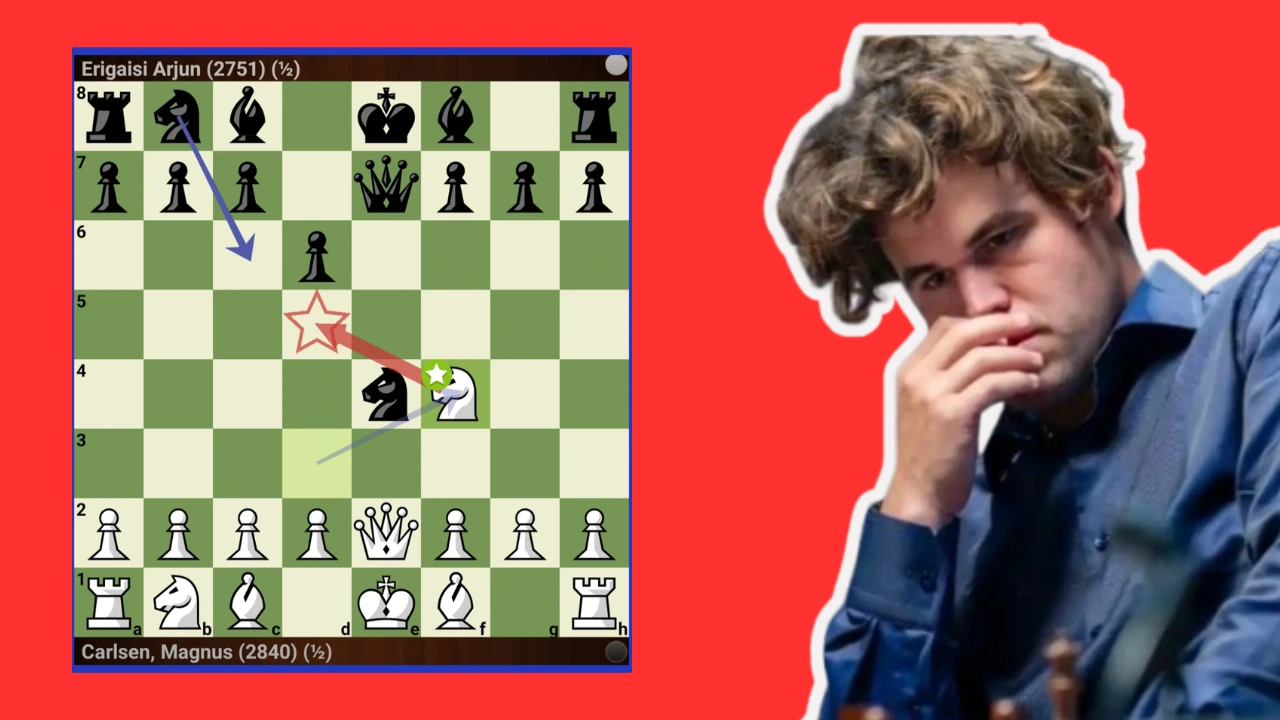
3. Nxe5 d6 4. Nd3 Nxe4
White grabs a pawn early, but Black quickly regains balance. This is normal in the Petrov opening. Both sides aim for equal development rather than quick attacks.
5. Qe2 Qe7 6. Nf4 Nf6
White tries to pressure the center and keep the knight active. Black responds calmly and avoids weaknesses.
At this stage:
- The position is equal
- No side has a clear advantage
- Both players focus on development
By move 10:
10… Bxd3

The position simplifies further. Queens are already exchanged, which usually leads to quieter games. This shows both players were not looking for sharp tactics early.
Early Middlegame (Moves 11–18): Slow Planning Begins
After queen exchange:
White plays:
- 12. f3 – strengthens center and prepares control
- 13. Kf2 – unusual but protects key squares and supports kingside
Black responds:
- …g6 and …Bg7 – a classic setup to control long diagonals
- …h5 – shows Black is trying to gain space on the kingside
White plays:
- 14. a4 and 19. b5 – trying to expand on the queenside
This phase shows a clear idea:
- White wants space on the left side (queenside)
- Black wants stability and counterplay on the kingside
The position is still balanced, but both sides are slowly creating long-term plans instead of immediate attacks.
Middlegame Battle (Moves 19–30): Strategic Fight
This is where the game becomes more interesting.
Black plays:
20… Ne6 and 21… c5
This is an important idea. Black is challenging White’s center and trying to block White’s pawns.
White responds:
- 22. d5 – closes the center and gains space
- This is a key decision: White locks the position to restrict Black’s pieces
Then comes an important phase:
- 23. a5 and 24. a6 – White pushes aggressively on queenside
- Black responds with …b6, stopping further invasion
At this moment:
- White controls more space on queenside
- Black has strong knight activity in center
Then comes a very important maneuver:
26… Nd4 and 27… Nc2
Black’s knight becomes extremely active, jumping into White’s territory. This is one of Black’s best strategic ideas in the game. The knight becomes annoying and forces White to defend carefully.
Key Tactical Phase (Moves 28–34): Repetition Begins
White exchanges:
28. Rxe8 Rxe8
This simplifies the position again. Now both sides enter a pure endgame structure.
Black’s knight continues:
- 29… Ne3
- 32… Ne3
- 34… Ne3
This repetition shows a key idea:
- Black is not trying to win immediately
- Black is maintaining pressure and testing White’s defense
White responds with:
- 30. Nd1
- 32. Nc3
- 33. Nd1
- 34. Nc3
White is basically chasing the knight and keeping everything under control.
At this stage:
- The position is equal
- Neither side can break through
- Both players are repeating safe moves
Final Phase (Moves 35–36): Draw Agreement
The final moves:
35. Nb2 Ne5
36. Nd3 1/2-1/2
Both sides reach a stable position. No breakthrough is possible. The game ends in a draw.
This is a very typical result in high-level chess when:
- Queens are exchanged early
- The center is locked
- Both sides have strong defensive setups
Key Lessons from This Game
- Petrov Defense leads to equality
This opening is designed to avoid early mistakes and keep balance. - Queen exchange reduces attacking chances
Once queens left the board, the game became strategic instead of tactical. - Space advantage matters
White tried to gain space on queenside with pawns, but Black controlled center well. - Knight activity is powerful
Black’s knight jumps (especially to c2 and e3) created constant pressure. - Repetition is a defensive tool
Both players used repetition to avoid risk and simplify the position.
Conclusion
This game between Carlsen and Arjun Erigaisi was not flashy, but it was deeply strategic. Both players showed high-level understanding of structure, timing, and piece coordination. The game was balanced from start to finish, and neither side allowed a decisive breakthrough.
It is a good example of modern elite chess where even small advantages are hard to convert, and precision matters more than aggression.
Magnus Carlsen vs Arjun Erigaisi, TePe Sigeman & Co Chess Tournament 2026
1. Why did the game become so strategic after only a few moves?
The game entered a highly strategic phase because of the early queen exchange in the Petrov Defense. When queens remain on the board, both sides must constantly calculate tactical threats, king attacks, and possible sacrifices. However, once the queens were exchanged, the character of the game changed completely. Instead of looking for direct attacks, both players focused on long-term positional factors such as pawn structure, space advantage, piece activity, and control of key squares.
This type of position is very common among elite grandmasters. Magnus Carlsen is particularly famous for playing these seemingly quiet positions because he believes small advantages can be increased over time. Arjun Erigaisi understood this and refused to give White any easy targets. As a result, the game became a battle of patience and precision rather than tactics and combinations.
2. What was the purpose behind Carlsen’s unusual king move Kf2?
At first glance, moving the king to f2 instead of castling looks strange. Most chess players are taught to castle as quickly as possible. However, chess at the highest level often follows different rules once queens are off the board.
Carlsen played Kf2 because king safety was no longer a major concern. Without queens, there were very few attacking opportunities against the king. The move also connected White’s rooks and improved overall coordination. In many queenless middlegames, the king becomes an active piece much earlier than usual.
The move also demonstrated Carlsen’s confidence in the position. He understood that activity and coordination were more important than following traditional opening principles. This small decision helped White maintain a comfortable position throughout the game.
3. Why did Carlsen push his queenside pawns with a4, a5, and a6?
The queenside pawn expansion was White’s main strategic plan. By advancing these pawns, Carlsen aimed to gain space and restrict Black’s pieces. Space is an important advantage in chess because it gives your pieces more freedom while limiting your opponent’s options.
The move a5 pushed Black backward and made it harder for Black to challenge White on the queenside. Later, a6 increased the pressure even further and forced Black to react carefully. Carlsen hoped these advances would eventually create weaknesses in Black’s structure that could be attacked in the endgame.
Although the plan was logical and well-executed, Arjun defended accurately. He never allowed White’s queenside pressure to become dangerous, which is why the game remained balanced despite White’s territorial advantage.
4. Why was the move 22.d5 considered one of the key moments of the game?
The move 22.d5 was a critical strategic decision because it closed the center and determined how the rest of the game would be played. Before this move, there was still some possibility of central activity and piece exchanges. After the center became locked, both players had to rely on maneuvering rather than direct confrontation.
Carlsen gained additional space with this move, which is normally considered a positional success. However, every strategic decision comes with a trade-off. By closing the center, White also reduced the chances of opening lines and creating immediate threats.
The move essentially transformed the game into a battle of plans. White would play on the queenside, while Black would seek activity through piece maneuvering and central control. This strategic imbalance became the main theme of the entire middlegame.
5. What was Arjun Erigaisi’s best idea in the entire game?
Arjun’s most impressive idea was undoubtedly the knight maneuver involving …Nd4, …Nc2, and later …Ne3. Instead of passively defending against White’s space advantage, he searched for active counterplay.
The move …Nd4 placed the knight on a powerful central square. From there, the knight could jump deeper into White’s position. When the knight reached c2, it became extremely active and forced White to pay attention to various threats. Later, the repeated use of the e3-square allowed Black to maintain pressure without taking unnecessary risks.
This sequence showed outstanding positional understanding. Rather than trying to solve his problems with tactics, Arjun improved the activity of his pieces and created enough counterplay to neutralize White’s advantage.
6. Did either player ever have realistic winning chances?
From a practical perspective, neither player was ever close to winning. Computer engines may show small evaluation changes throughout the game, but elite chess is about much more than engine numbers.
Carlsen had slightly more space and perhaps a marginal positional edge for parts of the game. Meanwhile, Arjun had active pieces and excellent defensive coordination. These advantages effectively cancelled each other out.
What makes this game impressive is the absence of serious mistakes. Usually, winning chances appear when one side creates weaknesses or misjudges a position. Here, both players demonstrated remarkable accuracy. Because neither side gave the other a real opportunity, the draw remained the most likely result throughout the game.
7. Why was Black’s knight more important than White’s extra space?
This game is a perfect example of a classic chess principle: active pieces can compensate for a lack of space.
Carlsen controlled more territory on the queenside and had slightly more room to maneuver. However, Arjun’s knight became an incredibly active piece. It occupied strong squares, attacked important points, and forced White to spend time reacting.
A single active knight can sometimes be more valuable than several extra squares of territory. While White’s space advantage looked impressive, Black’s knight activity ensured that White could never fully exploit it. This balance between space and activity is one of the most instructive lessons from the game.
8. Why did the rook exchange on move 28 help Black equalize completely?
The rook exchange reduced the complexity of the position and removed one of White’s potential attacking resources. In chess, exchanges generally favor the defending side when the position is already balanced.
Carlsen may have believed that simplifying the position would make his queenside space advantage more meaningful. However, Arjun’s active knight remained strong even after the rooks disappeared from the board.
Once the exchange occurred, it became increasingly difficult for either side to create meaningful winning chances. The remaining pieces were simply too well-placed, and neither side had obvious weaknesses to target. The simplification pushed the game closer to its natural conclusion: a draw.
9. How impressive was Arjun’s performance against Magnus Carlsen?
The performance was extremely impressive because Arjun never looked uncomfortable despite facing one of the greatest players in chess history. Many players become passive against Carlsen and slowly drift into worse positions. Arjun did the opposite.
He remained active, looked for counterplay whenever possible, and never allowed White to dictate the game completely. His knight maneuvers were particularly impressive because they demonstrated confidence and strategic maturity.
Holding a balanced position against Carlsen requires exceptional concentration. Arjun showed not only strong calculation skills but also a deep understanding of positional chess, proving once again why he is considered one of the world’s strongest young grandmasters.
10. What does this game tell us about Magnus Carlsen’s playing style?
Even in equal positions, Carlsen constantly searches for small improvements. He rarely forces complications without reason. Instead, he tries to create tiny positional advantages and gradually increase the pressure.
In this game, his queenside expansion was a perfect example of that philosophy. He gained space, improved his pieces, and continued asking difficult questions. Although he never achieved a winning advantage, he remained faithful to his strategic style from beginning to end.
The game shows why Carlsen has been so successful for so many years. He understands that chess is often decided by small details rather than spectacular combinations.
11. What is the biggest lesson club players should learn from this game?
The most important lesson is that chess is not always about attacking the king. Many amateur players believe every game should feature sacrifices, tactical combinations, and dramatic checkmates. In reality, strong chess is often about improving pieces, controlling important squares, and limiting your opponent’s activity.
This game teaches the value of patience, strategic planning, and accurate defense. Carlsen demonstrated how to create pressure through space and structure, while Arjun showed how active pieces can neutralize that pressure. Club players who study this game carefully will learn that understanding positions is often more important than calculating tactics. That is why this quiet draw remains such an instructive example of elite-level chess.
TEPE SIGEMAN CHESS TOURNAMENT 2026 | HMFLIX