


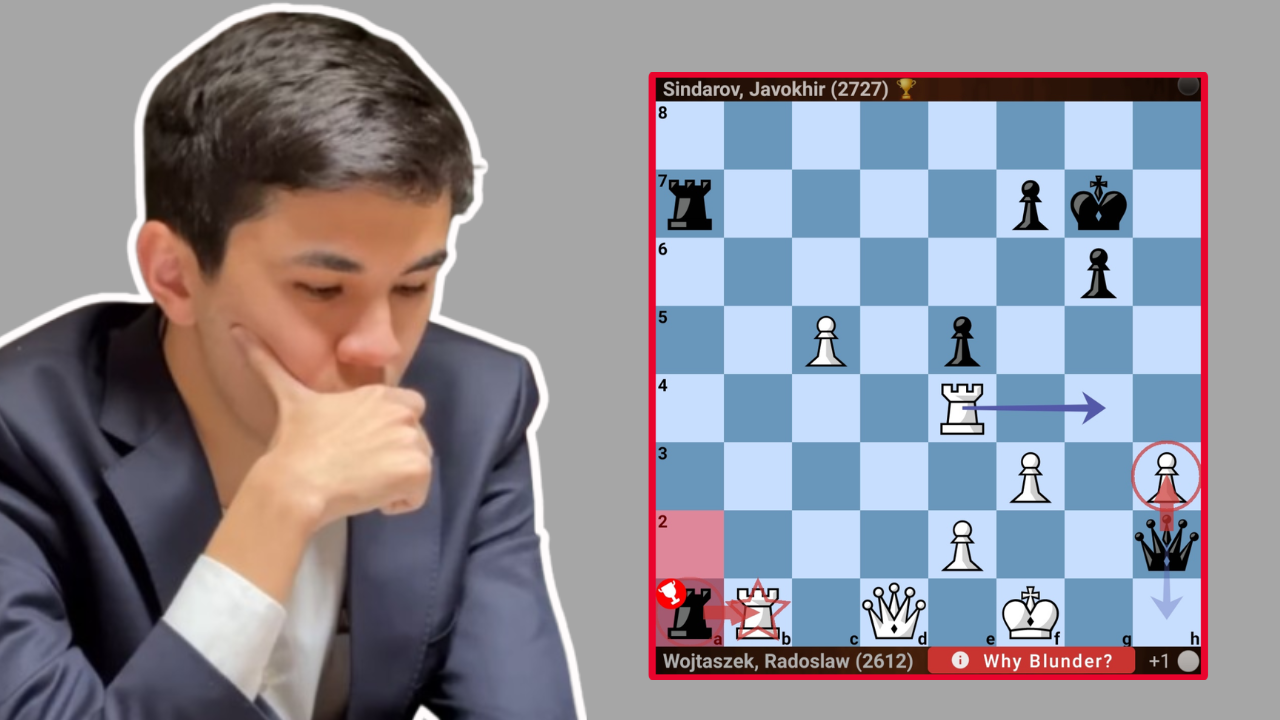
Radoslav vs Sindarov: Super Rapid & Blitz Poland 2026 delivered an exciting clash where Sindarov (Black) showed a powerful and smart performance against Wojtaszek (White). This game is a perfect example of modern attacking chess, where patience, strategy, and timing play a huge role.
In this blog, we will explain the full game in very simple words, so even beginners can understand how a top grandmaster wins step by step.
Radoslav vs Sindarov Opening Phase (Moves 1–10): Smart and Flexible Start
The game started with:
1. d4 Nf6 2. c4 g6 3. g3 c5
Black chose a flexible setup similar to the Benoni Defense.
- White captured early with dxc5, gaining a pawn
- Black quickly recovered it using …Na6 and …Nxc5
- Both players developed pieces normally
👉 Key Idea:
Instead of worrying about a pawn, Sindarov focused on piece activity, which is more important in fast games.
Grand Chess Tour 2026-Middlegame (Moves 11–25) Balanced but Strategic
After some exchanges:
- White had a safe and solid position
- Black had better piece activity and control
Important moves:
- …Rc8, …Qd7, …Rfd8 → Improving pieces
- …Qb7, …Rd7 → Preparing for future attack
👉 Turning Moment:
25. Nxc5 bxc5
- This changed the pawn structure
- Black got a strong center and open lines
👉 Key Idea:
Small changes in pawn structure can decide the game later.
Turning Point (Moves 26–36): Game Starts Shifting
Now Sindarov slowly took control:
- …a5 and …a4 → Creating pressure on queenside
- …Rc6 and …Ra6 → Activating rooks
Then came the most important move:
👉 36…d5!
- Opened the center
- Activated all Black pieces
- Created attacking chances
👉 Key Idea:
A pawn break at the right time can completely change the game.
Attack Phase (Moves 37–45): Pressure Increases
After the center opened:
- …Bh6 → Strong attacking setup
- …d4 → Gaining space
- …Rda7 → Doubling pressure
White tried to defend with:
- b4
- Rb2, Rb4
But Black stayed in control.
👉 Brilliant Move:
43…Be3!
- Put White under pressure
- Forced defensive moves
Then:
👉 44…Bxf2!
- Removed an important defender
- Opened the king position
👉 Key Idea:
Before attacking, remove key defending pieces.
Radoslav vs Sindarov Final Attack (Moves 46–52): Clean and Powerful Finish
Now Sindarov launched the final attack:
- …Ra2 → Rook enters second rank
- …Qe5 and …Qh2+ → Direct attack on king
White tried:
- Rh4+
- Re4
- Kf1
But it was too late.
👉 Final Moves:
51…Ra1!
52…Qh1+
White resigned because checkmate was unavoidable.
👉 Key Idea:
When your pieces are active and the king is weak, the attack finishes quickly.
Key Lessons from This Game
1. Activity is More Important Than Material
Radoslav vs Sindarov-Sindarov ignored small material details and focused on active play.
2. Perfect Timing of Pawn Break
The move …d5 changed the entire game.
3. Strong Coordination
All Black pieces worked together perfectly.
4. Attack at the Right Moment
Sindarov waited and attacked only when his position was ready.
Conclusion
This game is a perfect example of high-level chess strategy turning into a powerful attack. Javokhir Sindarov showed excellent control, patience, and timing to defeat Radoslaw Wojtaszek.
If you want to improve your chess, study this game carefully. It teaches:
- How to prepare an attack
- When to open the position
- How to finish the game like a professional.
Q1. What was the most important move in Sindarov vs Wojtaszek at Grand Chess Tour 2026?
The most important move of the game was undoubtedly 36…d5! played by Javokhir Sindarov.
At first glance, this move may look like a simple pawn push, but it completely changed the course of the game. Before this moment, the position was relatively balanced. White had a solid setup, and neither player seemed to have a clear advantage. However, Sindarov understood that his pieces were already placed on active squares and were ready for action.
The move …d5 opened the center and created new attacking lines for Black’s rooks, queen, and bishop. Once the center opened, White’s pieces became less coordinated while Black’s pieces suddenly became much more powerful.
Strong chess players often spend many moves preparing a single pawn break. Sindarov patiently improved his position before playing this move. Because of that preparation, the pawn break worked perfectly and gave Black the initiative.
For beginners, this move is a great example of how strategy works in chess. A well-timed pawn break can transform an equal position into a winning one. Instead of looking for immediate tactics, players should learn how to prepare important pawn advances that improve the activity of all their pieces.
Q2. Why did Radoslaw Wojtaszek lose this game?
Wojtaszek’s defeat was not caused by a single blunder. Instead, it happened because Black slowly gained control over the position and created increasing pressure.
One major problem was that White became too passive. While Sindarov continued improving his pieces, White struggled to create active plans. In modern chess, simply defending is often not enough. If one side improves their position while the other side waits, the stronger position usually gains the advantage over time.
Another important factor was king safety. As the game progressed, Black’s pieces became more active and started targeting White’s king. Once the center opened, White’s king became increasingly vulnerable to attack.
The move 44…Bxf2! was particularly important because it removed a key defender and weakened White’s defensive setup. After that, Black’s attack became much easier to execute.
The game also demonstrated the importance of piece coordination. Black’s queen, rooks, bishop, and pawns all worked together toward the same goal. White’s pieces, on the other hand, were often forced into defensive positions and could not generate meaningful counterplay.
In short, Wojtaszek lost because Black gained more activity, better coordination, stronger attacking chances, and eventually complete control of the game.
Q3. What can beginners learn from this Grand Chess Tour 2026 game?
This game contains many valuable lessons for improving players.
The first lesson is that piece activity is extremely important. Many beginners focus only on material and become obsessed with winning pawns. Sindarov showed that active pieces are often worth more than small material advantages.
The second lesson is understanding pawn breaks. The move …d5 changed the entire game because it opened lines and activated Black’s army. Learning when and how to open the position is a critical chess skill.
The third lesson involves patience. Sindarov did not launch an attack immediately. Instead, he improved his pieces one by one and waited until the position was ready. Many club players attack too early and end up weakening their own positions.
The fourth lesson is king safety. Even small weaknesses around the king can become serious problems later. White’s position looked safe for a long time, but once Black’s attack started, those weaknesses became important.
Finally, beginners should learn the value of piece coordination. Every Black piece contributed to the final attack. When your pieces support each other, your position becomes much stronger and your attacks become harder to stop.
Q4. Why was Sindarov’s strategic approach so impressive?
What makes this game special is that Sindarov did not rely on a quick tactical trick. Instead, he won through strategic understanding.
Throughout the game, Sindarov consistently improved the position of his pieces. Moves like …Rc8, …Qd7, …Rfd8, …Rc6, and …Ra6 may not look spectacular, but they played an important role in preparing future operations.
Strong grandmasters understand that successful attacks usually require preparation. Before opening the center, Sindarov made sure his pieces were ready to take advantage of the new opportunities that would appear.
Many players see attacks only as sacrifices and combinations. However, most successful attacks begin with strategic preparation. This game is a perfect demonstration of that principle.
Sindarov’s patience allowed him to create ideal conditions for an attack. Once everything was prepared, the tactical opportunities appeared naturally.
This balance between strategy and tactics is one of the reasons why the game is so instructive.
Q5. How did Black create such a strong attack against White’s king?
Black’s attack was not created in a single move. It developed gradually through a series of strategic decisions.
First, Sindarov improved the activity of all his pieces. Active pieces naturally create threats and force the opponent to react.
Second, he expanded on the queenside with moves such as …a5 and …a4. These moves restricted White’s position and created additional pressure.
Third, the critical pawn break …d5 opened important lines and allowed Black’s pieces to enter the game more aggressively.
Afterward, moves like …Bh6, …Be3, and …Bxf2 increased the pressure around White’s king. Instead of attacking blindly, Sindarov targeted key defensive pieces and weakened White’s defensive structure.
Finally, the rooks and queen invaded the position. The move …Ra2 placed a rook deep inside White’s territory, while the queen joined the attack with moves like …Qe5 and …Qh2+.
By the time the final attack arrived, White’s position was already under tremendous pressure. The checkmating attack was simply the result of many earlier strategic decisions.
Q6. What role did piece coordination play in Sindarov’s victory?
Piece coordination was one of the biggest reasons Black won the game.
In chess, a single active piece can be dangerous, but several pieces working together are much more powerful. Throughout the game, Sindarov ensured that every piece had a useful role.
His rooks controlled open files and invaded enemy territory. His queen supported both attack and defense whenever necessary. His bishop created powerful threats against White’s king. Even the pawns helped by controlling important squares and opening lines.
The final attack worked because every Black piece supported the others.
In contrast, White’s pieces often had defensive duties and could not coordinate effectively. When pieces are forced into passive positions, they become less effective and struggle to help each other.
This game teaches an important lesson: before starting an attack, make sure your pieces are working together. Good coordination often matters more than material advantage.
Q7. Why is this game important for club and tournament players?
Club players can learn a tremendous amount from this game because it demonstrates practical chess concepts that appear frequently in real games.
Many instructional games focus on brilliant sacrifices or complicated tactics. While those examples are entertaining, they are not always practical. Sindarov’s victory, however, was built on principles that every player can use.
These include:
-
Improving piece activity.
-
Preparing pawn breaks.
-
Creating long-term pressure.
-
Maintaining king safety.
-
Coordinating pieces effectively.
-
Choosing the right moment to attack.
Players rated anywhere from beginner level to advanced club level can benefit from studying this game.
The game also shows that winning does not always require spectacular combinations. Often, victory comes from making a series of strong positional decisions that gradually improve your chances.
For tournament players, this lesson is extremely valuable because consistency often matters more than brilliance.
Q8. What is the biggest takeaway from Sindarov’s victory over Wojtaszek?
The biggest takeaway is that successful attacks are usually built through preparation rather than immediate aggression.
Many players believe attacking means sacrificing pieces and launching threats from the opening. Sindarov demonstrated a much more professional approach.
He first improved his pieces.
He then created favorable pawn structures.
Next, he opened the center at the perfect moment.
After that, he removed important defenders.
Finally, he launched a decisive attack when all of his pieces were ideally placed.
This step-by-step process is exactly how strong grandmasters convert small advantages into victories.
For improving players, the lesson is simple: focus on improving your position first. When your pieces are active and coordinated, attacking opportunities will naturally appear.
Sindarov’s victory at the Grand Chess Tour 2026 is a perfect example of how patience, planning, and precise execution can turn an equal position into a memorable win.
Radoslav vs Sindarov | HMFLIX
Table of Contents
Toggle