

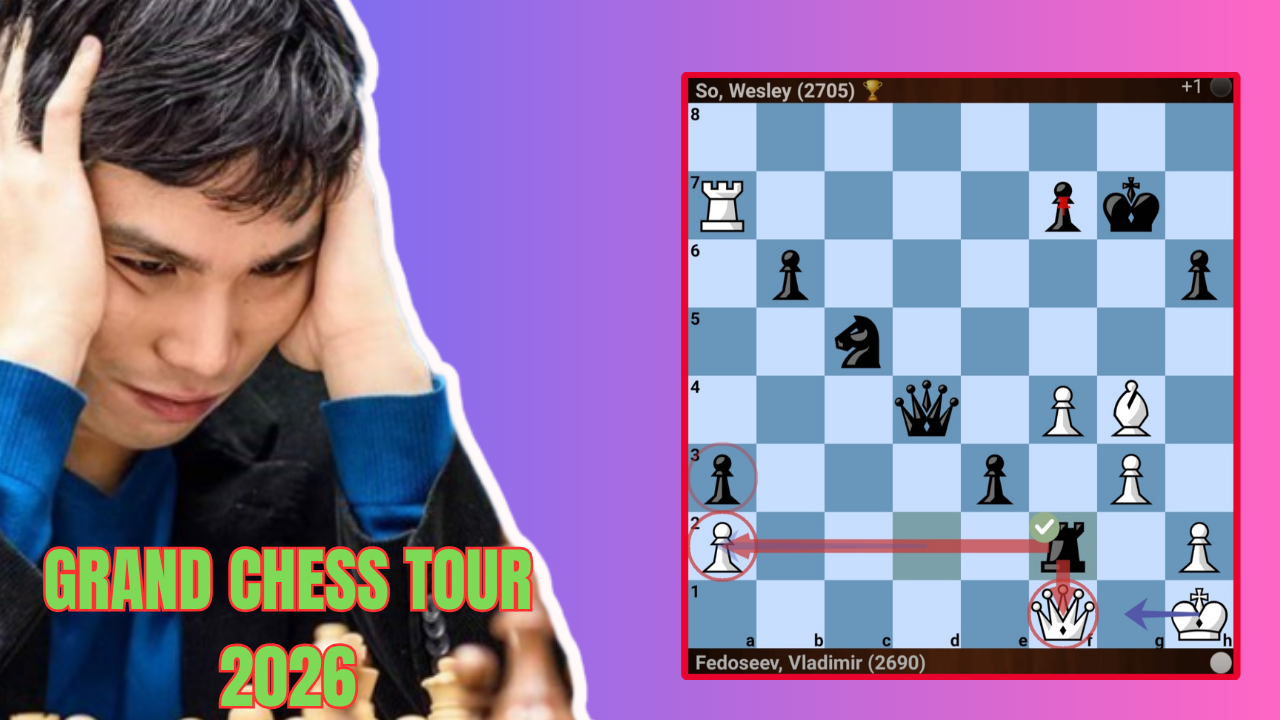
This match is already becoming popular among chess fans because of Wesley So’s calm defense, strong pawn play, and powerful rook activity in the final phase of the gamehttps://www.chessbase.in/news/gukesh-vs-javokhir-sindarov-at-super-rapid-2026-day-2
Opening Phase – Queen’s Gambit Declined Setup
The game started with:
1.d4 Nf6 2.c4 e6 3.Nf3 d51.d4\ Nf6\ 2.c4\ e6\ 3.Nf3\ d51.d4 Nf6 2.c4 e6 3.Nf3 d5
Both players entered a solid Queen’s Gambit Declined structure. Fedoseev chose a calm setup with g3 and Bg2, while Wesley So developed his pieces naturally and prepared central counterplay.
One important moment came after in these grand chess tour match :
7…c57…c57…c5
This move challenged White’s center immediately. Wesley So was not interested in passive defense. Instead, he wanted active piece play and pressure in the center.
After 8.dxc5, Wesley responded strongly with 8…d4, gaining space and forcing White’s knight away. This gave Black active play very early in the game.
Wesley So Takes Control of the Center
Fedoseev tried to simplify the position, but Wesley So slowly improved his pieces. The move 11…e5 was very important because it gave Black strong central control.
Later, after:
18…dxe318…dxe318…dxe3
Black opened the position at the perfect moment. Wesley So understood that active pieces are more important than material balance in rapid chess.
White’s position started becoming uncomfortable because Black’s bishops and rooks became very active. Wesley’s pieces were perfectly coordinated, while White struggled to create counterplay.
Middlegame Strategy – Wesley So’s Powerful Piece Activity
A very important turning point came with:
25…e425…e425…e4
This move pushed White backward and opened attacking chances. Wesley So used his central pawns aggressively and created pressure on multiple squares.
Soon after, Black played:
26…Nd326…Nd326…Nd3
This knight became a monster piece inside White’s position. It attacked important squares and supported Black’s attack from the center.
Fedoseev triedto defend carefully, but Wesley So continued improving his position with precise moves like a4, Rad8, and a3. These moves slowly increased pressure without taking unnecessary risks.
This is one reason why Wesley So is considered one of the strongest rapid chess players in the world. He combines strategy, patience, and tactical accuracy perfectly.
Tactical Explosion in the Endgame
The game became extremely sharp after move 31.

Fedoseev tried a tactical idea with:
32.Bxg732.Bxg732.Bxg7
White sacrificed material to create attacking chances against Black’s king. However, Wesley So remained calm under pressure.
Instead of panicking, he continued collecting pawns and activating his rooks.
The critical sequence was:
36…Rd3 37…Rd2 38…Qd4+36…Rd3\ 37…Rd2\ 38…Qd4+36…Rd3 37…Rd2 38…Qd4+
These rook and queen moves completely dominated White’s position. Wesley So’s pieces entered the second rank and created unstoppable threats against the white king.
Fedoseev’s clock was also running low, which made defending even harder.
Finally, the brilliant move:
40…Rf240…Rf240…Rf2
ended the game immediately.
White resigned because Black’s attack was too strong. The rook on f2 and queen pressure created unavoidable mating threats.
Why Wesley So Won This Game
There were several key reasons behind Wesley So’s victory:
1. Strong Central Control
Wesley So controlled the center with moves like e5 and e4. This gave him more space and active pieces.
2. Better Piece Coordination
All Black pieces worked together perfectly. The knight on d3 and active rooks became extremely dangerous.
3. Excellent Endgame Technique
Even in a complicated position, Wesley So stayed calm and improved his position step by step.
4. Time Management
Fedoseev went into severe time trouble, while Wesley So handled the clock much better in the final phase.
Best Move of the Game
The strongest move in this game was probably:
37…Rd237…Rd237…Rd2
This move invaded White’s position and prepared deadly queen and rook coordination. After this, White’s defense became almost impossible.
Final Thoughts
The game between Wesley So and Vladimir Fedoseev was a perfect example of modern rapid chess. It included strategic planning, pawn control, tactical attacks, and precise endgame play.
Wesley So showed why he remains one of the most dangerous rapid chess players in the world. His calm decision-making and accurate attacking play helped him secure a brilliant victory in the opening round of the Grand Chess Tour Poland 2026.
Chess fans can learn many important lessons from this game:
-
- Control the center
-
- Activate your pieces
-
- Stay calm under pressure
-
- Use rooks actively in the endgame
This was not just a win for Wesley So — it was a masterclass in positional pressure and attacking chess.
Frequently Asked Questions (FAQ)
Who won the game between Wesley So and Vladimir Fedoseev in Grand Chess Tour Poland 2026?
Wesley So won the game against Vladimir Fedoseev in the opening round of the Grand Chess Tour Poland 2026. The American grandmaster demonstrated excellent positional understanding, strong central control, and precise endgame technique. His active pieces and well-coordinated attack eventually forced Fedoseev to resign after Black created unstoppable threats against the white king.
What opening was played in the game?
The game began with a Queen’s Gambit Declined structure. Both players chose a solid and classical setup. Fedoseev developed with g3 and Bg2, aiming for a flexible position, while Wesley So focused on controlling the center and activating his pieces. The opening remained balanced for several moves before Black began taking the initiative through active central play.
Why was 7…c5 an important move?
The move 7…c5 was one of the first key moments of the game. Instead of remaining passive, Wesley So immediately challenged White’s central control. By attacking the center, Black created dynamic opportunities and prevented White from comfortably building a long-term positional advantage.
This move showed Wesley So’s aggressive approach and willingness to fight for the initiative from the very beginning.
How did Wesley So gain control of the center?
Wesley So gained central control through a series of well-timed pawn moves and active piece placement. The move 11…e5 strengthened Black’s grip on important central squares and restricted White’s options.
Later, the advance of the e-pawn and the opening of central lines allowed Black’s bishops, rooks, and queen to become increasingly active. Strong central control became the foundation of Wesley So’s entire strategy throughout the game.
Why was 18…dxe3 such an important decision?
The move 18…dxe3 opened the position at exactly the right moment. Wesley So understood that his pieces were better placed and could benefit from open lines.
By opening the center, Black increased the activity of his bishops and rooks while creating new targets in White’s position. This decision transformed a relatively balanced game into one where Black gradually gained the upper hand.
What made the move 25…e4 so powerful?
The move 25…e4 was a major turning point in the middlegame. This pawn push gained space, restricted White’s pieces, and prepared future attacking opportunities.
In chess, advanced central pawns can become extremely dangerous when supported by active pieces. Wesley So used this principle perfectly. The move not only improved Black’s position but also created long-term weaknesses in White’s camp.
Why was the knight on d3 so strong?
After 26…Nd3, Black’s knight became one of the strongest pieces on the board. The knight occupied an advanced outpost deep inside White’s position and attacked several important squares simultaneously.
The knight supported attacking operations, restricted White’s movement, and worked together with the rooks and queen. Advanced knights like this are often worth more than their normal material value because of the pressure they create.
Why did Fedoseev sacrifice material with 32.Bxg7?
The move 32.Bxg7 was an attempt to create attacking chances against Black’s king. When a player feels pressure in the position, sacrifices are often used to generate counterplay and complications.
Fedoseev hoped that active play against the king would compensate for the material investment. However, Wesley So defended accurately and never allowed White’s attack to become dangerous.
How did Wesley So handle the pressure after White’s sacrifice?
One of the most impressive aspects of the game was Wesley So’s calm reaction. Many players might panic when facing a sudden attack, especially in a rapid chess game.
Instead, Wesley So remained focused, activated his pieces, and continued improving his position. His accurate defensive play neutralized White’s threats while increasing his own attacking chances.
This ability to remain calm under pressure is one of the qualities that makes Wesley So one of the world’s strongest rapid chess players.
Why were the rook moves 36…Rd3 and 37…Rd2 so strong?
These rook moves completely transformed Black’s advantage into a winning position.
The rooks invaded White’s territory and attacked multiple weaknesses at the same time. Once Black’s rook reached the second rank, White’s position became extremely difficult to defend.
Active rooks are often the most powerful pieces in the endgame and late middlegame. Wesley So demonstrated this principle perfectly by placing his rooks on aggressive squares.
What was the best move of the game?
Many chess fans consider 37…Rd2 to be the best move of the game.
This move combined tactical precision with strategic domination. The rook invasion increased pressure on White’s position, supported the queen, and prepared decisive threats against the king.
After this move, Black’s attack became extremely difficult to stop.
Why did White resign after 40…Rf2?
The move 40…Rf2 created unstoppable mating threats and overwhelming pressure against White’s king.
Black’s rook and queen worked together perfectly, leaving White with no effective defense. Even if White continued the game, Black would either win material or deliver checkmate in the coming moves.
At the grandmaster level, players often resign when they recognize that the position is completely lost.
What does this game reveal about Wesley So’s playing style?
This game highlights many of Wesley So’s greatest strengths:
-
Strong positional understanding.
-
Excellent opening preparation.
-
Precise calculation.
-
Calm decision-making under pressure.
-
Outstanding endgame technique.
Wesley So rarely rushes attacks. Instead, he improves his position step by step until the opponent’s weaknesses become impossible to defend.
Why is Wesley So considered one of the best rapid players in the world?
Wesley So has built a reputation as one of the strongest rapid and blitz players because of his consistency and accuracy.
Unlike many aggressive players who rely purely on tactics, Wesley combines strategic understanding with tactical precision. He rarely makes major mistakes under time pressure and often finds practical solutions in complicated positions.
This victory against Fedoseev is a perfect example of those qualities.
Was this one of the best games of Grand Chess Tour Poland 2026?
Many fans consider this game one of the most instructive games of the tournament. It featured strong opening preparation, excellent positional play, active piece coordination, and a powerful finishing attack.
For players studying modern rapid chess, the game serves as an excellent example of how central control and active pieces can lead to a decisive victory.
Final FAQ Summary
The Wesley So vs Vladimir Fedoseev game from Grand Chess Tour Poland 2026 was a masterclass in positional pressure, central domination, and active piece play. Wesley So gradually improved his position, seized control of the center, activated his rooks, and converted his advantage with remarkable precision. The game offers valuable lessons for every chess player and remains one of the standout performances of the tournament.