

Norway Chess 2026-Magnus Carlsen Vs Vincent Keymer
In Round 4 of Norway Chess 2026, Magnus Carlsen showed once again why he is one of the greatest players in history. Facing Vincent Keymer, Carlsen didn’t rely on flashy tactics or wild attacks. Instead, he played a calm, positional game, slowly improving his pieces and squeezing his opponent until the position collapsed.
This game is a perfect example of how strong players win without taking big risks. If you want to understand positional chess in simple terms, this game is gold.
Opening Phase (Moves 1–10): A Quiet Start with a Hidden Idea
1. b3
Magnus Carlsen begins with a flexible and somewhat unusual move. This opening is called the Larsen Opening. The idea is simple: develop the bishop to b2 and control the long diagonal.
1… d5 2. Bb2 Nf6 3. Nf3 c5
Keymer responds in a classical way, taking control of the center. So far, everything is balanced.
4. e3 g6 5. c4 Bg7
Magnus Carlsen now challenges the center with c4. This leads to an early imbalance, which is exactly what he wants.
6. cxd5 Qxd5 7. Nc3 Qf5
Here’s an important moment. Keymer moves his queen early, which is slightly risky. Carlsen immediately gains time by attacking it.
8. Nb5 Na6
Carlsen continues to play actively. The knight jump to b5 is aggressive and annoying.
Key Idea:
Carlsen is not trying to win immediately. He is slowly creating small problems for Black.
Middlegame Setup (Moves 10–20): Simplification and Control
9. Be2 O-O 10. O-O b6 11. a3 Bb7
Both sides complete development. The position is still equal, but Carlsen is more comfortable.
12. Qb1 Qxb1 13. Rfxb1
Carlsen trades queens. This is very important.
Why Trade Queens?
Carlsen knows he is better in long positional games. By removing queens, he reduces tactics and increases his control.
13… Rfc8 14. b4 Nc7 15. Nxc7 Rxc7

Carlsen exchanges pieces and simplifies further.
16. Be5 Rcc8
This is a strong move. The bishop becomes very active and puts pressure on Black’s position.
Strategic Battle (Moves 17–27): Slow Pressure Builds
17. Kf1 Ne4 18. Bxg7 Kxg7
Carlsen gives up his bishop pair but damages Black’s king structure slightly.
19. Ke1 Nd6 20. a4 c4
Keymer tries to create counterplay, but this move also gives Carlsen a target.
Important Concept:
When your opponent pushes pawns, those pawns can become weaknesses later.
21. Rc1 Rc7 22. g3 Rac8
Carlsen improves his position step by step. No rush. No panic.
23. Nd4 a6 24. f4 h5
Carlsen starts expanding on the kingside.
25. Rc3 Ne4 26. Rc2 Nd6
Keymer is repeating moves slightly. This shows he is unsure of a plan.
Turning Point (Moves 27–35): Carlsen Takes Over
27. b5 a5
Carlsen locks the queenside. Now Black has less space.
28. Rac1 Rc5 29. Bf3 Bxf3 30. Nxf3
Carlsen improves his knight and keeps control.
30… c3 31. d3 f6
Keymer tries to break free, but it’s too late.
Key Insight:
Carlsen has better structure, better coordination, and more space.
32. Nd4 Kf7 33. Nc6
This is a beautiful move. The knight becomes very strong on c6.
Black’s position is now very uncomfortable.
Endgame Domination (Moves 34–41): Clean and Precise Finish
33… h4 34. g4 g5
Keymer tries to create chaos, but Carlsen handles it calmly.
35. Rxc3 Rxc3 36. Rxc3 gxf4 37. exf4 h3
The position opens up—but this favors Carlsen.
Why?
Because Carlsen’s pieces are more active and better placed.
38. Kf2 Rg8 39. Kf3 Nb7
Black is passive. Carlsen is ready to strike.
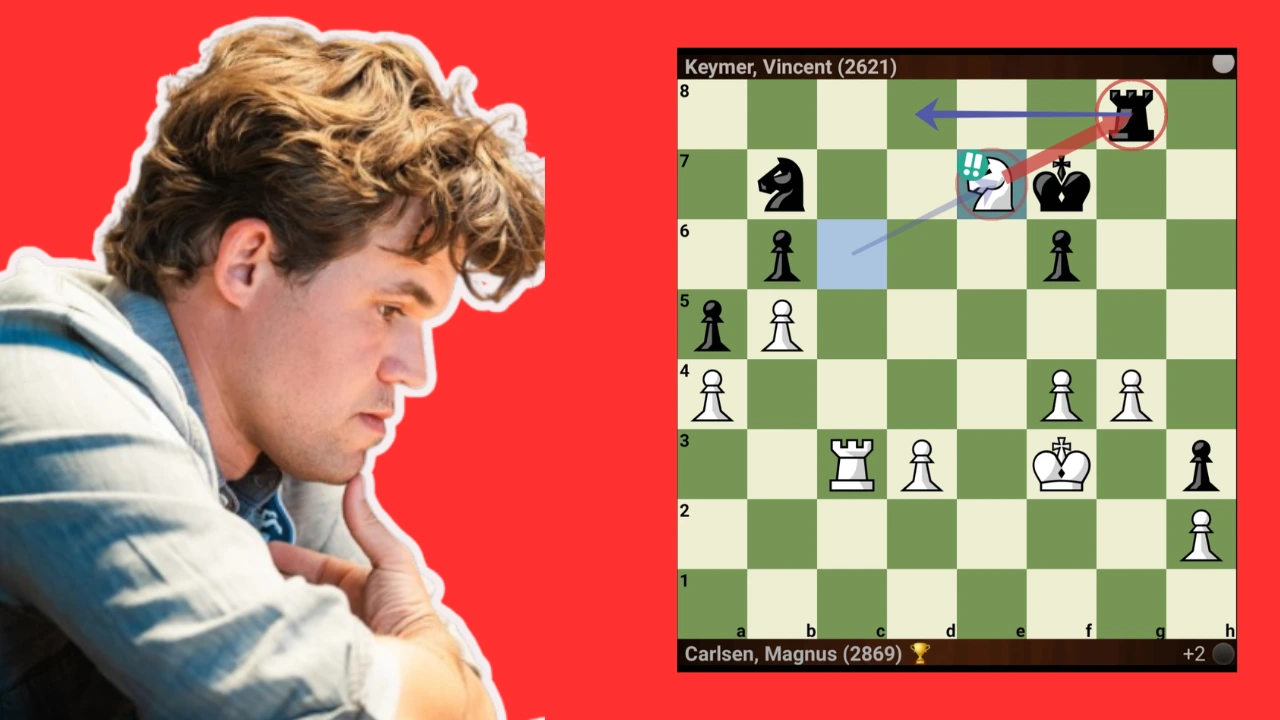
40. Nxe7!
This is the winning move.
Carlsen finally switches from slow play to tactics.
40… Nc5 41. Nxg8
And Black resigns.
Final Result: 1-0
Carlsen wins with a perfect mix of patience and precision.
What Made This Game Special?
1. Simple Opening, Deep Ideas
Carlsen didn’t play anything complicated. But every move had a purpose.
2. Perfect Timing
He waited for the right moment before attacking.
3. Piece Activity Over Material
He focused on improving his pieces rather than grabbing pawns early.
4. Endgame Strength
Once queens were off, Carlsen completely dominated.
Lessons You Can Learn
- Don’t rush attacks. Improve your position first.
- Trading queens can be a strong strategy if you are better positionally.
- Small advantages can turn into big wins.
- Active pieces are more important than material in many positions.
Frequently Asked Questions (FAQ)
1. Why did Carlsen play 1.b3 instead of a common move like e4 or d4?
Carlsen often chooses flexible openings to avoid heavy theory. With 1.b3, he gets a playable position without entering deeply analyzed lines. It also allows him to outplay opponents in the middlegame rather than relying on memorization.
2. Was trading queens early a good decision?
Yes, and it was a key moment in the game. By trading queens, Carlsen removed tactical complications and moved the game into a positional battle. This is where he is strongest. It also made it harder for Keymer to create attacking chances.
3. What mistake did Keymer make in this game?
Keymer didn’t make a big blunder early. Instead, his main issue was lack of a clear plan. Moves like moving the knight back and forth (Ne4–d6) showed uncertainty. Against a player like Carlsen, even small inefficiencies can become serious problems.
4. Why was Nc6 such a strong move?
The move Nc6 placed the knight in a dominant position. From c6, it attacked key squares and restricted Black’s pieces. Strong outposts like this are often game-winning in positional chess.
5. What is the main takeaway from this game for beginners?
The biggest lesson is patience. You don’t need to attack immediately. First, improve your pieces, control space, and create small advantages. If you play accurately, the winning chances will come naturally—just like Carlsen showed in this game.
6. How did Carlsen convert his advantage so smoothly?
Carlsen didn’t force anything. He slowly improved his position, restricted his opponent, and waited for the right moment. When the position was fully under control, he switched to tactics and finished the game cleanly.
Conclusion
This game is not about show sacrifices or brilliant tactics from the start. It’s about control, patience, and understanding. Magnus Carlsen showed how to win a game step by step, without taking unnecessary risks.
If you study this game carefully, you will understand what high-level chess really looks like: simple moves, deep ideas, and perfect timing.