

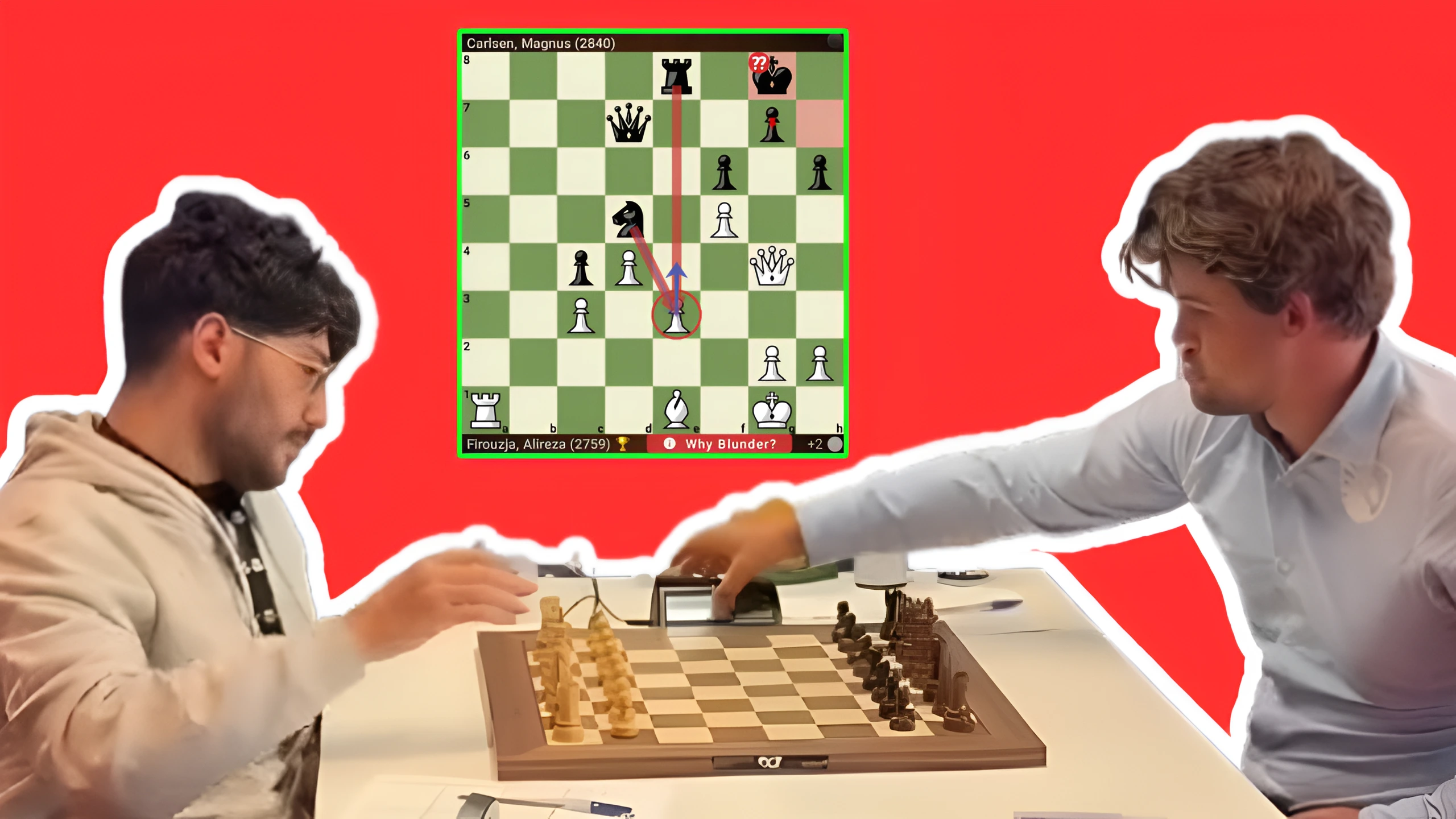
The game between Alireza Firouzja and Magnus Carlsen in Norway Chess 2026 was not just a win—it was a statement. Firouzja didn’t rush, didn’t gamble wildly. Instead, he slowly built pressure, waited for the right moment, and then struck with precision.
Let’s go through the game step by step in very simple terms so you can clearly understand what happened and why it mattered.
Norway Chess 2026 Opening Phase: A Quiet Start with Hidden Ideas
1. d4 d5 2. c4 e6 3. Nf3 Nf6 4. Nc3 h6
The game starts as a Queen’s Gambit Declined. This is a very solid and common opening. But Carlsen plays 4…h6, which is a bit unusual. It stops Bg5 ideas but also slightly weakens his kingside.
5. a3 c5 6. cxd5 exd5 7. Bf4 Nc6 8. e3 a6
Firouzja plays calmly. Moves like a3 and Bf4 show he wants a flexible position. Carlsen responds actively with …c5, fighting for the center.
9. Be2 c4
This is an important moment. Carlsen closes the center with c4. This means the game will now be about movement and long-term plans rather than quick tactics.
👉 Simple idea: When the center is closed, both players attack on the sides.
Middle Game: Firouzja Builds Pressure
10. Ne5 Bd6 11. O-O O-O 12. Bg3 Bf5
Firouzja places his knight on e5 — a strong central square. His pieces are slowly becoming more active.
13. f4
This is a key move. Firouzja starts attacking on the kingside.
👉 Idea: Push pawns forward to gain space and prepare an attack.
13…Be7 14. Bf3 Rc8 15. Rc1 b5
Carlsen starts pushing on the queenside with b5. So now we clearly see:
- White attacks kingside
- Black attacks queenside
Classic chess battle.
The Turning Point: Carlsen Gets Too Ambitious
16. Be1 b4 17. axb4 Bxb4
Carlsen pushes aggressively with b4. At first time, it looks strong. But it also opens lines.
👉 Problem: When you push pawns too far, you create weaknesses behind them.
18. Bh4 Bxc3 19. bxc3 Qd6

Firouzja calmly accepts structural damage (doubled pawns), but gains open lines and activity.
This is very important:
👉 In modern chess, activity is often more important than pawn structure.
Critical Moment: Firouzja Strikes
20. Ra1 Ne4 21. Rxa6
🔥 This is a brilliant move.
Firouzja sacrifices material (or at least takes a risk) to activate his rook.
👉 Idea: Open lines + attack = long-term advantage
21…f6 22. Bxe4 Bxe4 23. Ng4
Firouzja keeps improving his pieces. He is not rushing.
24. Nf2 Ne7 25. Qe2 Rc6
Carlsen tries to defend, but his position is already uncomfortable.
Position Collapses for Black
26. Rxc6 Qxc6 27. Nxe4 dxe4
Now things become clear:
- Firouzja has better piece coordination
- Carlsen has weaknesses everywhere
28. Ra1 Nd5 29. Be1 Rb8
Carlsen tries to counterattack, but it’s too slow.
Endgame Transition: Firouzja Takes Full Control
30. f5 Kh7 31. Qg4 Qd7 32. Qxe4
Firouzja wins a pawn and improves his position further.
👉 This is the result of earlier pressure—not luck.
32…Re8 33. Qg4 Kg8
Carlsen is now in serious time trouble (just seconds left).
Final Blow: Clean and Precise Finish
34. e4 Ne3 35. Qf3 Nc2 36. Rc1 Na3 37. Bg3 Nb5
Carlsen tries tricks, but Firouzja stays calm.
38. e5 1-0
Carlsen resigns.
👉 Why?
Because:
- White’s attack is unstoppable
- Black’s king is unsafe
- Material loss is coming
What Made Firouzja’s Win Special?
Let’s break it down simply:
1. Patience
Firouzja didn’t try to win quickly or force anything. He kept improving his pieces step by step and waited for the right chance. This made his position stronger without taking risks. In top-level chess, patience often leads to better opportunities.
2. Understanding Pawn Structure
Even though his pawns became doubled, Firouzja didn’t worry about it. He knew active pieces matter more than perfect pawns. Those pawns actually helped open lines for his attack. This shows deep positional understanding.
3. Perfect Timing
Firouzja chose the exact right moment to become aggressive. The move Rxa6 came when his pieces were ready and Carlsen was slightly unprepared. Acting too early or too late would not work—but his timing was perfect.
4. Pressure + Time Trouble
Firouzja kept putting constant pressure on Carlsen’s position. As the game progressed, Carlsen had very little time left to think. Under time pressure, even small problems become big mistakes, making defense much harder.
Where Did Carlsen Go Wrong?
Even the best players make mistakes. Here’s what hurt Carlsen:
- 4…h6 was slightly slow
- 16…b4 was too aggressive
- Allowed too many open lines
- Fell into time trouble
👉 Important lesson: Over-pushing pawns can backfire.
Simple Lessons You Can Learn
If you’re a beginner or intermediate player, take these:
- Don’t rush attacks — build them slowly
- Activity is more important than perfect pawn structure
- Watch your time — it matters a lot
- Don’t push pawns without a clear plan
FAQ Section
1. Why is this win important for Firouzja?
This win is huge because beating Magnus Carlsen, especially in a classical game, is very difficult. It shows that Firouzja is not just talented but also mature in his decision-making. He didn’t rely on tricks—he outplayed Carlsen step by step.
2. What was the best move in the game?
The move 21. Rxa6 was the most important. It showed deep understanding. Firouzja opened the position at the right time and activated his rook. That moment shifted the game in his favor.
3. Did Carlsen make a big mistake?
Not one single blunder, but several small inaccuracies:
- Over-aggressive pawn push (b4)
- Slightly passive defense later
- Time pressure
In top-level chess, small mistakes are enough to lose.
4. Why did Firouzja accept doubled pawns?
Because he understood something important:
👉 Open lines and active pieces are more valuable than perfect pawns.
Those doubled pawns actually helped him open files for attack.
5. Could Carlsen have defended better?
Possibly, yes. But it would have required:
- More precise defense
- Better time management
- Avoiding risky pawn pushes
Even then, Firouzja’s position was very strong.
6. What is the main takeaway from this game?
The biggest lesson is:
👉 Good chess is about patience and timing.
Firouzja didn’t attack immediately. He prepared everything first—and only then fight back.
My Opinion on Firouzja vs Carlsen
Watching Alireza Firouzja beat Magnus Carlsen in this game didn’t feel like a lucky win or a one-off surprise. It felt like something deeper—a quiet shift in control.
What impressed me most was not the result, but how Firouzja did it.
He didn’t come out swinging. There was no early chaos, no wild sacrifice to shock Carlsen. Instead, he played with control, almost like he was dictating the pace of the game from move one. That’s rare against someone like Carlsen, who usually grow strongly in exact way, these kinds of slow, strategic battles.
Carlsen’s choice of …h6 and later the aggressive …b4 push felt slightly off rhythm to me. Not outright mistakes, but decisions that gave Firouzja something to work with. And that’s the key difference—Firouzja didn’t let those moments pass.