


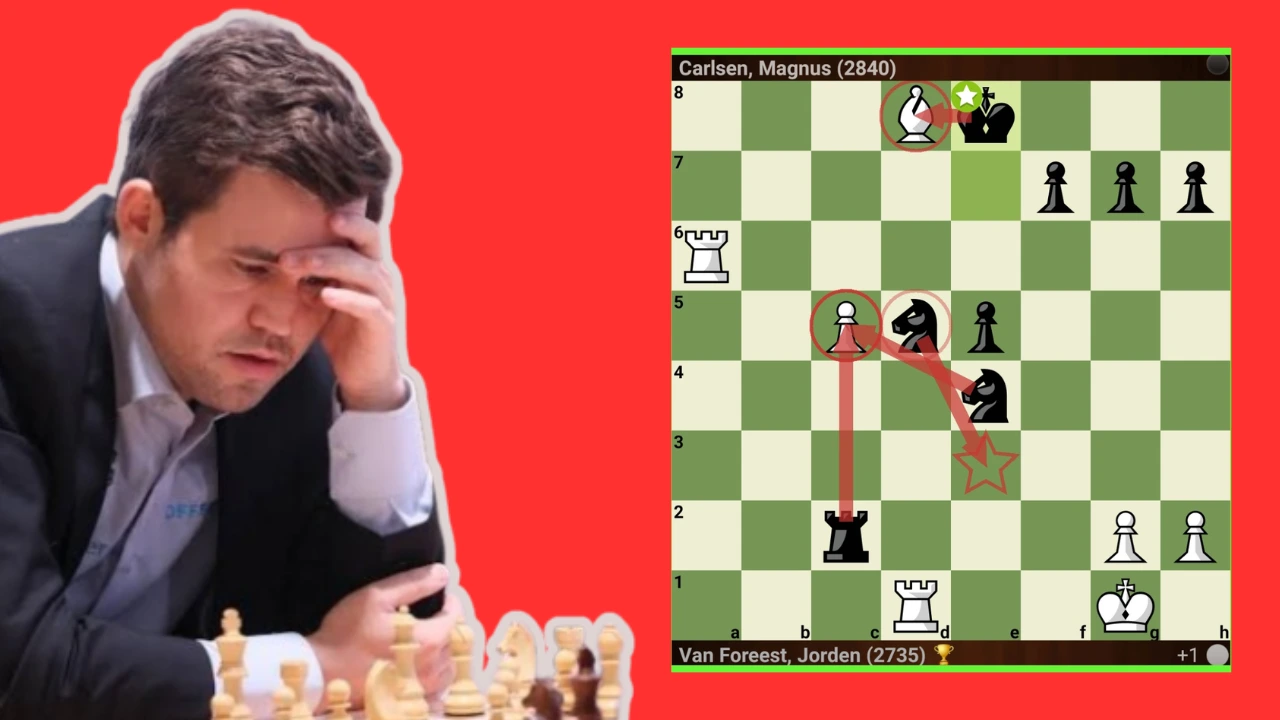
Van Foreest vs Magnus Carlsen – When you see Magnus Carlsen on the board, you expect control, precision, and victory. But in Round 4 of the TePe Sigeman & Co Chess Tournament 2026, something different happened.
Jorden van Foreest didn’t just survive—he outplayed Carlsen step by step and won a long, exhausting endgame. This wasn’t a quick attack. It was a slow grind where every small advantage mattered.
Let’s break it down in very simple terms so you can understand exactly how this game unfolded.
From equal position to complete control: how the game slipped away from Carlsen
Van Foreest vs Magnus Carlsen | Opening Phase (Moves 1–10): A Quiet Start
The game begins with the Sicilian Defense:
1. e4 c5 2. Nf3 d6 3. d4 cxd4 4. Nxd4 Nf6 5. Nc3 a6
This is a very common setup. Both players know it deeply.
Then comes an important moment:
6. f4 e5 7. Nb3 Be7 8. fxe5 dxe5 9. Qxd8+ Bxd8
White trades queens early.
What this means (simple idea):
- No queens = less attacking chances
- Game becomes positional and strategic
- Small mistakes matter more
Van Foreest clearly wanted a long game, not a tactical fight.
Early Middlegame (Moves 10–20): Small Imbalances Begin
10. Be3 Be6 11. Nc5 Ba5 12. Bd3 Bc8 13. Nb3 Bxc3+ 14. bxc3
Here, something important happens:
- White gets doubled pawns (c-pawns)
- But gains control and open lines
Then:
16. Rb1 Bxe4 17. Bxe4 Nxe4 18. Rxb7
This is a key moment.
White sacrifices structure but:
- Activates rooks
- Gets deep into Black’s position
Carlsen now has to defend carefully.
Critical Middlegame (Moves 20–30): Turning Point
21. Nc6 Rxc6 22. Rb8+ Ke7 23. Rxh8
White wins material (exchange).

But the position is still tricky.
Then:
24. Ra8 Ra4 25. c4 Rxa2
Material looks messy, but here’s the truth:
- White has better activity
- Black’s king is slightly exposed
Then comes a powerful idea:
27. c5!
This move is very strong.
Why?
- Creates a passed pawn
- Restricts Black pieces
- Forces Carlsen into defense
This is where Van Foreest starts taking control.
Endgame Transition (Moves 30–40): Pressure Builds
31. Rd1 Nd5 32. Bd8+ Ke8 33. Ra8
White keeps improving slowly.
Then a very nice tactic:
34. Bxf6+
This wins more material and keeps pressure alive.
At this point:
- White has better coordination, Magnus Carlsen is struggling to untangle
Carlsen is already under serious pressure.
Long Endgame Battle (Moves 40–60): Pure Grinding
Now the queens are gone, and we see a classic Carlsen-style endgame… but played by his opponent.
White:
- Improves king position
- Controls key squares
- Slowly pushes pawns
Black:
- Tries to hold
- Looks for counterplay
But Van Foreest stays calm.
Moves like:
41. Bb2, 42. Rg3, 43. Rc3
show perfect patience.
No rush. Just improvement.
Final Phase (Moves 60–88): Carlsen Breaks
By move 60:
60. Re5 Nf5+ 61. Kg4 Nd4
White’s king is active, pieces are coordinated.
Then slowly:
- White pushes pawns
- Controls space
- Limits Black knight
By move 70+, the position becomes clearly winning.
Carlsen tries tricks, but:
Van Foreest doesn’t panic.
Finally:
88. Rd3 — Black resigns
Van Foreest vs Magnus Carlsen | Key Lessons from This Game
1. Queen Trades Change Everything
Early queen exchange turned the game into:
- Strategy battle
- Not tactics
Van Foreest was ready for this.
2. Activity is More Important Than Structure
Even with doubled pawns:
- White had better piece activity
- That mattered more
3. Passed Pawns Win Games
The move c5 was critical.
It:
- Created long-term pressure
- Forced Black to defend
4. Patience Beats Even the Best
magnus Carlsen is known for grinding opponents.
But here:
- Van Foreest outplayed him in his own style
That’s what makes this game special.
Van Foreest vs Magnus Carlsen | Conclusion
This wasn’t a flashy win.
It was something deeper.
Jorden van Foreest showed:
- Calm decision-making
- Strong positional understanding
- Incredible patience
Beating Magnus Carlsen is always huge—but doing it in a long endgame grind is even more impressive.
1. Why did Jorden van Foreest trade queens so early in the game?
The queen exchange on move 9 was one of the most important strategic decisions of the game. Many players prefer keeping queens on the board because they create attacking opportunities and tactical complications. However, Van Foreest chose a different path. By trading queens, he reduced the chances of a direct attack and transformed the game into a positional battle.
This decision was particularly interesting because Magnus Carlsen is famous for his ability to create complications and find resources in dynamic positions. Van Foreest essentially said, “Let’s play a long strategic game instead.” The queen trade meant that piece activity, pawn structure, and endgame technique would become the deciding factors. As the game progressed, this choice worked perfectly for White because he slowly gained small advantages that became more significant over time.
2. Were White’s doubled pawns actually a weakness?
At first glance, the doubled pawns on the c-file looked like a positional weakness. Traditional chess principles often teach beginners that doubled pawns are bad because they cannot defend each other properly. However, chess is much more complex than simple rules.
In this game, the doubled pawns came with important benefits. White gained open lines for his pieces and better activity. The bishops and rooks found useful squares, while Black struggled to coordinate his forces effectively. Throughout the game, the activity of White’s pieces more than compensated for any structural weaknesses.
This position demonstrates a valuable lesson: a weak pawn structure does not automatically mean a bad position. If active pieces and strong coordination come in return, the structural weakness may not matter at all.
3. Why was 18. Rxb7 considered such an important moment?
The move 18. Rxb7 showed Van Foreest’s aggressive approach to the position. Rather than playing passively and defending his structure, he actively invaded Black’s territory. This move immediately created practical problems for Carlsen and forced him to think carefully about defense.
One of the most important aspects of chess is piece activity. An active rook deep inside the opponent’s position can often be worth more than small material considerations. The rook on b7 became a constant source of pressure and helped White maintain the initiative.
Even though the position remained balanced in material terms, White’s active pieces gave him easier plans to follow. From this point onward, Carlsen spent much of the game reacting to White’s threats instead of carrying out his own ideas.
4. Why do many analysts consider 27. c5 the turning point?
The move 27. c5 was the strategic heart of the entire game. Before this move, White had some activity but no clear long-term advantage. After c5, everything changed.
The pawn advanced into Black’s position and created a dangerous passed pawn. A passed pawn is one of the most powerful assets in chess because it constantly threatens to advance toward promotion. Even if it never reaches the eighth rank, it forces the opponent to dedicate pieces and attention to stopping it.
The move also restricted Black’s pieces. Instead of seeking active squares, Carlsen’s pieces had to focus on controlling the pawn. This allowed White to gradually improve his position while Black became increasingly passive. Many observers believe this single move defined the rest of the game.
5. When did Carlsen’s position begin to deteriorate?
Unlike many losses that result from a single blunder, Carlsen’s position worsened gradually. There was no dramatic moment where everything suddenly collapsed. Instead, White accumulated small advantages one after another.
The period between moves 25 and 35 was particularly important. During this phase, White’s pieces became increasingly active, while Black’s pieces struggled to find useful squares. The passed pawn created constant pressure, and Carlsen was forced to spend valuable time dealing with defensive concerns.
By the time the game reached the later stages, Black’s position was already difficult to play. The problems were not obvious to casual viewers, but experienced players could see that White’s position was becoming easier and easier to handle.
6. Why couldn’t Carlsen create enough counterplay?
Counterplay is often the key to defending difficult positions. Even when a player is slightly worse, active counterplay can create complications and force the opponent to make difficult decisions.
In this game, however, White successfully prevented most of Black’s active ideas. The passed pawn limited Black’s freedom, while White’s pieces controlled important squares. Carlsen searched for opportunities to activate his pieces, but each attempt was met with accurate responses.
Without active counterplay, defending becomes much harder. Instead of creating threats, Black was constantly reacting to White’s plans. This imbalance gradually increased the pressure and made the defense more difficult with every move.
7. How did Van Foreest outplay Carlsen in the endgame?
The endgame was a masterclass in patience and technique. Van Foreest never rushed his advantage. Instead, he improved his pieces one at a time and steadily increased pressure.
Many players become impatient when they sense a winning opportunity. They look for immediate tactical solutions and sometimes throw away their advantage. Van Foreest avoided that mistake completely. He trusted his position and focused on improving it move by move.
Ironically, this is exactly the style that made Carlsen famous. For years, Carlsen has defeated elite players by squeezing tiny advantages and gradually increasing pressure. In this game, Van Foreest used the same method against him and executed it brilliantly.
8. Did Carlsen make a major mistake that directly lost the game?
Not really. One of the most fascinating aspects of this game is that there was no obvious blunder. Carlsen did not hang a queen or overlook a simple tactic. Instead, he slowly drifted into a passive position.
This type of loss is often more difficult to prevent because it results from several small inaccuracies rather than one clear mistake. Each decision may appear reasonable on its own, but together they allow the opponent to gain momentum.
By the time Black’s position became clearly worse, there was no simple way to fix the problems. White’s advantages had become too deeply rooted in the position.
9. Why was White’s king activity so important in the endgame?
In the opening, the king’s primary job is staying safe. In the endgame, the king becomes an active fighting piece. Strong endgame players understand this principle very well.
Van Foreest gradually brought his king toward the center of the board, where it could support pawns and help control key squares. This increased White’s overall coordination and strengthened every aspect of the position.
Meanwhile, Carlsen’s king often had to remain defensive. The difference in king activity became increasingly important as more pieces were exchanged. By the later stages of the game, White’s king was playing an active role while Black’s king remained tied to defensive responsibilities.
10. What was the most impressive aspect of Van Foreest’s performance?
The most impressive part was his composure. Playing against Magnus Carlsen can be intimidating for anyone. Many players become nervous and start second-guessing their decisions.
Van Foreest showed none of that hesitation. He trusted his evaluation of the position and continued making strong practical decisions. Even when the win was not yet clear, he maintained his focus and avoided unnecessary risks.
His ability to stay calm during a long and demanding struggle demonstrated tremendous confidence and maturity. It was the performance of a player who fully believed in his position and his chances.
11. Why is this victory considered one of the biggest results of the tournament?
Any victory against Magnus Carlsen attracts attention because he remains one of the strongest players in the world. However, this win stands out for another reason: the manner in which it was achieved.
Van Foreest did not rely on a surprise opening or a tactical trick. He defeated Carlsen in a long strategic battle that lasted deep into the endgame. Winning in this fashion against one of the greatest endgame specialists in history is extremely rare.
The game showcased not only preparation but also deep understanding, patience, and technical accuracy. That combination makes the victory especially memorable.
12. What is the biggest lesson new players can learn from this game?
The biggest lesson is that chess games are often decided by small advantages rather than spectacular combinations. Many beginners focus entirely on tactics and attacking ideas, but this game highlights the importance of strategic thinking.
Piece activity, king improvement, passed pawns, and patience all played major roles in White’s victory. Van Foreest did not win because of one brilliant move. He won because he consistently made good decisions over many hours of play.
For club players, this is a valuable reminder that improving positional understanding can lead to better results. Sometimes the strongest move is not a flashy sacrifice but a quiet improvement that increases pressure little by little until the opponent can no longer hold the position.
Van Foreest vs Magnus Carlsen TePe Sigeman Chess tournament 2026 | HMFLIX