


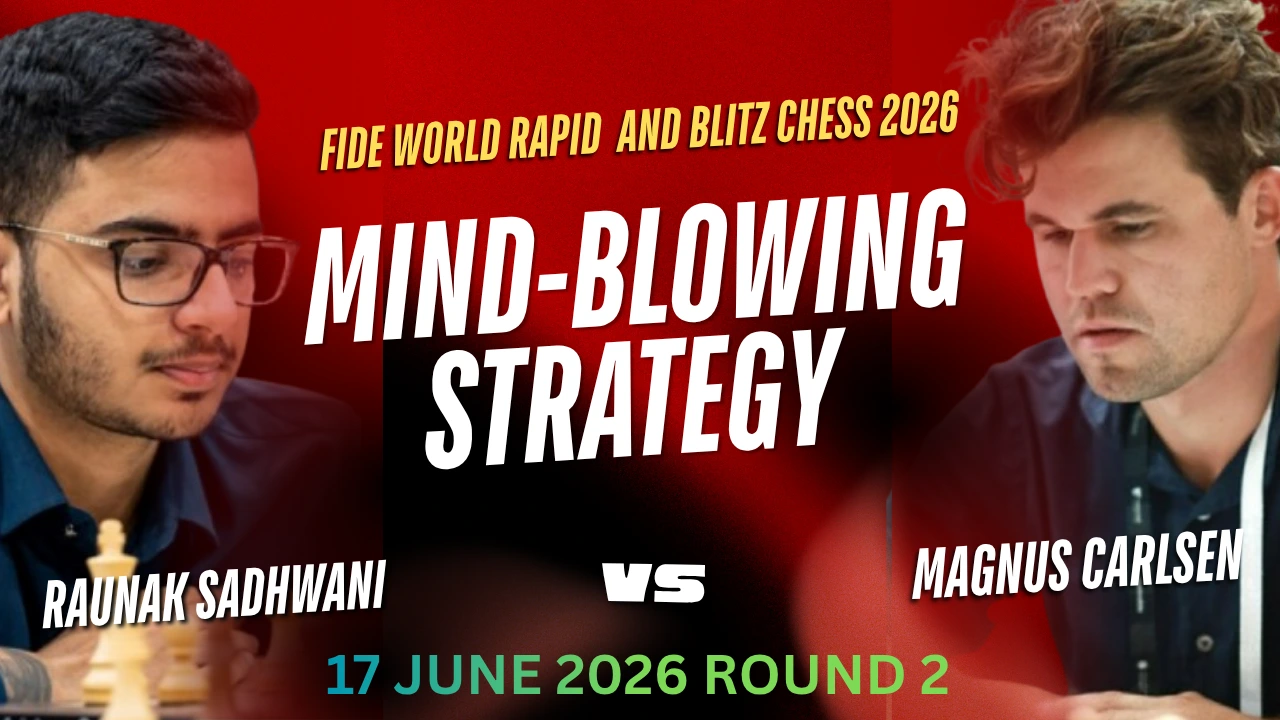
Raunak Sadhwani vs Magnus Carlsen – Complete Game Analysis | FIDE World Rapid & Blitz Team Chess Championships 2026
Introduction
When a young grandmaster faces Magnus Carlsen, every move becomes important. In Round 2 of the FIDE World Rapid & Blitz Team Chess Championships 2026, Indian Grandmaster Raunak Sadhwani played with the white pieces against the world’s highest-rated player, Magnus Carlsen. The game ended in a draw after 46 moves, but it was full of excellent positional ideas, careful defense, and an exciting king and pawn endgame.
Many fans expected Carlsen to slowly outplay his opponent, but Raunak showed great preparation and confidence. He never allowed Carlsen to create serious winning chances and defended the endgame accurately.
Let us understand the complete game in very simple words.
Game Information
Event: FIDE World Rapid & Blitz Team Chess Championships 2026
Round: 2
White: Raunak Sadhwani (2576)
Black: Magnus Carlsen (2832)
Result: ½–½
Opening: Sicilian Defense (Kan Variation)
Opening Phase (Moves 1-10)
1.e4 c5
Raunak starts with the King’s Pawn opening, while Carlsen chooses the Sicilian Defense. This opening immediately creates an unbalanced game where both players fight for the center in different ways.
2.Nf3 e6
Carlsen chooses the Kan setup. Instead of developing quickly, he keeps his options flexible.
3.d4 cxd4 4.Nxd4 Nc6 5.Nc3 Qc7
Both players develop naturally. Carlsen’s queen move supports the e5 square and prepares queenside development.
6.Be3 a6
This is a standard Sicilian move. It prevents White’s pieces from jumping into b5 and prepares …b5 later if needed.
7.Qf3
An interesting attacking idea.
The queen supports kingside attacks and also keeps an eye on the c6 knight.
7…Bd6
Carlsen develops his bishop aggressively. He wants active pieces instead of passive defense.
8.O-O-O Be5
White castles long while Black immediately attacks the bishop on e3.
Already both players are playing actively.
9.Nxc6 bxc6
Raunak exchanges the knight for Carlsen’s knight.
This doubles Black’s pawns but also opens the b-file, giving Black active rook possibilities later.
10.Bd4 Bxd4 11.Rxd4
White develops the rook to an active square.
Instead of worrying about doubled pawns, Carlsen has already completed most of his development.
After ten moves, both sides have healthy positions.
Early Middlegame (Moves 11-20)
11…Nf6
Carlsen develops another piece and prepares to castle by hand since queens will soon disappear.
12.Qg3 Qxg3 13.hxg3
Queens are exchanged.
Without queens on the board, direct attacks disappear, and positional play becomes more important.
13…d5
Carlsen immediately challenges the center.
He wants equal space and active pieces.
14.f3 h6
White strengthens the center.
Black prevents future bishop or knight jumps on g5.
15.Rd1 Ke7

Instead of castling, Carlsen safely walks his king toward the center.
This is common after queens are exchanged.
16.Bd3 a5
Black gains space on the queenside.
17.Rhe1 Rd8
Both sides place their rooks on open files.
Everything is aimed toward future central play.
18.Na4 Ba6
Raunak improves his knight.
Carlsen develops his bishop to an active diagonal.
19.Bxa6 Rxa6
The bishops are exchanged.
Carlsen’s rook becomes active immediately.
20.c4
This is a very important move.
White challenges Black’s center before Black can fully organize his pieces.
At this point the position is almost completely balanced.
Positional Battle (Moves 20-30)
20…Ra7
Carlsen calmly improves the rook.
There is no need to rush.
21.Nc5
Excellent square for the knight.
The knight attacks important central and queenside squares.
21…h5
Carlsen begins creating kingside space.
22.b3 g6
Both players slowly improve their pawn structures.
Neither player wants unnecessary weaknesses.
23.Kc2 Nd7
Carlsen attacks the active knight.
24.Nxd7 Raxd7
Raunak exchanges the knight.
The position becomes even simpler.
25.exd5 cxd5
White removes the central pawn.
Black immediately recaptures.
26.cxd5 Rxd5
Another exchange.
Carlsen activates his rook beautifully.
27.Rxd5 Rxd5
The rooks are exchanged.
Only one rook remains.
28.f4
White prevents Black from expanding too easily.
28…Kd6
Carlsen centralizes his king.
This is textbook endgame play.
29.Rd1 Rxd1 30.Kxd1
The last rook disappears.
Now the game reaches a pure king and pawn endgame.
This is exactly the type of ending where Carlsen has won countless games during his career.
King and Pawn Endgame (Moves 30-40)
Many players become nervous against Carlsen in this phase.
Raunak remained calm.
30…Kc5
Carlsen immediately activates his king.
The king is now an attacking piece.
31.a3
White prevents queenside pawn expansion.
31…Kd4
Carlsen walks deep into White’s territory.
His king becomes extremely active.
32.Kc2 f6
Black prepares kingside pawn breaks.
33.Kd2 g5
Carlsen starts creating pawn weaknesses.
He wants to open lines for his king.
34.fxg5 fxg5
White captures first.
Black keeps active pawns.
35.b4
Raunak creates counterplay.
Instead of defending passively, he attacks.
35…axb4 36.axb4
The queenside becomes simplified.
36…g4
Carlsen creates a dangerous passed pawn possibility.
Still, White’s king remains close enough.
37.Ke2 Kc4
Black wins the queenside pawn.
Carlsen now has an extra pawn.
Many spectators probably thought Black would win.
However, the position is more difficult than it looks.
Final Phase (Moves 38-46)
38.Ke3 Kxb4
Carlsen captures another pawn.
Material advantage increases.
39.Kd4 Kb3
Black keeps pushing.
40.Ke5
Excellent activity by White’s king.
Instead of chasing pawns, Raunak attacks Black’s center.
40…Kc3
Carlsen tries to stop White’s king.
41.Kxe6
White wins an important pawn.
Now Black’s extra material becomes much smaller.
41…Kd3
Both kings continue racing.
42.Kf5 Ke3
Carlsen tries to support his kingside pawns.
43.Kg5 Kf2
The kings approach the remaining pawns.
44.Kxh5 Kxg3
Both players continue capturing.
45.Kg5 Kxg2
Again both sides collect pawns.
46.Kxg4
White captures the final important pawn.
Now neither player has winning chances.
The players agreed to a draw.
Best Moves of the Game
20.c4
This move challenged Black’s center at exactly the right moment.
Instead of waiting, Raunak took active control.
24.Nxd7
The knight exchange removed Black’s most active piece and simplified the position.
Excellent practical decision.
28.f4
A quiet move that stopped Black from expanding easily.
Small defensive moves like this are often overlooked.
31…Kd4
Classic Carlsen.
The king entered deep into enemy territory and created maximum activity.
35.b4
Rather than defending passively, White created counterplay.
This helped reduce Black’s winning chances.
41.Kxe6
Probably White’s most important move.
Capturing this pawn completely changed the evaluation of the endgame.
46.Kxg4
The final accurate capture removed Black’s last winning hopes.
After this move, the draw became unavoidable.
What We Can Learn From This Game
This game teaches several valuable chess lessons.
Exchange queens when necessary.
Raunak understood that simplifying the position against a stronger opponent was not always a bad idea.
Activate your king early.
Both players quickly moved their kings toward the center once the queens disappeared.
Small positional moves matter.
Moves like 28.f4 or 31.a3 do not look exciting, but they prevented important counterplay.
Counterattack instead of only defending.
Raunak constantly searched for active ideas instead of sitting back.
King activity wins endgames.
Carlsen once again showed why his king is often his strongest piece in simplified positions.
Do not panic when down a pawn.
Raunak stayed active and found enough counterplay to secure the draw.
Why This Draw Is Important
Holding Magnus Carlsen to a draw is never easy, especially in a rapid game.
Raunak Sadhwani showed excellent preparation, calm decision-making, and impressive endgame technique. Even after Carlsen won extra pawns, White continued finding accurate moves and never allowed the position to collapse.
Carlsen demonstrated his usual strengths—active king play, excellent pawn structure, and constant pressure—but this time Raunak defended with confidence.
The game is an excellent example of modern positional chess. There were no flashy sacrifices or quick attacks, but every move had a clear purpose. Chess players from beginner to advanced level can learn a lot from the way both grandmasters improved their pieces, simplified at the right moments, and handled the king and pawn endgame.
Raunak Sadhwani vs Magnus Carlsen | Complete Game Analysis
Why was Raunak Sadhwani vs Magnus Carlsen considered one of the most impressive draws of the tournament?
The game between Raunak Sadhwani vs Magnus Carlsen became one of the most talked-about encounters of the FIDE World Rapid & Blitz Team Chess Championships 2026 because it showed how a young Indian grandmaster successfully handled constant pressure from the world’s highest-rated player. Drawing against Magnus Carlsen is never easy, especially in rapid chess where one mistake can completely change the result.
Raunak never looked afraid during the game. Instead of playing overly defensive chess, he developed his pieces naturally and chose practical plans. After the queens were exchanged early, many players expected Carlsen to slowly increase the pressure in a long endgame. That is exactly the type of position Carlsen has won countless times throughout his career.
However, Raunak showed excellent understanding of positional chess. He avoided creating weak pawns, kept his king active, and looked for counterplay whenever possible. Even when Carlsen managed to win extra pawns later in the game, Raunak continued finding accurate moves instead of panicking.
Another reason this draw became special is that Carlsen had several opportunities to press for a win. His king became very active, and he entered an endgame where he usually dominates opponents. Despite that, Raunak defended with patience and never allowed Black to create a decisive breakthrough.
For young chess players, this game is a perfect example that confidence, careful calculation, and good endgame technique can help even against the strongest player in the world. The result was not based on luck but on accurate decisions throughout the entire game.
Which move changed the direction of Raunak Sadhwani vs Magnus Carlsen the most?
Several moves were important, but 20.c4 was probably the biggest turning point in Raunak Sadhwani vs Magnus Carlsen.
Until this moment, both players were developing their pieces and improving their positions. Carlsen had comfortable equality and was slowly preparing to increase his activity. Instead of waiting for Black’s plan to become stronger, Raunak immediately challenged the center with c4.
This move served multiple purposes. It questioned Black’s pawn structure, limited the activity of Black’s pieces, and forced Carlsen to make important decisions. Rather than allowing Black to fully control the position, White created his own active play.
Another important moment came with 24.Nxd7, where Raunak exchanged his active knight. Some spectators may think exchanging pieces reduces winning chances, but in reality, it removed one of Black’s strongest attacking pieces and simplified the position into an easier endgame.
Later, 35.b4 was another excellent practical decision. Instead of passively defending against Carlsen’s advancing king, White created counterplay on the queenside. This prevented Carlsen from improving his position without facing problems of his own.
Finally, 41.Kxe6 completely changed the evaluation of the ending. By capturing this important pawn, Raunak reduced Black’s material advantage and ensured that the remaining king-and-pawn ending would likely end in a draw.
These small but accurate decisions proved that one brilliant tactical move is not always necessary. Sometimes several strong positional moves together decide the result.
How did Magnus Carlsen try to create winning chances after the queens were exchanged?
One of the most fascinating parts of Raunak Sadhwani vs Magnus Carlsen began immediately after the queens disappeared from the board. Most club players think exchanging queens automatically leads to a draw, but Carlsen has built his career by proving exactly the opposite.
Without queens, Carlsen shifted his attention toward piece activity and king improvement. Instead of rushing to attack, he slowly improved every piece. His rook entered active squares, his king moved confidently toward the center, and he patiently waited for small weaknesses.
Carlsen understands that many players become uncomfortable in long endgames because every move matters. He repeatedly improved his king position while searching for opportunities to create pawn weaknesses.
The move 31…Kd4 was a perfect example of his strategy. His king invaded deep into White’s territory, increasing pressure on multiple pawns. From that point onward, Carlsen constantly looked for ways to create passed pawns and force White into passive defense.
He also used pawn breaks like …f6 and …g5 to change the pawn structure. These moves aimed to create weaknesses that could eventually become winning targets.
Even after gaining extra pawns, Carlsen continued improving his king instead of rushing forward. His technique showed why he is considered one of the greatest endgame players in chess history.
Although the game finally ended in a draw, Carlsen demonstrated textbook endgame strategy throughout the entire second half of the game.
What defensive ideas helped Raunak Sadhwani hold Magnus Carlsen to a draw?
The biggest reason Raunak Sadhwani vs Magnus Carlsen ended peacefully was Raunak’s outstanding defensive understanding.
His first important decision was simplifying the position at the right moments. Instead of keeping unnecessary complications on the board, he exchanged pieces whenever it reduced Black’s attacking chances.
Another excellent idea was activating his king as early as possible. Many club players leave their king behind during the endgame, but Raunak quickly brought his king toward the center where it could support pawns and stop Black’s king.
Raunak also avoided creating permanent weaknesses. His pawn structure remained relatively healthy for most of the game, making it difficult for Carlsen to find easy targets.
Whenever Carlsen increased pressure on one side of the board, Raunak responded by creating activity somewhere else. This prevented Black from playing without risk.
Perhaps the strongest defensive moment came after Carlsen won extra pawns. Instead of becoming passive, Raunak immediately looked for opportunities to capture Black’s central pawns. This active defense completely changed the balance of the ending.
His accurate king movement during the final moves also deserves praise. Every king move reduced Black’s winning chances while increasing White’s counterplay.
The game proves that good defense is not about waiting for your opponent to make mistakes. Strong defense means staying active, improving your own position, and forcing your opponent to solve new problems every move.
Why did the king become the strongest piece in Raunak Sadhwani vs Magnus Carlsen?
One of the biggest lessons from Raunak Sadhwani vs Magnus Carlsen is understanding the power of the king during the endgame.
Once the queens and rooks were exchanged, there were very few attacking pieces left on the board. At that moment, the king changed from being a piece that needed protection into one of the strongest attacking weapons.
Carlsen immediately recognized this and marched his king toward the center. His king attacked pawns, supported pawn breaks, and helped create threats on both sides of the board.
Raunak understood exactly the same principle. Instead of leaving his king on the back rank, he activated it quickly and matched Carlsen’s activity.
The battle between both kings became one of the most interesting parts of the game. Every step forward or sideways changed the evaluation of the position. Sometimes a single king move prevented a passed pawn, while another king move allowed an important pawn capture.
When Carlsen captured queenside pawns, Raunak’s king entered the center and won important central pawns in return. This constant king activity balanced the position.
Club players often underestimate the king during the endgame, but this game clearly shows that an active king is often more valuable than an extra pawn.
Learning how both players used their kings is one of the most educational aspects of this game.
Could Magnus Carlsen have won Raunak Sadhwani vs Magnus Carlsen, or was the draw unavoidable?
Many chess fans have debated whether Magnus Carlsen missed winning chances in Raunak Sadhwani vs Magnus Carlsen.
The answer is that Carlsen certainly had practical chances. After entering the king-and-pawn ending, Black gradually won extra pawns and achieved a position that looked easier to play. Against many opponents, this advantage might have been enough to secure victory.
However, chess is not decided by appearances alone. Raunak defended with remarkable accuracy. He consistently chose active king moves, captured key pawns at exactly the right time, and refused to allow Black to create a protected passed pawn.
The move 41.Kxe6 was especially important because it removed one of Black’s strongest assets. Instead of allowing Carlsen to maintain a large material advantage, White reduced the imbalance significantly.
As the remaining pawns disappeared from the board, Black’s winning chances also became smaller. Eventually both players reached a position where neither side could realistically force progress.
Carlsen undoubtedly pressed for victory until the very end, which is one of his greatest strengths. He never settles for an easy draw if there is even a small chance to win.
Nevertheless, Raunak’s precise defense meant that every winning attempt was met with an accurate response. By move 46, the draw was the correct and logical result.
The ending reminds us that even the greatest endgame player cannot win every slightly better position when the opponent defends perfectly.
What can chess players learn from Raunak Sadhwani vs Magnus Carlsen?
The game Raunak Sadhwani vs Magnus Carlsen offers valuable lessons for players of every rating level because it focuses more on understanding than on complicated tactics.
The first lesson is to value piece activity over unnecessary attacks. Throughout the game, both players improved their pieces before looking for aggressive ideas.
The second lesson is not to fear exchanging queens. Many beginners avoid queen exchanges because they think attacking chances disappear. In reality, simplified positions often reward players with better positional understanding.
Third, always activate your king once major pieces leave the board. Waiting too long can easily lose an otherwise equal endgame.
Another important lesson is the value of patience. Neither player rushed into risky decisions. Every move improved a piece, strengthened the pawn structure, or reduced the opponent’s activity.
The game also teaches that defending does not mean sitting still. Raunak constantly searched for active ideas, even when Carlsen appeared to have the advantage.
Finally, players should understand that small positional improvements often decide games more than brilliant sacrifices. Moves like c4, b4, f4, and careful king moves may look quiet, but together they completely changed the course of the game.
Anyone studying this game carefully will improve their understanding of endgames, king activity, pawn structure, and practical decision-making. That is why Raunak Sadhwani vs Magnus Carlsen is likely to remain one of the most instructive rapid games of the 2026 season.