


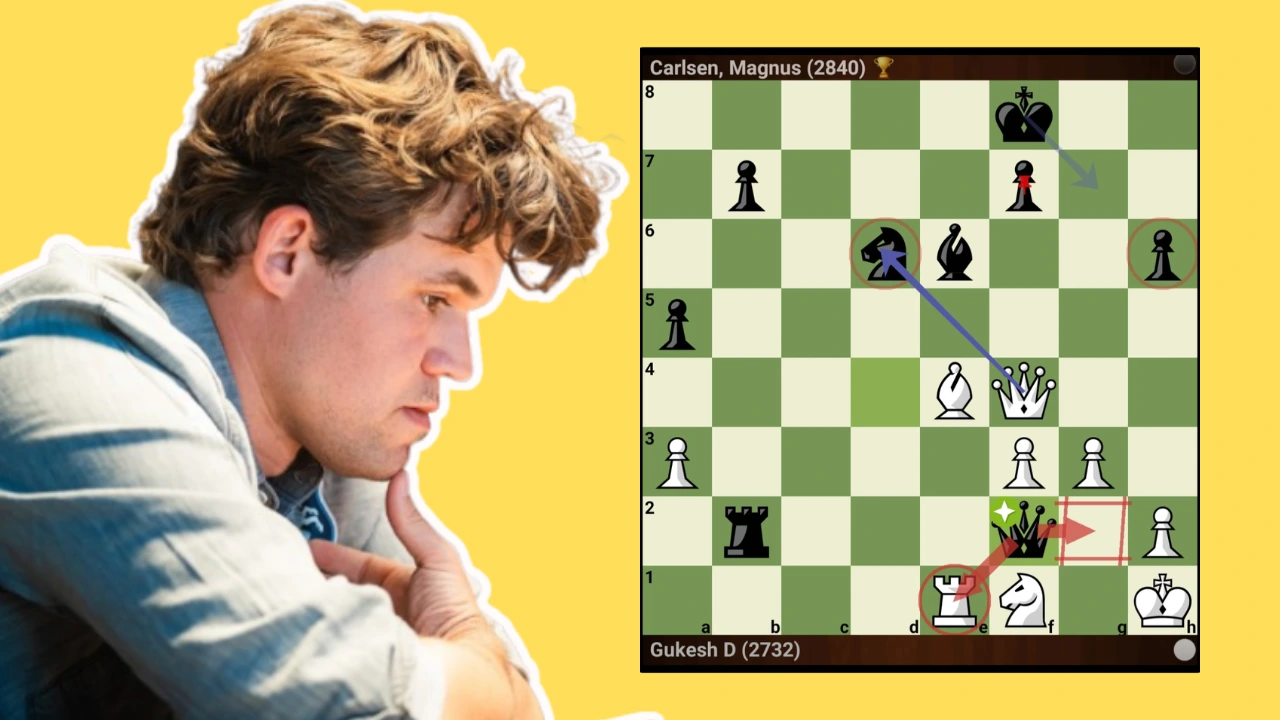
Gukesh vs Carlsen – Norway Chess 2026 Round 7
Norway Chess 2026 delivered another exciting battle when World Champion Gukesh D faced former World Champion Magnus Carlsen in Round 7. Fans around the world were eager to see this clash because both players are known for their deep preparation, fighting spirit, and strong endgame skills.
In this game, Carlsen showed why he is still considered one of the greatest players in chess history. He slowly built pressure, took advantage of small weaknesses, and converted his advantage into a winning position. Gukesh fought hard but eventually could not survive the pressure.
Let us look at the game step by step and understand what happened.
Opening Phase
The game started with:
1.d4 d5 2.c4 e6
This entered the Queen’s Gambit structure, one of the most respected openings in chess.
After:
3.Nc3 Nf6 4.cxd5 exd5 5.Bg5 Bb4
Carlsen chose an active setup. Instead of playing quietly, he immediately developed his bishop to b4 and put pressure on White’s position.
One interesting moment came after:
6.Nf3 Qd6
The queen moved early. This may look unusual, but Carlsen had a clear idea. He wanted flexibility and support for future kingside activity.
Gukesh vs Carlsen | The First Critical Moment
After:
9.Nb5 Qe7 10.Bxf6 gxf6
Gukesh decided to exchange his bishop for the knight.
At first glance, Carlsen’s pawn structure looks damaged because of the doubled pawns on the f-file.
Many club players would think White is better here.
However, Carlsen understood something important.
The open g-file gave Black attacking chances. The doubled pawns also opened lines for the rooks. Sometimes a damaged pawn structure can provide dynamic advantages.
This became one of the key themes of the game.
Carlsen Activates His Pieces
After:
13.Bd3 Rg8
Carlsen immediately placed a rook on the open g-file.
Then came:
14.g3 Bh3
This was a strong move.
The bishop became very active and pointed directly toward White’s king.
Instead of worrying about pawn weaknesses, Carlsen focused on piece activity.
This is one of the biggest lessons from the game.
Active pieces are often more important than perfect pawns.
Gukesh Tries to Fight in the Center
White continued with:
17.c4
This move aimed to challenge Black’s center.
Carlsen responded confidently:
17…dxc4 18.Qxc4 Nd6
Now Black’s pieces started finding excellent squares.
The knight on d6 became powerful and helped control important central squares.
At this point, the position was still balanced, but Carlsen’s pieces looked more comfortable.
The Middlegame Battle
A very important sequence came later:
20…Rg5
21…Rc8
22…c5

Carlsen slowly improved every piece.
This is classic Carlsen style.
Instead of rushing into tactics, he increased pressure little by little.
Many players look for immediate attacks.
Carlsen prefers improving his position first and creating long-term pressure.
Gukesh started spending a lot of time on the clock trying to find accurate moves.
Meanwhile, Carlsen’s position became easier to play.
Time Trouble Begins
Around move 23, the clock became a major factor.
Gukesh had only around twenty minutes left while Carlsen still had much more time.
The position was becoming complicated, and every move required careful calculation.
This is exactly the type of situation where Carlsen is extremely dangerous.
He often keeps pressure on opponents until mistakes appear naturally.
Carlsen Opens the Position
A major turning point happened after:
24…cxd4
25.exd4
Now the center opened.
Open positions usually favor active pieces.
Carlsen’s bishops, rooks, and queen became more dangerous.
Then came:
27…f5
28…f4
These moves showed Carlsen’s attacking intentions.
He pushed his kingside pawns forward and created new threats.
The move f4 was especially strong because it limited White’s defensive options.
Suddenly, Black was the player asking all the questions.
Building Pressure
Carlsen continued with:
29…Qf6
30…Rb5
31…Bb3
These moves looked simple, but they were very powerful.
Every piece entered the attack.
The rook became active.
The bishop improved.
The queen joined the pressure.
This is a textbook example of coordination.
All of Black’s pieces were working together.
White’s pieces, meanwhile, struggled to find active roles.
The Decisive Combination
The biggest breakthrough came after:
32…Rxc1
33.Qxc1 Qxd4+
Carlsen won an important pawn and opened lines against the king.
The check forced White into defensive play.
Now Black clearly had the initiative.
After:
34.Kg2 Be6
Carlsen calmly improved his position again.
He did not rush.
He trusted that the pressure would eventually produce results.
Time Trouble Disaster
One of the most important moments happened on move 35.
Gukesh had less than one minute remaining.
Playing accurately under such conditions is extremely difficult.
He chose:
35.Qxf4
trying to gain activity.
Carlsen immediately responded:
35…Rb2+
Now the attack became very dangerous.
The rook invaded the second rank and created multiple threats.
After:
36.Kh1 Qf2
Black’s queen entered the attack.
Suddenly White’s king was under serious pressure.
Queen Trade and Winning Endgame
The game continued:
37.Qxd6+ Kg7
38.Qe5+ f6
39.Qxb2 Qxb2
The queens were exchanged.
Normally queen exchanges reduce attacking chances.
However, Carlsen entered an endgame where he had the better position and healthier structure.
After:
40…Qxa3
Black won another pawn.
Materially and positionally, Black was now better.
Then came:
42…a4
This move created a dangerous passed pawn.
White’s position became extremely difficult.
At this point, Gukesh resigned because stopping Black’s pawn and defending the remaining weaknesses was nearly impossible.
Why Carlsen Won
Several factors helped Magnus Carlsen win this game.
1. Better Piece Activity
Even with doubled pawns, Carlsen’s pieces were extremely active.
His rook on the g-file and bishop on h3 created constant pressure.
2. Strong Middlegame Planning
Carlsen never rushed.
He slowly improved each piece and waited for the right moment to strike.
3. Excellent Use of Open Lines
The g-file, c-file, and central files became highways for Black’s pieces.
Carlsen used them perfectly.
4. Pressure Under Time Trouble
Gukesh faced difficult decisions with very little time.
Carlsen continued creating problems move after move.
5. Superior Endgame Technique
Once the queens were exchanged, Carlsen smoothly converted his advantage into a winning endgame.
Gukesh vs Carlsen | Key Lessons for Club Players
If you want to improve your chess, this game offers several lessons.
Activity Is More Important Than Pawn Structure
Carlsen accepted doubled pawns but gained active piece play.
Do not judge a position only by pawn weaknesses.
Improve Every Piece
Before launching an attack, make sure all your pieces are participating.
Carlsen followed this rule perfectly.
Use Open Files
Rooks become powerful on open files.
Carlsen’s rook activity was one of the biggest reasons for his victory.
Stay Calm Under Pressure
Carlsen never forced anything.
He trusted his position and waited for opportunities.
Endgames Matter
Many games are won after the queens come off the board.
Studying endgames can greatly improve your results.
Conclusion
Magnus Carlsen’s victory over Gukesh in Norway Chess 2026 Round 7 was a masterclass in strategic chess. The game showed how active pieces, patience, and constant pressure can overcome even the strongest opponents.
Gukesh defended well for a long time, but Carlsen’s experience and precision eventually made the difference. The former world champion slowly increased the pressure, exploited small weaknesses, and converted his advantage with impressive technique.
For chess fans, this game is a perfect example of why Magnus Carlsen remains one of the most feared players in the world. Every move had a purpose, every piece found an ideal square, and the final result was a convincing victory against one of the strongest young players on the planet.
How did Magnus Carlsen manage to win despite having doubled pawns early in the game?
One of the most fascinating aspects of this game was Carlsen’s willingness to accept a damaged pawn structure after 10.Bxf6 gxf6. Many club players immediately view doubled pawns as a weakness, but strong grandmasters often evaluate positions much more deeply.
Carlsen understood that the doubled f-pawns came with important benefits. The move opened the g-file, giving his rook immediate access to an attacking lane. It also created possibilities for active kingside play and allowed his pieces to become more aggressive.
Throughout the game, Carlsen demonstrated that active piece placement can often outweigh structural defects. His rook quickly occupied the g-file, his bishop became active on h3, and his queen and knights found useful squares. While Gukesh may have had a slightly healthier pawn structure, Carlsen’s pieces were simply more effective.
This game is a reminder that chess is not just about pawn weaknesses. Dynamic factors such as activity, initiative, and coordination frequently matter more than static considerations.
Was Gukesh actually worse after the opening?
Not really. The opening phase remained relatively balanced, and there was no obvious tactical mistake from Gukesh. In fact, White’s position was quite playable for a long time.
The challenge was that Carlsen gradually created a position that was easier for Black to handle. Every move seemed natural and improved his pieces. Meanwhile, Gukesh faced increasingly difficult decisions.
Many elite games are not decided by a single blunder. Instead, one player slowly gains comfort while the other is forced to solve a series of problems. That is exactly what happened here.
The computer evaluation may not have shown a large advantage for Carlsen early on, but practical chess is often about which side is easier to play. Carlsen steadily improved his position until the pressure became difficult to resist.
Why was the bishop move to h3 so important?
The move …Bh3 was one of the most instructive moments of the game.
At first glance, it looks like a simple developing move. However, it served several strategic purposes at once. The bishop pointed directly toward White’s king, supported future attacking ideas, and forced Gukesh to constantly consider kingside threats.
The bishop also worked perfectly with the rook on the g-file. Together, these pieces created long-term pressure that never completely disappeared.
Strong players often look for squares where a piece can remain active for many moves. The bishop on h3 became exactly that kind of piece. It was not making an immediate threat, but it continuously influenced the position.
For club players, this is an excellent example of how a well-placed bishop can be more valuable than a bishop that simply follows standard development principles.
What was Carlsen’s overall strategy in the middlegame?
Carlsen’s middlegame plan was remarkably simple but incredibly effective.
Instead of launching a direct attack, he focused on improving every piece one at a time. His rook became active. His bishop found an aggressive square. His knight occupied strong central outposts. His queen remained flexible.
This gradual improvement created a situation where all of Black’s pieces were working together.
Many players become impatient and try to force tactical complications too early. Carlsen did the opposite. He first ensured that every piece was contributing to the position.
Only after achieving maximum coordination did he begin opening the center and creating concrete threats.
This patient approach is one of the defining characteristics of Carlsen’s chess. He often wins not because of spectacular combinations but because his pieces consistently occupy better squares than his opponent’s.
Why did the move …c5 become such an important turning point?
The pawn break …c5 represented a major shift in the game.
Before this moment, the position remained relatively stable. Once Carlsen challenged the center, new lines began to open and tactical possibilities increased.
Opening the position generally favors the side whose pieces are more active. Since Carlsen had already spent many moves improving his pieces, the opening of the center worked in his favor.
This is a common strategic principle. Before opening the position, a player should make sure their pieces are prepared to take advantage of the new opportunities.
Carlsen followed this principle perfectly. When the center opened, his rooks, bishops, and queen immediately became stronger.
Gukesh, on the other hand, had to spend energy dealing with multiple threats at once. The position became significantly more difficult to defend.
How much did time pressure influence the result?
Time pressure played a major role, especially during the later stages of the middlegame.
As the position became more complicated, Gukesh’s clock situation worsened. Difficult decisions had to be made quickly, and every move carried significant consequences.
Carlsen is famous for exploiting exactly these situations. He rarely allows opponents to relax. Instead, he keeps presenting new challenges until the pressure becomes overwhelming.
When a player has only a minute or two remaining, even strong defensive resources can be missed. Accurate calculation becomes harder, and practical mistakes become more likely.
That does not mean the result was solely decided by the clock. Carlsen had already built a strong position. However, the time imbalance made it much easier for him to convert his advantage.
The game illustrates how important clock management is at the highest level of chess.
Why were the moves …f5 and …f4 so powerful?
The pawn advances …f5 and …f4 completely changed the character of the position.
Rather than remaining passive, Carlsen used his kingside pawns as attacking weapons. These advances restricted White’s pieces, gained space, and created new tactical opportunities.
The move …f4 in particular was very uncomfortable for White. It limited defensive possibilities and helped Black seize the initiative.
Strong players often use pawn advances not only to create threats but also to restrict the opponent’s counterplay. Carlsen achieved both goals simultaneously.
Another important point is that these moves were only possible because his pieces were already well placed. Pawn storms are most effective when supported by active pieces.
Without proper preparation, aggressive pawn pushes can create weaknesses. With proper preparation, they can become decisive attacking tools.
What was the significance of the exchange sacrifice sequence involving …Rxc1?
The sequence beginning with …Rxc1 demonstrated Carlsen’s excellent sense of timing.
By exchanging pieces at the right moment, he simplified into a position where his advantages became easier to exploit. The follow-up move …Qxd4+ increased pressure and won material.
Many players focus only on attacking moves, but elite grandmasters constantly look for favorable transitions into endgames.
Carlsen understood that the resulting position would be easier for Black to play. He did not need a brilliant mating attack. He simply needed a position where his activity and structure could be converted into a tangible advantage.
This practical approach is one of the reasons he has been so successful throughout his career.
Could Gukesh have held the endgame after the queen exchange?
Once the queens came off the board, the task became extremely difficult.
Carlsen entered the endgame with multiple advantages. He had active pieces, healthier coordination, and opportunities to create passed pawns. White, meanwhile, faced defensive challenges on several fronts.
The move …Qxa3 further increased Black’s advantage by collecting another pawn. Soon afterward, the advance …a4 created a dangerous passed pawn that demanded constant attention.
While elite players can sometimes save difficult endgames, this particular position offered very few practical chances. Carlsen’s technique in such positions is legendary.
The resignation reflected the reality that Black’s advantages were becoming overwhelming and that stopping the passed pawn while addressing other weaknesses would likely prove impossible.
What does this game reveal about Carlsen’s playing style in 2026?
This game showed that many of the qualities that made Carlsen dominant for more than a decade remain fully intact.
He demonstrated patience, strategic understanding, precise timing, and excellent endgame technique. There was no need for flashy sacrifices or speculative attacks.
Instead, he relied on the fundamentals that have always defined his chess. He improved his pieces, increased pressure, exploited small weaknesses, and converted advantages efficiently.
What stands out most is how natural his moves appeared. None of them seemed extraordinary individually. Yet together they created a position that gradually became impossible for his opponent to manage.
This ability to accumulate tiny advantages remains one of Carlsen’s greatest strengths.
Gukesh vs Carlsen | Norway Chess 2026 | HMFLIX