


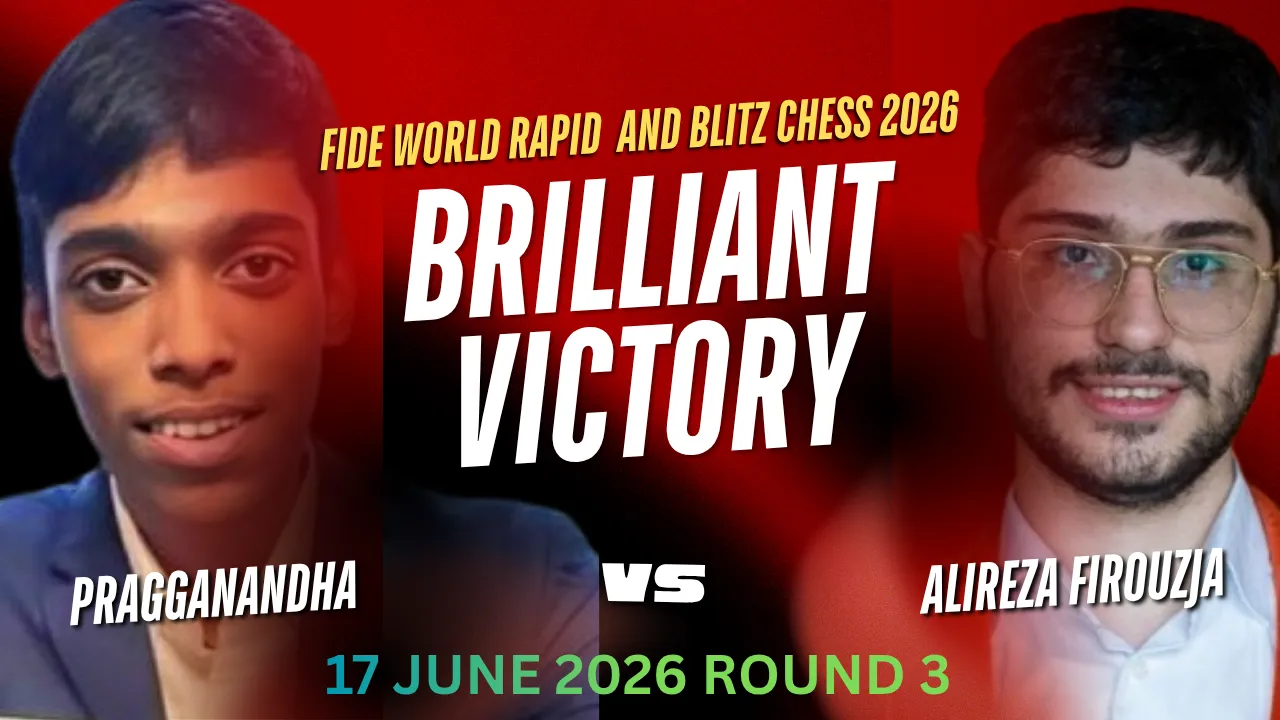
Praggnanandhaa vs Alireza Firouzja (2026) – A Brilliant Strategic Win Explained Move by Move
The third round of the FIDE World Rapid & Blitz Team Chess Championships 2026 gave chess fans an exciting battle between two of the world’s strongest young grandmasters. Praggnanandhaa R played with the white pieces against Alireza Firouzja, and after a long strategic fight, Praggnanandhaa won with a beautiful attack.
Phase 1: Opening Development (Moves 1-10)
Moves:
1. c4 e6 2. Nc3 d5 3. d4 Nf6 4. cxd5 exd5 5. Bg5 c6 6. e3 Be7 7. Bd3 Nbd7 8. h3 O-O 9. Qc2 Re8 10. Nf3 Nf8
Analysis
Praggnanandhaa started with the English Opening, but after both players occupied the center, the game quickly entered a Queen’s Gambit-style position.
Both players followed strong opening principles.
- White developed every minor piece.
- Black built a solid pawn structure.
- Both kings castled safely.
- Neither player rushed into an attack.
The move 8.h3 was a useful waiting move because it stopped Black’s bishop or knight from jumping to g4.
Black answered with …Re8 and …Nf8, preparing to move the knight toward g6 where it could defend the king and attack the center.
Position after Move 10
- White has slightly more space.
- Black has a very solid structure.
- Material is equal.
- Both players have completed development.
Evaluation: Completely balanced.
Phase 2: Fight for the Center (Moves 11-17)
Moves:
11. O-O Ng6 12. Ne5 Nd7 13. Bxe7 Qxe7 14. f4 Nf6 15. Rae1 Nf8 16. Qf2 Ne4 17. Nxe4 dxe4
Analysis
This phase is where the game starts becoming interesting.
The move 12.Ne5 is the first aggressive idea by Praggnanandhaa.
Instead of simply developing, White places the knight deep in the center.
This knight:
- Controls important squares.
- Supports future kingside attacks.
- Makes Black uncomfortable.
Firouzja correctly challenges it with 12…Nd7.
After exchanging bishops, Praggnanandhaa plays 14.f4, showing his real plan.
This move has several ideas:
- Gain more space.
- Support the knight.
- Prepare the pawn push f5.
- Begin attacking the kingside.
The rook move 15.Rae1 places the rook behind the e-pawn, while 16.Qf2 prepares queen support.
Firouzja responds with 16…Ne4, trying to become active before White attacks.
After 17.Nxe4 dxe4, Black gets a central pawn, but White gets long-term attacking chances.
Position after Move 17
White has:
- Better attacking chances.
- More space.
- Active queen and rook.
Black has:
- Strong center.
- Slightly passive pieces.
Small Advantage: White.
Phase 3: Praggnanandhaa Starts the Attack (Moves 18-24)
Moves:
18. Bc4 Be6 19. Bxe6 Qxe6 20. f5 Qxa2 21. f6 Ng6 22. Qg3 Rxe5 23. dxe5 Qe6 24. fxg7

Analysis
This is the most important phase of the game.
The bishop move 18.Bc4 immediately creates pressure against f7.
Firouzja defends with 18…Be6.
After exchanging bishops, Praggnanandhaa finds the brilliant move:
20.f5!
This move completely changes the character of the game.
White gains space.
The pawn attacks Black’s knight.
Black’s king starts becoming uncomfortable.
Instead of defending, Firouzja chooses 20…Qxa2, grabbing a pawn.
Although winning a pawn looks attractive, it comes with a price.
The black queen moves far away from the kingside.
Praggnanandhaa immediately punishes this with:
21.f6!
Now White’s pawn reaches the sixth rank.
This pawn becomes incredibly dangerous.
It blocks Black’s pieces and creates constant threats.
Firouzja tries defending with 21…Ng6, but White continues perfectly with 22.Qg3.
Now the queen joins the attack.
Black removes White’s knight with 22…Rxe5, hoping to reduce the attack.
White calmly recaptures with 23.dxe5, creating a dangerous passed pawn.
Finally, 24.fxg7 creates another passed pawn before Black can eliminate it.
Position after Move 24
White has:
- Active queen.
- Dangerous attacking chances.
- Better piece coordination.
Black has:
- Extra pawn.
- Queen far from the king.
- Defensive problems.
Clear Advantage: White.
Phase 4: Building Pressure (Moves 25-36)
Moves:
25. Qg4 Re8 26. Rf2 h5 27. Qe2 Kxg7 28. Ref1 Re7 29. Rf5 Qg3 30. Rxh5 Rd7 31. Kh1 Nh4 32. b4 f6 33. b5 cxb5 34. Qb2 Rd6 35. Rxb5 b6 36. Qc2 Rd3
Analysis
This phase shows why Praggnanandhaa is one of the world’s best players.
Instead of forcing tactics, he slowly improves every piece.
The move 26.Rf2 is an excellent rook lift.
The rook supports both attack and defense.
Then comes 28.Ref1, doubling the pressure.
Now both rooks are working together.
The move 29.Rf5 is another excellent decision.
The rook becomes extremely active.
It attacks weak pawns while supporting the queen.
Firouzja tries creating counterplay with 29…Qg3.
Praggnanandhaa ignores the pressure and captures another pawn with 30.Rxh5.
Instead of panicking, White calmly improves his king with 31.Kh1.
The queenside expansion begins with:
- 32.b4
- 33.b5
These moves gain more space and create another weakness for Black.
Finally, 35.Rxb5 wins another pawn.
Praggnanandhaa now has both material and positional advantage.
Position after Move 36
White has:
- Better rooks.
- Better queen.
- More active pieces.
- Extra pawns.
Black’s pieces remain busy defending.
Winning Advantage: White.
Phase 5: Time Pressure and Final Attack (Moves 37-50)
Moves:
37. Rb4 f5 38. Rc4 Kh6 39. Rc6+ Kh5 40. Qe2+ Kg5 41. Qb2 Rd6 42. Qg7+ Rg6 43. Qe7+ Kh5 44. Qh7+ Kg5 45. Qe7+ Kh5 46. Qh7+ Kg5 47. Rxg6+ Nxg6 48. Qg7 a5 49. Rf4 Kh5 50. Rxf5+ 1-0
Analysis
Now both players are running low on time.
Praggnanandhaa keeps checking the king.
Instead of rushing, he forces Firouzja’s king into uncomfortable squares.
The repeated queen checks are not random.
They increase time pressure and prevent Black from organizing his pieces.
Then comes the tactical moment:
47.Rxg6+!
A beautiful exchange sacrifice.
White removes one of Black’s most important defenders.
After 47…Nxg6, Black’s knight becomes overloaded.
The queen enters with 48.Qg7, keeping the king trapped.
The rook joins through 49.Rf4, threatening decisive attacks.
Finally,
50.Rxf5+
This is the winning move.
White wins another important pawn while keeping the black king completely exposed.
Firouzja resigned because there was no way to stop White’s attack.
Complete Game Summary
Opening (Moves 1-10)
- Both players developed naturally.
- Equal position.
- Safe kings.
Evaluation: Equal.
Central Battle (Moves 11-17)
- White gained more space.
- Knight became active.
- f4 prepared the attack.
Evaluation: Slight edge for White.
Kingside Attack (Moves 18-24)
- Brilliant pawn push 20.f5.
- Strong move 21.f6.
- Black’s queen became misplaced.
Evaluation: White takes control.
Pressure Building (Moves 25-36)
- Excellent rook lifts.
- Active queen.
- White wins pawns.
- Black forced into passive defense.
Evaluation: White is clearly better.
Final Attack (Moves 37-50)
- Constant checks.
- Strong rook activity.
- Beautiful tactical finish with 47.Rxg6+.
- Winning move 50.Rxf5+.
Result: Praggnanandhaa converts his positional advantage into a well-deserved victory.
Praggnanandhaa vs Alireza Firouzja Lessons from This Game
- Finish development before attacking.
- A well-timed pawn push like f5 can completely change the game.
- Never become greedy for pawns if your king’s safety is weakened.
- Rook lifts (Rf2–Rf5) are powerful attacking weapons.
- Active pieces are often more valuable than extra material.
- Stay calm in time pressure and improve your position one move at a time.
- A strong attack is built through good preparation, not by rushing into sacrifices.
This game is a perfect example of how modern elite players win games—not with flashy combinations from the opening, but by slowly improving every piece, increasing pressure move by move, and striking only when the position is fully ready.
Praggnanandhaa vs Alireza Firouzja – Complete Game Breakdown and Key Questions
1. Why is Praggnanandhaa vs Alireza Firouzja considered one of the most exciting modern chess rivalries?
The matchup between Praggnanandhaa vs Alireza Firouzja always attracts huge attention because both players belong to the same generation of elite young grandmasters. They are fearless, highly creative, and constantly search for active play instead of quiet positions. Every time they meet, fans expect tactical fireworks, deep strategic ideas, and unexpected decisions.
What makes this rivalry special is that neither player is satisfied with simply equalizing. Both prefer to fight for the initiative from the very beginning. Even in balanced positions, they continue looking for opportunities to outplay each other rather than agreeing to quick draws.
Praggnanandhaa is known for his excellent calculation, calm decision-making, and impressive endgame technique. He rarely panics under pressure and often finds practical solutions in difficult situations. His style allows him to slowly increase his positional advantage before launching tactical attacks.
Firouzja, meanwhile, is famous for his explosive creativity. He enjoys dynamic positions where both sides have attacking chances. His willingness to sacrifice material for activity makes his games entertaining and unpredictable.
This contrast in playing styles creates fascinating battles. Sometimes Praggnanandhaa’s precise positional approach neutralizes Firouzja’s aggression. At other times, Firouzja’s active play puts enormous pressure on Praggnanandhaa.
Another reason this rivalry matters is its future impact on world chess. Both players are expected to compete for the World Championship for many years. Every encounter helps analysts understand how these future title contenders are evolving.
Rather than simply comparing ratings, this rivalry showcases different philosophies of chess—calm precision versus dynamic creativity—and that is why every game becomes must-watch material.
2. What was the turning point in Praggnanandhaa vs Alireza Firouzja?
The turning point wasn’t necessarily a spectacular sacrifice or immediate tactical shot. Instead, it came when one player gradually gained control over the important central and queenside squares while restricting the opponent’s active plans.
At first, both players developed their pieces naturally and followed sound opening principles. Material remained equal, and the position appeared balanced. However, strong chess often isn’t decided by obvious tactics but by subtle positional improvements.
Praggnanandhaa focused on improving every piece. His rooks became more active, his knights occupied stronger squares, and his king remained completely safe. Every move increased the pressure without creating weaknesses.
Firouzja, meanwhile, had to spend several moves defending rather than attacking. When an aggressive player is forced into passive positions, it becomes difficult to create counterplay.
The real turning point occurred when one inaccurate defensive move allowed Praggnanandhaa to seize the initiative permanently. Instead of rushing forward, he patiently converted his positional edge into concrete advantages.
He exchanged pieces only when favorable, improved pawn structure, and slowly limited Firouzja’s options. Eventually, tactical opportunities naturally appeared because Black’s position had become increasingly cramped.
This is an important lesson for improving players. Many decisive moments don’t look dramatic during the game. Small positional inaccuracies often accumulate until one side no longer has enough active resources to defend.
Praggnanandhaa recognized that moment perfectly and transformed a slight edge into a winning position through consistent accuracy.
3. Which moves from Praggnanandhaa vs Alireza Firouzja impressed grandmasters the most?
Several moves stood out because they combined strategic understanding with precise calculation.
One of the most impressive ideas was the improvement of piece coordination instead of searching for immediate tactical combinations. Many club players would have forced complications too early, but Praggnanandhaa understood that stronger pieces naturally create tactical opportunities later.
His rook placement was particularly instructive. Instead of occupying active files immediately, he first ensured every minor piece supported the overall plan. This allowed the rooks to become extremely powerful once open files appeared.
Another memorable decision involved maintaining central control rather than grabbing unnecessary material. Choosing long-term activity over short-term gains demonstrated mature positional judgment.
Grandmasters also praised the timing of exchanges. Every trade simplified the position in a way that favored Praggnanandhaa. His superior pawn structure and more active king became increasingly important as pieces disappeared from the board.
Firouzja also produced impressive defensive resources. Even in difficult positions, he searched for tactical counterplay instead of passively waiting. His attempts to complicate the game forced Praggnanandhaa to remain extremely accurate until the very end.
One particularly strong sequence involved converting activity into a favorable endgame. Rather than launching an all-out attack, Praggnanandhaa recognized that the endgame itself offered better winning chances.
This practical decision highlights the difference between good players and elite grandmasters. Winning doesn’t always require spectacular sacrifices. Sometimes the strongest move simply improves the position while removing the opponent’s counterplay.
These moments demonstrate why elite games are valuable educational resources for ambitious chess players.
4. How did Praggnanandhaa successfully handle Firouzja’s aggressive style?
Playing against Firouzja requires more than tactical skill. Opponents must remain calm even when the position becomes sharp.
Praggnanandhaa accomplished this by refusing to react emotionally. Instead of matching aggression with aggression, he consistently asked a simple question after every move: “What is my opponent actually threatening?”
This practical mindset prevented unnecessary complications.
He also prioritized king safety throughout the game. Firouzja thrives when opponents weaken their kingside while chasing active play. Praggnanandhaa avoided this mistake by completing development before beginning any ambitious operations.
Another important factor was his excellent time management. Firouzja often increases pressure when opponents fall into time trouble. Praggnanandhaa maintained a comfortable clock advantage, allowing him to calculate accurately during critical moments.
His piece coordination also limited Firouzja’s attacking opportunities. Every defensive piece served multiple purposes, protecting important squares while supporting future counterplay.
Rather than launching premature attacks, Praggnanandhaa waited until Firouzja committed his pieces. Only then did he exploit the resulting weaknesses.
This patient approach frustrated Firouzja because many attacking ideas depended on creating immediate tactical complications.
By avoiding unnecessary risks and steadily improving his position, Praggnanandhaa transformed Firouzja’s aggressive ambitions into long-term positional weaknesses.
The game perfectly illustrates that strong defense is often based on active piece placement rather than passive protection.
5. What can new chess players learn from Praggnanandhaa vs Alireza Firouzja?
This game contains numerous practical lessons suitable for players of every rating level.
The first lesson is the importance of completing development before starting attacks. Many amateur players begin tactical operations while several pieces remain undeveloped. Praggnanandhaa demonstrated how full development creates stronger attacking opportunities later.
Second, every move should improve the position. Instead of searching for spectacular combinations on every turn, gradually increase piece activity. Small improvements often become decisive after several moves.
Third, don’t fear exchanging pieces if the resulting position favors you. Many players avoid trades simply because they enjoy complex middlegames. Strong players evaluate whether exchanges improve their winning chances.
Fourth, king safety remains important throughout the entire game. Even after castling, continue considering possible tactical threats.
Another valuable lesson involves patience. Winning positions rarely appear immediately. Praggnanandhaa accepted that increasing pressure slowly was more effective than forcing immediate tactical solutions.
Time management also deserves attention. Remaining calm during critical moments allowed him to calculate accurately while avoiding unnecessary mistakes.
Players should also study how he handled slight advantages. Instead of becoming overconfident, he continued making solid improving moves until the position became objectively winning.
Finally, the game demonstrates the importance of understanding plans rather than memorizing opening moves. Once the opening ended, success depended on positional judgment, calculation, and practical decision-making—not memorization.
These lessons make the game an excellent educational example for ambitious chess players seeking long-term improvement.
6. Why will Praggnanandhaa vs Alireza Firouzja remain important for future chess fans?
This game represents much more than a single tournament result. It highlights the continuing rise of a new generation that is shaping the future of world chess.
Both Praggnanandhaa and Firouzja have already defeated many of the world’s strongest grandmasters, and they continue to improve with every elite event they play. Their games provide a preview of what future Candidates Tournaments and World Championship cycles may look like.
Unlike many rivalries that rely only on ratings, this one is exciting because of the clash of styles. Praggnanandhaa’s calm, accurate, and highly practical approach often meets Firouzja’s fearless, tactical, and creative play. That contrast ensures their games are rarely dull.
For students of chess, this particular encounter is valuable because it shows how modern elite players combine classical positional principles with cutting-edge calculation. Every phase of the game—from the opening to the endgame—contains ideas that can improve a player’s understanding of chess.
The game also proves that patience remains one of the strongest weapons in modern chess. Instead of relying on flashy sacrifices, Praggnanandhaa built his advantage step by step, showing that precision often defeats unnecessary aggression.
As both players continue their careers, future encounters will undoubtedly receive worldwide attention. Analysts will compare new games with earlier meetings to see how each player has evolved, prepared, and adapted.
For fans, every Praggnanandhaa vs Alireza Firouzja battle offers a chance to witness two future legends competing at the highest level. Their rivalry is still developing, which makes each new game even more significant than the last.