


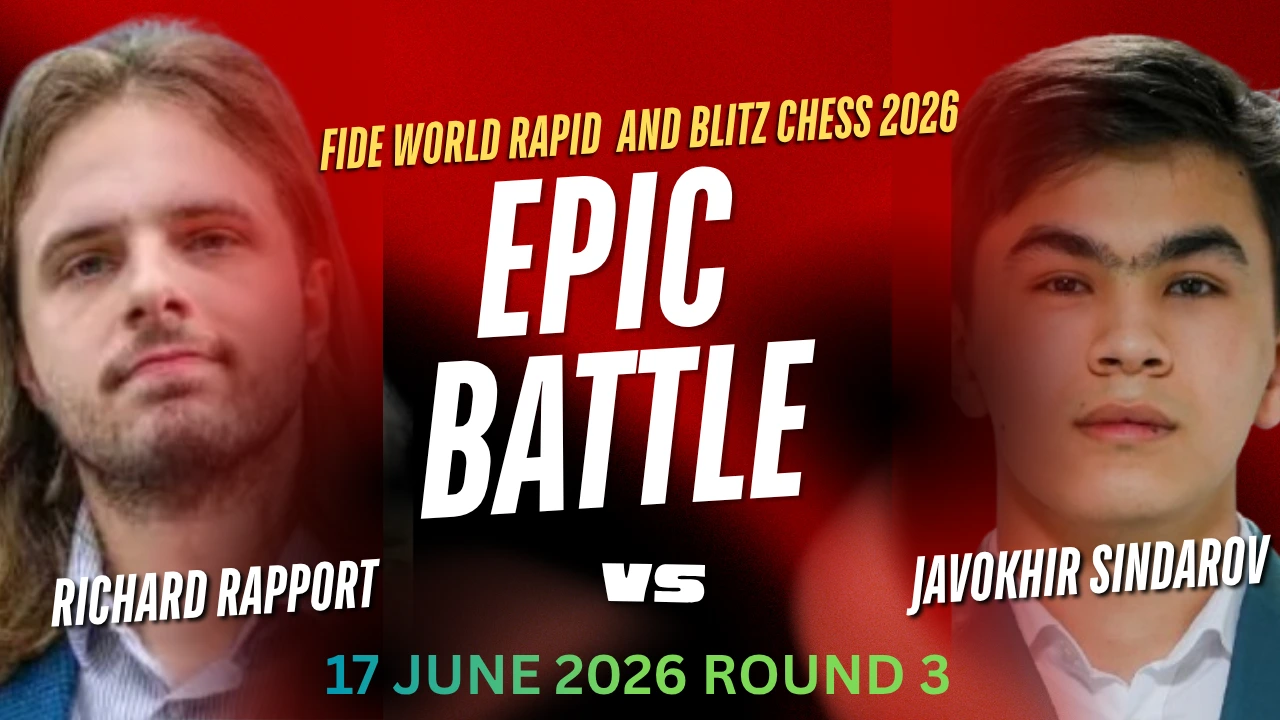
Richard Rapport vs Javokhir Sindarov – Complete Game Analysis (FIDE World Rapid & Blitz Team Chess Championships 2026)
Richard Rapport vs Javokhir Sindarov – A Brilliant Strategic Fight
The third round of the FIDE World Rapid & Blitz Team Chess Championships 2026 gave chess fans a very exciting battle between Richard Rapport and Javokhir Sindarov. Rapport is famous for his creative and fearless style, while Sindarov is known for his sharp calculation and aggressive play.
This game started as a normal Ruy Lopez, but very quickly became a complicated middlegame with attacks on both sides. Rapport slowly took control, survived Black’s active play, and finally converted his extra pawn into a winning endgame.
Let’s understand the entire game in very simple words.
Opening Phase (Moves 1-10)
1. e4 e5
Both players fight for the center.
2. Nf3 Nc6
White attacks the e5 pawn while Black defends it.
3. Bb5
Rapport chooses the famous Ruy Lopez Opening.
Instead of immediately attacking, White develops a bishop and puts pressure on Black’s knight.
3…a6
Black asks the bishop to decide.
4. Bxc6 dxc6
Rapport immediately exchanges the bishop for the knight.
Now Black has doubled c-pawns but also gains the bishop pair.
This is a common idea in the Exchange Variation.
5. O-O
White safely castles.
5…Bg4
Black pins the knight.
6. h3 Bh5
White questions the bishop.
Black keeps the pin.
7. g4
A very aggressive move.
Rapport immediately attacks the bishop.
This move also shows that White wants active play instead of quiet development.
7…Bg6
The bishop safely retreats.
8. Nxe5
Now White wins the e5 pawn because the bishop no longer protects it.
Excellent tactical timing.
8…Bd6
Black immediately attacks the knight.
9. Nxg6 hxg6
Rapport exchanges another bishop.
Black’s pawn structure becomes even weaker.
10. Qf3
White protects the knight and prepares d4.
Opening Summary
- White damaged Black’s pawn structure.
- Black kept the bishop pair.
- White gained a pawn.
- Both sides still had chances.
Rapport slightly preferred.
Early Middlegame (Moves 11-20)
11. d4
White grabs more space.
Now White controls the center.
11…O-O-O
Black castles long.
Now both kings are on opposite wings.
Usually this means both players can attack.
12. Nd2
White develops naturally.
12…f5
Sindarov starts a kingside attack.
He wants to open lines.
13. e5
A very strong move.
White gains space.
The bishop on d6 must move.
13…Be7
The bishop retreats.
14. Nb3
The knight improves its position.
14…Rh4
Very creative.
The rook joins the attack.
Black is preparing sacrifices.
15. gxf5
Rapport opens the position first.
15…gxf5
Black recaptures.
16. Bf4
White develops while attacking important squares.
16…g5
Black keeps attacking.
17. Bg3
The bishop retreats safely.
17…Rxh3
Fantastic exchange sacrifice.
Black sacrifices material to attack White’s king.
This makes the game extremely exciting.
18. e6
Instead of defending, Rapport counterattacks.
Excellent practical decision.
18…Qxe6
Black removes the dangerous pawn.
19. Rfe1
White develops with tempo.
The queen becomes uncomfortable.
19…Qd5
Black offers queen exchange.
20. Qxd5 cxd5
Queens leave the board.
The attack becomes smaller.
Middlegame Summary
This phase completely changed the game.
Black gave material for activity.
White stayed calm.
After queens disappeared, White’s extra pawn became more important.
Positional Battle (Moves 21-31)
21. Be5
Excellent bishop placement.
White controls important diagonals.
21…Rh7
The rook comes back.
22. Kg2

King becomes safer.
22…Nf6
Black develops.
23. Bxf6
Rapport exchanges an active piece.
23…Bxf6
Black recaptures.
24. Re6
Very active rook.
It attacks several weaknesses.
24…Rf8
Black activates the rook.
25. Rae1
Both White rooks now dominate the board.
Excellent coordination.
26. c3
White protects important squares.
26…g4
Black still searches for counterplay.
27. Nc1
The knight starts improving.
27…f4
Black creates a passed pawn.
However, Black is now extremely short on time.
28. Re8+
White forces exchanges.
28…Rxe8
29. Rxe8+
Only one rook remains.
29…Kd7
King centralizes.
30. Rg8
White attacks the g-pawn.
30…Rg7
Black defends.
31. Rxg7+
White exchanges rooks.
31…Bxg7
Now only minor pieces remain.
Position after Move 31
White has a healthier pawn structure.
Black has activity but fewer long-term chances.
The game slowly enters an endgame.
Endgame Begins (Moves 32-40)
32. Nd3
Excellent knight centralization.
32…g3
Black pushes the passed pawn.
33. Nxf4
White wins another pawn.
Very important.
33…gxf2
Black creates a dangerous passed pawn.
34. Nxd5
Rapport immediately wins another pawn.
Now White has clear material advantage.
34…Bh6
Black activates the bishop.
35. Kxf2
White finally removes the dangerous pawn.
Now White has complete control.
35…Bc1
The bishop attacks queenside pawns.
36. b3
Everything stays protected.
36…Bb2
The bishop becomes active.
37. Ke3
The king enters the center.
Very important in endgames.
37…Kd6
Black’s king also improves.
38. Nf6
Knight becomes active.
38…Bc1+
Check.
39. Kd3
King calmly steps away.
39…Bh6
Black keeps trying.
40. Ng4
Knight attacks again.
White slowly improves every piece.
Endgame Summary
Rapport never rushed.
Instead of searching for quick tactics, he slowly improved every piece.
This is excellent endgame technique.
Long Endgame Grind (Moves 41-52)
The next part of the game was all about patience.
White’s knight kept jumping between strong squares.
The king slowly walked forward.
Black’s bishop tried to stop White, but White always found better squares.
Important moments:
- White fixed Black’s pawns.
- White king became stronger.
- Knight controlled many important squares.
- Black could only defend.
By move 50, White’s king was completely active.
This was the biggest difference between the two players.
Final Winning Plan (Moves 53-68)
53. d5+
The passed pawn starts moving.
This becomes White’s biggest weapon.
54…axb5
Black opens the queenside.
55. c5
Another passed pawn appears.
Now Black must stop two pawns.
56. Ne4
Knight supports both pawns.
Excellent coordination.
57. Kd4
King comes closer.
58. Kd3
Small improvement.
Rapport never allows counterplay.
59. Nc3
Knight attacks from another direction.
60. Ne2
Preparing better squares.
61. Nd4
Knight dominates the center.
62. Nc6
Another powerful outpost.
63. Ke4
King supports the pawns.
64. Kf5
King becomes extremely active.
65. Ke6
White’s king invades.
Now Black’s pieces become passive.
66. Na5+
Knight gives check.
Black’s king is pushed backward.
67. Kd7
The king supports the passed pawn.
Now the d-pawn becomes unstoppable.
67…Bd2
Last attempt.
68. d6
The passed pawn reaches the sixth rank.
Promotion is coming.
Black has no way to stop it without losing everything.
Sindarov resigned.
White wins.
Why Richard Rapport Won This Game
Rapport did many small things better than his opponent.
1. Excellent Opening Choice
He damaged Black’s pawn structure very early.
This weakness remained until the end.
2. Calm Under Pressure
When Black sacrificed the exchange and attacked, Rapport never panicked.
He simply developed his pieces and exchanged queens.
3. Better Endgame
Rapport’s king became much stronger.
His knight found excellent squares.
Black’s bishop never became truly dangerous.
4. Strong Passed Pawns
The d-pawn and c-pawn slowly became unstoppable.
Black eventually ran out of defensive resources.
Key Turning Points
Move 8 – Nxe5
White safely won a pawn.
Move 17…Rxh3
Sindarov sacrificed material for attack.
Very ambitious but risky.
Move 20 – Queen Exchange
Once queens disappeared, Black’s attack almost ended.
White’s extra pawn became much more valuable.
Move 33 – Nxf4
Rapport won another important pawn.
This gave him a clear material advantage.
Move 53 – d5+
White’s passed pawn started the winning march.
Move 68 – d6
The final winning move.
Promotion could not be stopped.
Black resigned.
Lessons Every Chess Player Can Learn
- Do not panic when your opponent attacks. Sometimes calm defense is the best answer.
- Pawn structure matters. Black’s doubled pawns became a long-term weakness.
- Exchange queens if your opponent’s attack depends on them.
- Activate your king in the endgame as early as possible.
- Knights become very powerful when they reach central squares.
- Passed pawns often decide endgames more than tactical tricks.
- Improve your pieces one by one instead of rushing.
- Patience is one of the strongest weapons in chess.
Richard Rapport vs Javokhir Sindarov
1. Why was Richard Rapport vs Javokhir Sindarov one of the most exciting games of the FIDE World Rapid & Blitz Team Chess Championships 2026?
The Richard Rapport vs Javokhir Sindarov game stood out because it featured everything chess fans love—creative opening ideas, an aggressive exchange sacrifice, complex middlegame tactics, and a beautifully played endgame. Instead of following quiet positional play, both grandmasters immediately entered a sharp battle where every move carried important strategic ideas.
Richard Rapport chose the Exchange Variation of the Ruy Lopez, but the game quickly became unique after he expanded with h3 and g4. These aggressive pawn moves showed that Rapport was ready to fight from the very beginning instead of settling for a slow positional game.
Javokhir Sindarov responded actively by developing quickly and launching a kingside attack with …f5 and …Rh4. The biggest surprise came when Sindarov sacrificed the exchange with 17…Rxh3, hoping to expose White’s king and create dangerous attacking chances.
Many players would panic after such a sacrifice, but Rapport stayed calm. Instead of trying to defend every threat, he looked for active counterplay by pushing his central pawn with 18.e6. This move forced Black to spend time stopping White’s passed pawn rather than continuing the attack.
Another reason the Richard Rapport vs Javokhir Sindarov game became memorable was the excellent transition into the endgame. Once the queens were exchanged, Rapport understood that Black’s attacking chances had decreased significantly. From that point onward, he focused on improving his king, activating his knight, and targeting Black’s weak pawn structure.
The final phase of the game demonstrated outstanding endgame technique. Rapport patiently improved every piece instead of rushing. His king invaded the center, his knight dominated important squares, and his passed pawn eventually became unstoppable.
This combination of tactical creativity and strategic precision makes Richard Rapport vs Javokhir Sindarov one of the finest rapid games of the tournament.
2. What was the biggest turning point in Richard Rapport vs Javokhir Sindarov?
Several important moments appeared during Richard Rapport vs Javokhir Sindarov, but the biggest turning point was Black’s exchange sacrifice with 17…Rxh3 followed by White’s energetic response 18.e6.
Sindarov sacrificed material because he believed White’s king would become vulnerable. This was a practical decision in a rapid game since active attacks often create mistakes under time pressure.
However, Rapport immediately understood that defending passively would only increase Black’s attacking chances. Instead, he struck back in the center.
The move 18.e6 forced Black’s queen into defensive duties. Instead of continuing the attack freely, Black had to spend valuable time capturing the dangerous pawn.
The next critical moment came after 20.Qxd5 cxd5, when both queens were exchanged.
This queen exchange completely changed the evaluation of the position.
Before the queens disappeared, Black still had attacking opportunities.
After the queens came off, White’s safer king and healthier pawn structure became much more important than Black’s temporary activity.
Rapport then slowly increased his advantage by activating both rooks, centralizing his knight, and improving his king.
By the time the game reached the pure minor-piece endgame, Black no longer had enough compensation for the sacrificed exchange. Rapport converted his advantage with excellent technique.
Without these two moments—the active pawn push 18.e6 and the queen exchange on move 20—the result of Richard Rapport vs Javokhir Sindarov could have been very different.
3. Why did Richard Rapport push his kingside pawns so early in Richard Rapport vs Javokhir Sindarov?
One of the most surprising moments in Richard Rapport vs Javokhir Sindarov was White’s aggressive pawn expansion with 6.h3 and 7.g4.
At first glance, these moves look risky because they weaken White’s king. However, Rapport understood the position very well.
The bishop on g4 was pinning White’s knight, making it difficult to play freely. Instead of accepting the pin, Rapport immediately questioned the bishop.
After 6…Bh5, White continued with 7.g4, forcing the bishop away.
This aggressive pawn advance achieved several important goals.
First, it removed Black’s active bishop.
Second, it created the tactical opportunity for 8.Nxe5, allowing White to win a central pawn.
Third, it gained space on the kingside and limited Black’s future bishop activity.
Although White’s king looked slightly exposed, Rapport calculated that Black would not have enough time to launch a dangerous attack before White completed development.
This decision perfectly reflects Rapport’s creative playing style.
He often accepts small positional weaknesses if they allow him to seize the initiative and create practical problems for his opponent.
In Richard Rapport vs Javokhir Sindarov, this strategy worked perfectly because White maintained active piece play throughout the middlegame.
4. How did Richard Rapport convert his advantage in the endgame against Javokhir Sindarov?
The endgame of Richard Rapport vs Javokhir Sindarov is an excellent lesson in technique.
Many players know how to gain an advantage but struggle to finish the game. Rapport showed exactly how strong grandmasters convert small advantages into full points.
The first step was eliminating Black’s active counterplay.
Instead of chasing immediate tactics, Rapport exchanged queens and later exchanged one pair of rooks.
Once Black’s attacking chances disappeared, White’s healthier pawn structure became more valuable.
Rapport then centralized his king.
Unlike beginners, who often leave the king inactive, Rapport immediately brought his king toward the center, where it became an attacking piece.
His knight also played a huge role.
The knight repeatedly moved between strong central squares, attacking weak pawns while preventing Black’s king from becoming active.
Another important factor was patience.
Rapport never rushed to push his passed pawn.
Instead, he first improved every piece until the position was completely under control.
Only then did he begin advancing the d-pawn.
By move 68, the pawn had reached the sixth rank and promotion was unavoidable.
The endgame in Richard Rapport vs Javokhir Sindarov teaches that accurate piece placement is often more important than immediate pawn advances.
5. What lessons can club players learn from Richard Rapport vs Javokhir Sindarov?
The Richard Rapport vs Javokhir Sindarov game contains valuable lessons for players of every rating level.
The first lesson is to stay calm when your opponent attacks.
Sindarov sacrificed material and launched a dangerous attack, but Rapport never panicked.
Instead of reacting emotionally, he searched for active counterplay.
The second lesson is the importance of central control.
Rapport constantly used his central pawns to limit Black’s pieces.
Moves like e5 and e6 were not just pawn pushes—they changed the entire nature of the position.
The third lesson is understanding when to exchange queens.
Many players avoid queen exchanges because they enjoy attacking positions.
Rapport recognized that exchanging queens would reduce Black’s compensation and increase the value of his extra material.
The fourth lesson is king activity.
During the endgame, Rapport’s king became one of his strongest pieces.
The fifth lesson is patience.
Winning positions are often lost because players rush.
Rapport improved every piece first and only pushed his passed pawn after everything was perfectly prepared.
These practical ideas make Richard Rapport vs Javokhir Sindarov an excellent educational game for improving tournament players.
6. Why did Javokhir Sindarov lose despite creating strong attacking chances?
At several moments in Richard Rapport vs Javokhir Sindarov, Black appeared to have dangerous attacking opportunities.
The exchange sacrifice with 17…Rxh3 created practical pressure and forced White to calculate accurately.
However, creating threats is not always enough.
One reason Sindarov’s attack failed was that White found active defensive resources instead of passive ones.
Rapport’s move 18.e6 immediately shifted the focus back to Black’s position.
Another reason was the queen exchange.
Without queens on the board, Black’s attacking potential decreased dramatically.
Sindarov also entered severe time trouble during the critical phase of the game.
Rapid chess rewards practical decisions, but time pressure makes it difficult to find the most accurate continuations.
As the game entered the endgame, Black’s pawn weaknesses became increasingly difficult to defend.
Rapport slowly collected these weaknesses while keeping complete control of the position.
In the end, Sindarov’s active play was not enough to compensate for his long-term structural problems.
That is why Richard Rapport vs Javokhir Sindarov ended with a technically impressive victory for White.
Final Thoughts
Richard Rapport showed why he is one of the most creative grandmasters in the world. Instead of looking for flashy tactics throughout the game, he combined creativity with excellent positional understanding. Even after Sindarov launched an aggressive exchange sacrifice and created dangerous attacking chances, Rapport stayed calm, exchanged queens at the right moment, and slowly converted his small advantages.
The endgame was a masterclass in technique. Rapport activated his king, improved his knight step by step, collected weak pawns, and finally pushed his passed d-pawn all the way to the sixth rank, leaving Black with no defense. This game is an excellent example of how patience, accurate calculation, and strong endgame skills can defeat even the most active attacking ideas. Every club player can learn valuable lessons from this impressive victory.