


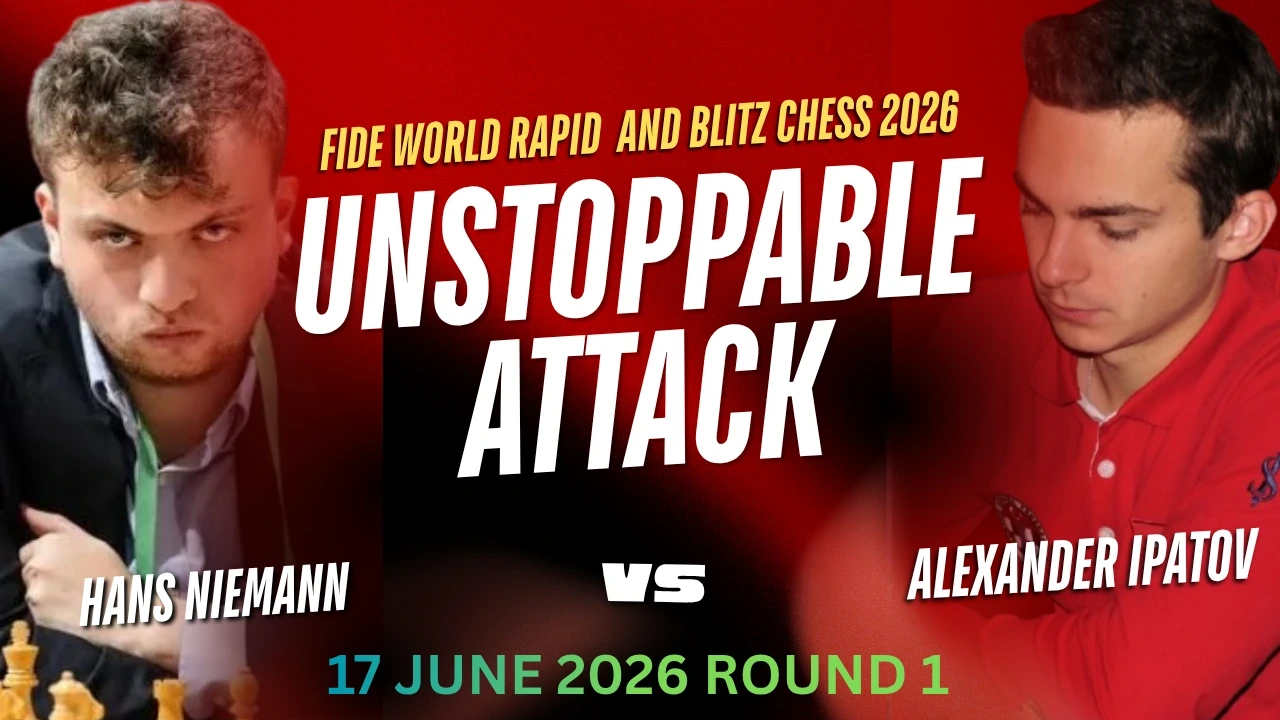
Hans Niemann vs Alexander Ipatov –FIDE World Rapid & Blitz Team Chess Championships 2026
Introduction
Hans Niemann played a fantastic positional game against Alexander Ipatov in the first round of the FIDE World Rapid & Blitz Team Chess Championships 2026. Instead of launching an early attack, Niemann slowly improved every piece, gained more space, and waited for the perfect moment to strike.
This game teaches an important lesson: you do not always need brilliant sacrifices to win. Sometimes patience, better planning, and small improvements are enough to create a winning position.
Let’s understand the entire game in very simple words.
Opening: A Quiet Start
1.e4 c6 2.Nf3 g6 3.d4 Na6
Black chose an unusual setup instead of the normal Caro-Kann ideas. The knight moved to a6 before returning toward the center.
Hans simply developed his pieces without trying anything risky.
After:
- h3
- Nc3
- Bd3
- O-O
White completed development safely.
Meanwhile Black developed with:
- Bg7
- d6
- Nh6
- O-O
Both players were still preparing their armies.
White Pushes Forward
8.e5
This was the first important moment.
Instead of waiting, Hans pushed his e-pawn.
Why?
Because this move gains space and makes Black’s pieces less comfortable.
Black answered calmly with normal development.
Soon the position became:
- White had more space.
- Black had a solid structure.
- Neither side had weaknesses yet.
The Middle Game Begins
After
9.Qe2
10.Rd1
11.Rxd3
White accepted doubled rooks on the d-file after exchanging bishops.
This actually helped White.
The rook became active on d3 and later moved wherever needed.
Black answered with:
11…d5
Now Black built a strong pawn center.
At first glance everything looked equal.
Black Tries Counterplay
Moves like
- f6
- Nf7
- Ne6
- f5
showed Black wanted to attack White’s center.
This is a common strategy.
Instead of sitting back, Black tried to challenge White’s space advantage.
Hans did not panic.
He simply improved his pieces.
White Slowly Improves Every Piece
Look at White’s moves:

- Bf4
- Bh2
- Nd2
- Qf1
- f3
None of them look spectacular.
But every move has a purpose.
The bishop stayed safe.
The knight prepared better squares.
The queen protected important points.
The pawn on f3 supported the center.
This is excellent positional chess.
Hans Niemann vs Alexander Ipatov | Black Starts an Attack
Black played
17…Nfg5
followed by
18…f4
Now Black tried to attack White’s king.
The kingside became tense.
Instead of rushing into tactics, Hans calmly defended.
He played
- Ne2
- Rb3
- Kh1
Everything remained under control.
Sometimes the best defense is simply staying organized.
A Long Queen Battle
Something interesting happened.
Black’s queen moved several times:
- Qa6
- Qb5
- Qa6
- Qb6
- Qc7
White answered with
- Rb3
- Ra3
- Rb3
- Ra3
At first this looks like both players wasted time.
Actually they were waiting.
Neither player wanted to make the first mistake.
This is common in high-level chess.
Sometimes improving your position is better than forcing action.
White Opens the Position
Finally Hans decided it was time.
25.c4
This move challenged Black’s center.
Later came
30.cxd5
Now the position opened.
Open positions usually reward active pieces.
White’s pieces were already well placed.
Black’s pieces became slightly passive.
That small difference became very important later.
Knight Finds a Great Square
After
31.Nc5
White’s knight became extremely active.
The knight attacked many important squares.
Black pushed
31…b6
forcing the knight away.
Hans calmly moved it to
32.Na6
Again the knight remained active.
Strong knights often win games without making flashy moves.
Queenside Expansion
Hans played
34.b4
This gained more space.
Black replied
34…b5
trying to stop White.
Both sides now had fixed pawn structures.
That meant piece activity became even more important.
White’s pieces were clearly better placed.
Hans Niemann vs Alexander Ipatov | Black Starts Running Out of Time
Around move 35, Black had only about one minute left.
Rapid chess becomes extremely difficult with so little time.
Hans still had several minutes.
This time advantage helped him calculate more accurately.
The Brilliant Breakthrough
The biggest turning point arrived.
40.e6!
This is the move that changed everything.
Instead of keeping the pawn back, Hans pushed it deep into enemy territory.
Now Black faced several threats.
The pawn disturbed every Black piece.
It also opened new attacking lines.
A passed pawn can become stronger than a piece.
This move perfectly demonstrates that idea.
Excellent Tactical Play
After
41.Re5
White increased pressure.
Then came
42.Rxf5!
This exchange sacrifice removed an important defender.
Although White gave up material for a moment, the attack became much stronger.
Black’s king started losing protection.
White’s active pieces became far more valuable than material.
The Passed Pawn Decides the Game
After
45.Nd7
White’s knight jumped into a powerful square.
Black captured it.
But this allowed
46.exd7
Now White’s passed pawn reached the seventh rank.
This pawn became incredibly dangerous.
Black could no longer stop every threat.
The pawn forced Black’s pieces into passive defense.
White Opens Black’s King
Hans continued perfectly.
He played
- g3
- gxf4
These moves opened more lines.
Every open file made Black’s king less safe.
Meanwhile White’s bishops and rooks became increasingly active.
This is how strong players attack:
First improve the pieces.
Then open lines.
Only then launch the final attack.
Winning the Queen Exchange
A critical moment arrived.
49.Qxf5
White won an important pawn.
Soon after
50.Qe5+
the king came under pressure.
Then
51.f5
created another dangerous passed pawn.
Black tried defending.
But White’s attack was already too strong.
Eventually
52.Qxf6
forced a queen exchange.
Normally exchanging queens reduces attacks.
Here it actually helped White because the ending clearly favored him.
The Winning Endgame
After the queens disappeared, Hans entered an excellent endgame.
White’s advantages were:
- Better king activity
- More active bishop
- Dangerous passed pawn
- Better piece coordination
Black’s king had to defend too many weaknesses.
White slowly improved every move.
Hans Niemann vs Alexander Ipatov | The Final Blow
The finishing sequence was beautiful.
56.Ng4+
forced Black’s king forward.
Then
57.f6
created another unstoppable passed pawn.
Now Black’s king could not stop both White’s pieces and the advancing pawn.
After
58.Re2
Black resigned.
There was simply no good defense left.
White would promote the pawn or win more material.
The game was over.
What We Can Learn From This Game
Hans Niemann showed that patience is often stronger than rushing into an attack.
Some important lessons include:
Develop First
White completed development before starting any attack.
Gain Space
The move e5 gave White more room to maneuver.
Improve Every Piece
Many quiet moves like Bh2, Qf1, and Nd2 made White’s position stronger without creating risks.
Wait for the Right Moment
Hans did not attack immediately.
He waited until every piece was ready.
Passed Pawns Are Powerful
The pawn on e6 completely changed the game.
Later the pawn on d7 became even stronger.
Activity Beats Material
The exchange sacrifice on f5 showed that active pieces can be more valuable than material.
Stay Calm Under Pressure
Even when Black attacked on the kingside, White never panicked.
Good defense often leads to good attack.
Hans Niemann vs Alexander Ipatov | Best Moves of the Game
8.e5
White gains space and takes control of the center.
25.c4
The perfect pawn break that challenges Black’s structure.
31.Nc5
The knight becomes extremely active and controls many key squares.
40.e6!
The strongest move of the game. The passed pawn creates constant problems for Black.
42.Rxf5!
Excellent tactical decision that increases White’s attacking chances.
45.Nd7!
A powerful knight move that helps create the dangerous passed pawn.
57.f6!
The final passed pawn that seals the victory.
Hans Niemann vs Alexander Ipatov (FIDE World Rapid & Blitz Team Chess Championships 2026)
Why was 8.e5 the first important move in Hans Niemann’s victory?
The move 8.e5 was the first moment when Hans Niemann clearly showed his long-term plan. Instead of exchanging pieces or playing quietly, he advanced the e-pawn to gain more space in the center. More space means your pieces have more freedom, while your opponent’s pieces have fewer comfortable squares.
This move also limited Black’s natural counterplay. Although Alexander Ipatov had a solid position, his pieces now had less room to develop actively. White did not win material with 8.e5, but he won something equally valuable—control of the board.
Another important point is that Niemann didn’t follow up with a direct attack. Many players push a pawn forward and immediately start attacking. Instead, he patiently improved every piece over the next several moves. That shows this wasn’t an emotional decision but part of a well-prepared strategy.
The move also helped White prepare future ideas like f3, Ne2, and c4 without worrying about losing central control. As the game progressed, this extra space became one of the biggest reasons White could slowly increase the pressure.
For club players, this move teaches that gaining space can often be more valuable than looking for immediate tactics. A good positional advantage often creates tactical opportunities later.
Why did Hans Niemann keep moving his rook between b3 and a3 instead of attacking?
Many viewers were surprised to see White’s rook move from Rb3 to Ra3 and back again. At first glance, these moves seem like a waste of time, but they actually served an important purpose.
During this stage of the game, neither player had a clear breakthrough. Instead of forcing an attack that might fail, Niemann waited patiently while keeping his rook flexible. The rook was ready to defend either side of the board and could quickly support future pawn breaks.
The rook also prevented Black from creating active counterplay. Every time Black shifted the queen, White simply adjusted the rook and maintained complete control of the position.
Another hidden idea was psychological. In rapid chess, repeated maneuvering forces the opponent to keep finding accurate moves while the clock continues to run. Alexander Ipatov’s time gradually dropped, increasing the chances of mistakes later.
This sequence also demonstrates that strong players don’t always make aggressive moves. Sometimes the best strategy is simply to improve your position while waiting for your opponent to weaken theirs.
The rook moves may not look exciting, but they show excellent positional understanding and patience.
Why was 40.e6 considered the turning point of the entire game?
The move 40.e6! completely changed the character of the position.
Until this point, White had only a small positional advantage. Black’s pieces were still defending reasonably well. But once the pawn advanced to e6, everything became much harder for Black.
The advanced pawn disrupted Black’s coordination. Pieces that wanted to attack suddenly had to defend. The pawn also threatened to move deeper into Black’s position, creating constant tactical ideas.
Passed pawns become stronger the closer they get to promotion. This pawn reached the sixth rank, where it controlled important squares and restricted Black’s movement.
Even though White did not immediately win material, the pawn forced Black into passive defense. Every move now had to consider the danger of the advancing pawn.
Strong grandmasters often create winning chances through pawn activity instead of direct attacks. Niemann recognized the perfect moment to push forward because his pieces were already well placed.
This single move transformed a small positional edge into a nearly winning position.
Why did Hans Niemann sacrifice the exchange with 42.Rxf5?
The move 42.Rxf5 was one of the most impressive decisions in the game.
Normally, players are taught not to give up a rook for a minor piece without good reason. However, chess is about the value of the position, not just the value of the pieces.
By capturing on f5, White removed one of Black’s key defenders. This opened important lines toward Black’s king and increased the activity of White’s remaining pieces.
The sacrifice also worked perfectly because White already had dangerous passed pawns. Black could not simply focus on material because the pawns were becoming stronger every move.
Another reason the sacrifice succeeded was White’s excellent piece coordination. Every White piece supported the attack, while Black’s pieces struggled to defend multiple threats at once.
If White’s pieces had been poorly placed, the sacrifice would probably have failed. But because Niemann prepared everything carefully beforehand, the exchange sacrifice became completely justified.
This moment teaches an important lesson: sacrifices should usually come after good preparation, not before it.
How did Alexander Ipatov’s time trouble affect the game?
Rapid chess is not only about finding strong moves but also about finding them quickly.
Around move 35, Alexander Ipatov had less than two minutes remaining, while Hans Niemann still had significantly more time.
This difference affected the quality of Black’s decisions. Complex positions require careful calculation, and with only seconds available, even grandmasters struggle to find the best defensive ideas.
Instead of looking for active counterplay, Black often chose safe moves simply because they were easier to calculate. White used this situation perfectly by gradually increasing the complexity of the position.
The pawn push 40.e6 and the tactical exchange sacrifice that followed became especially difficult to defend under time pressure.
However, it would be unfair to say the result happened only because of the clock. Niemann had already built a superior position before Black entered severe time trouble.
The clock simply made it even harder for Black to solve the difficult problems White had created.
This game reminds players that good time management is just as important as strong opening preparation.
Why was the passed pawn stronger than Black’s active pieces?
One of the biggest lessons from this game is the incredible power of passed pawns.
After White’s pawn reached the sixth and later the seventh rank, it became the center of the entire battle.
A passed pawn forces the opponent to constantly think about promotion. Even if promotion is still several moves away, the threat changes how every piece can move.
Black’s bishops, rooks, and queen all had to spend valuable time stopping the pawn instead of creating attacks.
Meanwhile, White’s remaining pieces gained freedom because the pawn was doing much of the attacking by itself.
This is why experienced players often describe an advanced passed pawn as being almost equal to an extra piece.
Niemann recognized this perfectly. Instead of rushing to win material, he supported the pawn and allowed it to create problems naturally.
Eventually, Black’s entire position collapsed because too many pieces were tied down defending against promotion threats.
For improving players, this game is an excellent example of why creating and supporting passed pawns should always be a major strategic goal.
What was the biggest mistake Alexander Ipatov made during the game?
There was no single blunder that immediately lost the game.
Instead, Black slowly drifted into a passive position.
One important issue was allowing White to keep the space advantage for too long. White improved every piece while Black mostly reacted instead of creating active counterplay.
Another problem came after White established the powerful passed pawn. Instead of finding active play elsewhere on the board, Black became tied to defensive duties.
As the game continued, Black’s pieces became increasingly restricted. Even though the position remained playable for several moves, White controlled the pace of the game.
Time pressure made this even worse. With only seconds remaining, finding the best defensive resources became extremely difficult.
The biggest lesson from Black’s play is that passive defense often allows a strong opponent to improve without interruption.
Against players of Niemann’s strength, giving them unlimited time to improve their position usually leads to defeat.
What can new chess players learn from Hans Niemann’s strategy in this game?
This game is full of practical lessons that every club player can use.
The first lesson is patience. Niemann did not try to win in the opening. Instead, he slowly built a better position before looking for tactical opportunities.
The second lesson is improving every piece. Quiet moves such as Bh2, Qf1, and Ne2 may not impress spectators, but they made White’s position stronger with every move.
The third lesson is understanding pawn structure. White waited until the right moment before playing c4 and later e6. Those pawn breaks worked because every piece was already prepared to support them.
Another important lesson is not fearing long games. Many players become impatient if nothing dramatic happens after twenty moves. Niemann remained calm, knowing that small advantages often become decisive later.
Finally, this game teaches the importance of coordination. Every White piece worked together toward one clear goal. Because the pieces supported each other perfectly, tactical opportunities appeared naturally.
Players below 2000 rating can improve significantly by studying games like this, where strategy and planning matter more than memorizing long opening variations.
Why is this game considered one of Hans Niemann’s best positional wins in rapid chess?
This victory stands out because it was built almost entirely on positional understanding rather than flashy combinations.
From the opening onward, Niemann consistently made practical decisions. He gained space, improved his pieces, controlled important squares, and patiently waited for the right moment to strike.
There was never a desperate attack or an unsound sacrifice. Every tactical idea grew naturally from White’s superior position.
The move 40.e6 showed outstanding timing, while the exchange sacrifice on f5 demonstrated deep calculation and confidence.
Perhaps the most impressive part was how White converted a small advantage into a completely winning endgame. Many players gain an edge but fail to finish the game. Niemann never allowed Black to escape.
The game also highlights excellent psychological control. Even when Black looked active, White never became nervous or abandoned the long-term plan.
For coaches and advanced students, this game is an excellent example of modern positional chess. It shows how accurate planning, patient maneuvering, active piece coordination, and well-timed pawn breaks can defeat even a very strong grandmaster without needing spectacular opening preparation.
That is why many chess fans consider Hans Niemann’s performance against Alexander Ipatov one of the finest strategic victories from the FIDE World Rapid & Blitz Team Chess Championships 2026.
Hans Niemann vs Alexander Ipatov | HMFLIX