


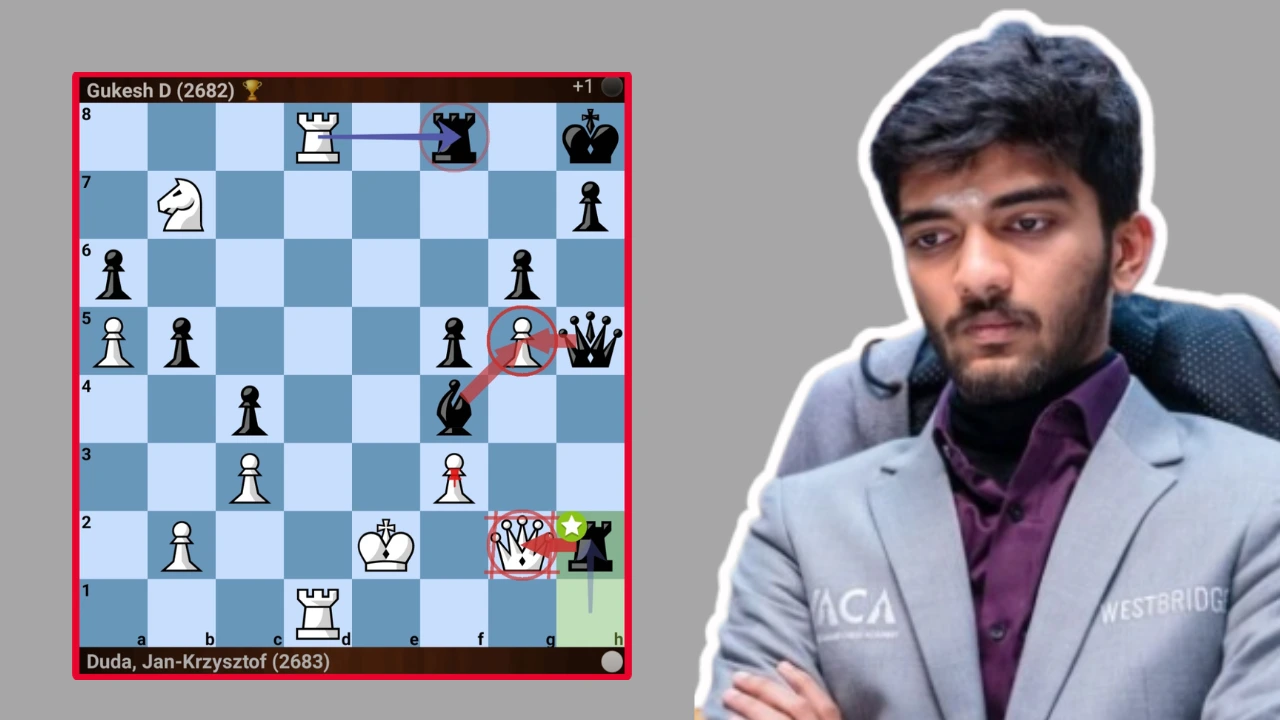
The clash between Duda vs gukesh in the Grand Chess Tour: Super Rapid & Blitz Poland 2026 gave chess fans an exciting battle full of strategy, pressure, and attacking ideas. Gukesh played with the black pieces and slowly outplayed Duda in a very tense rapid game. This match showed why Gukesh is becoming one of the most dangerous young players in world chess.
Duda vs Gukesh Opening Phase – Ruy Lopez with Sharp Ideas
The game started with the famous Ruy Lopez opening:
1.e4 e5 2.Nf3 Nc6 3.Bb51.e4\ e5\ 2.Nf3\ Nc6\ 3.Bb51.e4 e5 2.Nf3 Nc6 3.Bb5
Duda chose the classical setup while Gukesh answered with an aggressive variation using 4…Bc5. This move immediately created active chances for Black.
After:
-
- O-O
- 5…Nge7
- c3
- 6…Ng6
Gukesh prepared kingside activity and flexible pawn breaks. Duda tried to take control of the center with 7.d4, but Gukesh calmly moved his bishop back and continued development.
One important moment came after:
14…d514…d514…d5
This central pawn break changed the position completely. Gukesh opened the center at the perfect time and created active play for all his pieces.
Middlegame – Duda vs Gukesh
After exchanges in the center, Gukesh slowly improved his position. His rook activity and knight placement became stronger move by move.
The critical tactical moment started after:
-
- Nh4
- 18…Nxh4
Gukesh removed White’s attacking knight and reduced Duda’s kingside chances. Then after:
-
- Qh5
- 19…Bf5
Black activated the bishop with tempo and forced White into defensive play.
Soon the queens and minor pieces entered a very dynamic battle. Gukesh’s move:
21…Re521…Re521…Re5
was extremely important. The rook became very active and created pressure on both sides of the board.
Duda tried to create counterplay with pawn pushes like a4 and a5, but Gukesh handled the pressure very calmly. His rook doubling idea with:
- 26…Rbe8
showed excellent positional understanding.
Powerful Exchange Sacrifice and Positional Pressure
The turning point came after:
- 27…Nxe3
- Nxe3
- 28…c4
Gukesh created a dangerous passed pawn structure and restricted White’s pieces. Duda’s knight became active for a moment with 29.Nf5, but Black’s pieces were already dominating the board.
One of the best strategic moves was:
32…f532…f532…f5
This move opened attacking lines near White’s king and gave Black complete control of the kingside.
Gukesh then pushed his queen and rook into attacking positions with amazing precision despite being low on time.
Time Pressure Drama
In Duda vs Gukesh match the final phase of the game was very exciting because both players had only seconds remaining on the clock.
After:
-
- Nb7
- 37…Re4
Black’s rook became extremely dangerous. Then:
-
- Rd7
- 38…Qe5
created strong mating threats.
Duda tried to attack with 39.h5, but Gukesh responded perfectly:
39…Qh239…Qh239…Qh2
This move attacked the king and also threatened the h5 pawn.
After:
-
- Qg2
- 40…Qxh5
Black won another important pawn and fully took control.
The final attacking sequence was beautiful:
- 41…Rh4
- 42…Bh2+
- 43…Bf4
- 44…Rh1+
- 45…Rh2
At this moment White’s king was trapped and Duda resigned because mate and huge material losses were unavoidable.
Why Gukesh Won This Game
There were several important reasons behind Gukesh’s victory:
1. Excellent Central Break
The move 14…d5 gave Black active play and equalized comfortably.
2. Better Piece Activity
Gukesh’s rooks and queen became much more active than White’s pieces.
3. Calm Under Pressure
Even with very little time left, Gukesh continued finding accurate attacking moves.
4. Strong Kingside Attack
The pawn push 32…f5 and rook lift ideas completely destroyed White’s defenses.
Best Moves of the Game
Some of the strongest moves played by Gukesh were:
- 14…d5
- 21…Re5
- 26…Rbe8
- 32…f5
- 39…Qh2
These moves showed aggressive planning, tactical awareness, and excellent rapid chess skills.
Final Thoughts
This was one of the best rapid chess games by Gukesh Dommaraju in the Grand Chess Tour: Super Rapid & Blitz Poland 2026. He defeated Jan-Krzysztof Duda with impressive positional play and a powerful kingside attack.
Chess fans around the world are now seeing how dangerous Gukesh can become in rapid and blitz formats. His confidence, calculation speed, and attacking style are improving every tournament. he can become one of the biggest stars in modern chess and a serious challenger for every top player in the world.
Duda vs Gukesh | Grand Chess Tour Super Rapid & Blitz Poland 2026
Who won the game between Duda vs Gukesh in Grand Chess Tour Poland 2026?
Gukesh Dommaraju defeated Jan-Krzysztof Duda with the black pieces in Round 3 of the Grand Chess Tour: Super Rapid & Blitz Poland 2026. The Indian grandmaster produced an impressive performance by gradually improving his position before launching a powerful kingside attack. His victory demonstrated both tactical precision and positional understanding against one of Poland’s strongest chess players.
What opening was played in the Gukesh vs Duda game?
The game began with the famous Ruy Lopez Opening, one of the most respected openings in chess history. After the standard moves 1.e4 e5 2.Nf3 Nc6 3.Bb5, Gukesh chose an active setup featuring …Bc5. This variation allowed Black to develop naturally while creating opportunities for dynamic counterplay in the center and on the kingside.
The Ruy Lopez has been played by world champions for more than a century because it leads to rich strategic battles and deep middlegame positions.
Why was the move 14…d5 so important?
The move 14…d5 was one of the key moments of the game. By pushing the central pawn at the right time, Gukesh challenged White’s control of the center and opened lines for his pieces.
In chess, successful pawn breaks often determine the outcome of a game. This move activated Black’s bishops, improved rook activity, and ensured that all of Black’s pieces could participate in the fight. Many analysts consider this the moment when Gukesh fully equalized and started playing for the advantage.
What was the turning point of the game?
The most important turning point occurred when Gukesh played 32…f5. This aggressive pawn push opened attacking lines near White’s king and increased the activity of Black’s pieces.
Once the kingside opened, Duda found it difficult to coordinate his defenses. The move allowed Black’s queen, rooks, and bishop to work together in a powerful attacking formation. From that point onward, Gukesh maintained the initiative and never allowed White to recover.
How did Gukesh create such a strong kingside attack?
Gukesh did not attack immediately. Instead, he first improved the positions of all his pieces.
His rooks became active on open files, his queen found aggressive squares, and his bishop controlled important diagonals. Only after achieving superior piece activity did he launch the pawn break with …f5. This sequence is an excellent example of how strong players prepare attacks carefully before committing to them.
Why were Gukesh’s rooks so effective in this game?
The rooks played a major role in Black’s victory. Moves such as 21…Re5 and 26…Rbe8 placed the rooks on active squares where they controlled key files and ranks.
Later, rook lifts such as …Rh4 created direct attacking threats against White’s king. Good rook activity is often the difference between a successful attack and a failed one, and Gukesh demonstrated excellent rook coordination throughout the game.
What is a rook lift, and how did Gukesh use it?
A rook lift is a chess maneuver where a rook moves away from its starting rank and joins an attack through the third, fourth, or fifth rank.
In this game, Gukesh used rook lifts to increase pressure against White’s king. His rook moved actively across the board and helped create mating threats. This is a common attacking technique used by elite grandmasters.
How did Gukesh handle time pressure?
One of the most impressive aspects of the game was Gukesh’s performance under severe time pressure. Both players had very little time remaining on their clocks during the final phase.
Despite this, Gukesh continued to find strong and accurate moves. He avoided major mistakes, maintained control of the position, and converted his advantage efficiently. His ability to remain calm under pressure is one of the reasons he has become one of the world’s strongest young players.
What was the best move played by Gukesh?
Several moves deserve attention, including:
-
14…d5
-
21…Re5
-
26…Rbe8
-
32…f5
-
39…Qh2
Among these, many observers consider 32…f5 the most powerful move because it transformed a positional advantage into a direct attack against White’s king.
Did Duda have any chances to defend?
Duda defended resourcefully for much of the game and attempted to generate counterplay on the queenside with pawn advances such as a4 and a5.
However, once Black’s pieces became fully coordinated, White’s defensive resources became limited. The attack against the king eventually proved stronger than White’s queenside activity.
Why is Jan-Krzysztof Duda considered a dangerous opponent?
Jan-Krzysztof Duda is one of the strongest grandmasters in the world and has defeated many elite players throughout his career.
He is particularly known for his creativity, tactical awareness, and success in rapid and blitz chess. Defeating a player of Duda’s caliber is always a significant achievement and highlights the quality of Gukesh’s performance.
What does this victory mean for Gukesh’s career?
This win further strengthens Gukesh’s reputation as one of the leading players of the new generation.
Success in rapid and blitz events is especially important because these formats require quick decision-making and strong intuition. Victories against elite opponents show that Gukesh is becoming a complete player capable of competing in every format.
Can Gukesh become World Champion again in the future?
Many chess experts believe Gukesh has the talent, work ethic, and fighting spirit needed to remain at the top level for many years.
His constant improvement in opening preparation, positional play, endgames, and rapid chess suggests that he will continue challenging the strongest players in the world. While future results can never be guaranteed, he is widely viewed as one of the brightest stars in modern chess.
Why is this game worth studying?
This game combines opening theory, strategic planning, tactical execution, rook activity, time-pressure play, and attacking technique.
Players of all rating levels can learn important concepts from Gukesh’s approach. It is an excellent example of how a grandmaster slowly builds an advantage before launching a decisive attack against the enemy king.
Where does this game rank among Gukesh’s best rapid victories?
While Gukesh has already produced many memorable games in his career, this victory stands out because of the quality of his positional play and the precision of his final attack.
The game showed maturity, confidence, and excellent practical decision-making. Many fans consider it one of his strongest rapid performances in the 2026 Grand Chess Tour season.
What made Gukesh’s attack successful compared to many failed attacks?
The key difference was preparation. Gukesh did not attack simply because he wanted to. He first improved his pieces, secured central control, activated his rooks, and only then opened the kingside.
Strong attacks are usually built on positional foundations. This game is a perfect demonstration of that principle and serves as an instructional example for aspiring chess players.
Duda vs Gukesh | HMFLIX
Table of Contents
Toggle