


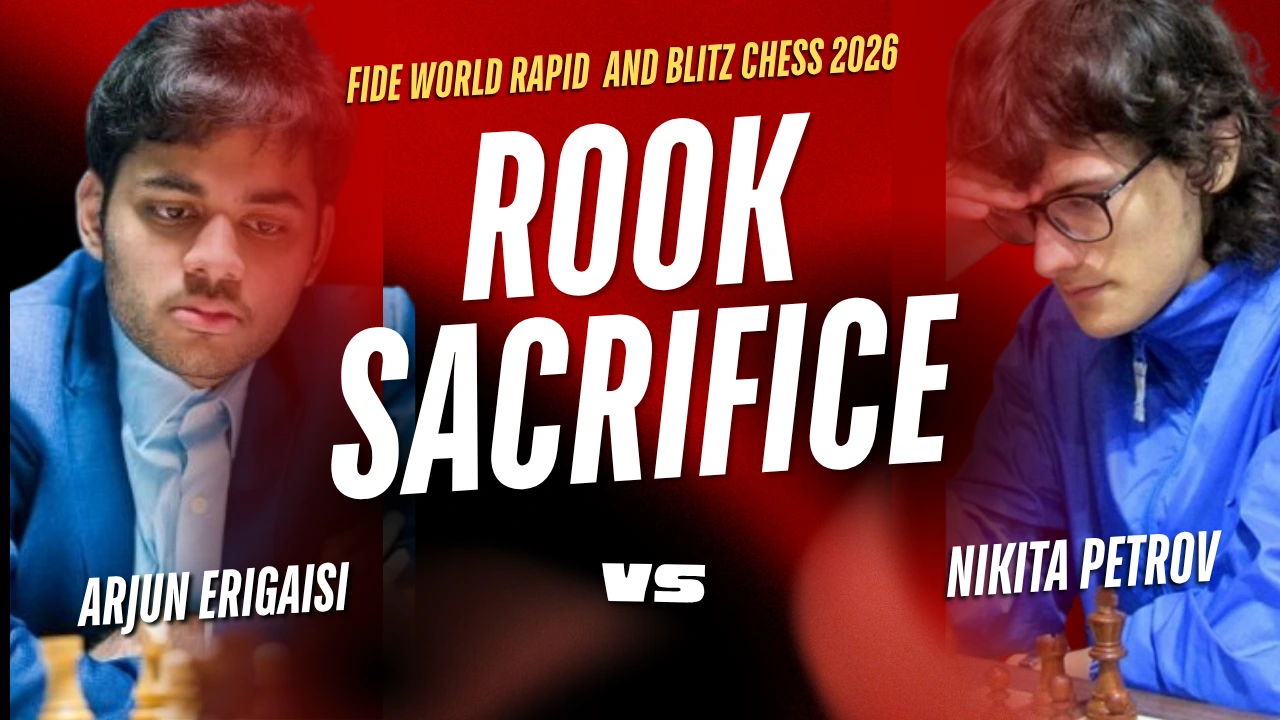
Arjun Erigaisi vs Nikita Petrov: Brilliant Attacking Masterclass | FIDE World Rapid Team Championship 2026
Introduction
Arjun Erigaisi vs Nikita Petrov was one of the most exciting games from Round 1 of the FIDE World Rapid & Blitz Team Chess Championships 2026. Playing with the black pieces, Arjun slowly improved his position before launching a powerful kingside attack.
Instead of rushing, Arjun built pressure move by move. Once White’s king became weak, he sacrificed material, opened attacking lines, and finished the game with a beautiful tactical combination.
In this article, we will analyze Arjun Erigaisi vs Nikita Petrov in very simple words so every chess fan can understand why Arjun’s play was so impressive.
Game Information
Event: FIDE World Rapid & Blitz Team Chess Championships 2026
Round: 1
White: Nikita Petrov (2551)
Black: Arjun Erigaisi (2741)
Time Control: 15+10
Opening: A Flexible Center Battle
Moves
1.d4 e6
2.Nf3 c5
3.c3 Nc6
4.e4 d5
5.exd5 Qxd5
Both players quickly fought for control of the center.
Instead of recapturing with a pawn, Arjun used his queen. This allowed him to develop his pieces actively while keeping pressure on White.
At this stage, both sides had equal chances.
White Tries to Gain Space
After normal development, White played
9.Qb3
This attacked the b7 pawn and also put pressure on Black’s queen.
Arjun calmly replied
9…Qf5
Instead of defending passively, he moved the queen to an active square where it continued supporting future attacks.
This is an important lesson.
Sometimes the best defense is active play.
White Wins a Pawn but Falls Behind
White continued
10.dxc5
He captured a pawn and hoped to keep the extra material.
Arjun immediately replied
10…Nd5
The knight attacked important squares while preparing rapid development.
Instead of worrying about the pawn, Arjun focused on activity.
In chess, active pieces are often more valuable than an extra pawn.
Arjun Starts Building Pressure
The next important moves were
11…Nf4
12…e5
These moves were the turning point.
The knight entered an excellent attacking square while the pawn on e5 opened lines for Black’s bishops.
Suddenly every Black piece became active.
White’s pieces started losing coordination.
Excellent Piece Placement
Arjun continued with
13…Be6
This developed the bishop with tempo.
The bishop attacked White’s queen while connecting Black’s rooks.
Strong players always improve their worst piece first.
That is exactly what Arjun did.
The First Important Exchange
White played
15.Bc4
Arjun answered
15…Nxe3!
This exchange damaged White’s position.
After
16.Bxe6 fxe6
Black accepted doubled pawns.
Although doubled pawns usually look weak, they also opened the f-file for Black’s rook.
This later became one of the biggest attacking weapons.
Black Takes Complete Control
The next moves were
17…Rad8
18…Bxc5
Now every Black piece became active.
The rook occupied the open file.
The bishop captured an important pawn.
White slowly lost control of the center.
Arjun’s pieces worked together perfectly.
Queen and Rooks Join the Attack
Arjun now played
19…Qh5
followed by
20…Rd5
These moves had one clear purpose.
Attack the White king.
The queen looked toward the kingside while the rook entered the fifth rank, ready to swing across the board.
This is a common attacking idea used by grandmasters.
Brilliant Rook Lift
One of the best moves in the game came next.
21…Rf4!
Instead of staying on the back rank, the rook moved forward.
This rook lift increased pressure on White’s king.
Soon the queen and rook were attacking together.
White was forced into passive defense.
White Gets into Time Trouble
Around move 23, White had only a few seconds left.
That made finding accurate defensive moves almost impossible.
Arjun, meanwhile, still had enough time and continued playing quickly and confidently.
Time pressure became another important factor in the game.
Arjun Launches the Final Attack
Now came the decisive moves.
23…g5
24…h5
These pawn pushes opened more attacking lines.
Instead of protecting material, Arjun focused entirely on the enemy king.
Every move increased the pressure.
White’s position became harder and harder to defend.
Tactical Finish Begins
After
25.Rxf4 exf4
Black opened the e-file and strengthened the attack.
Then came
26…Ne5
The knight jumped into the center.
Now Black threatened many tactical ideas at once.
White could no longer stop all the threats.
The Winning Combination
The final attack was beautiful.
Arjun played
27…g4
creating strong threats.
Then
28…f3!
This move was the beginning of the winning combination.
The pawn entered White’s position and created unstoppable threats.
Next came
29…g3!
Now both pawns became incredibly dangerous.
White’s king had almost no safe squares.
The Beautiful Finish
After
30…gxf2+
White’s king was forced forward.
Then Arjun played
31…fxe1=Q+
The pawn promoted to a new queen.
Promotion with check is one of the strongest tactical ideas in chess.
White captured the new queen,
but Arjun had already calculated everything.
Finally,
32…Nd3+
The knight delivered a winning check.
White resigned because the attack could not be stopped.
This was a brilliant tactical finish.
Arjun Erigaisi vs Nikita Petrov |
Best Moves of the Game
11…Nf4
The knight jumped into an active square and started the attack.
12…e5
Opened the center and activated Black’s bishop.
15…Nxe3
A smart exchange that gave Black active files.
21…Rf4
A beautiful rook lift that increased pressure on the White king.
28…f3!
The move that started the winning tactical sequence.
31…fxe1=Q+
An excellent pawn promotion with check that decided the game.
Arjun Erigaisi vs Nikita Petrov | FIDE World Rapid Team Championship 2026
Why is Arjun Erigaisi vs Nikita Petrov considered one of the best games of Round 1?
The game between Arjun Erigaisi vs Nikita Petrov is considered one of the standout games of Round 1 because it perfectly shows how a world-class grandmaster slowly builds an attack before finishing with brilliant tactics. Arjun was playing with the black pieces, which usually means reacting to White’s plans first. However, instead of defending passively, he quickly developed his pieces, controlled the center, and gradually took over the initiative.
What makes this game special is that Arjun never rushed his attack. Every move had a clear purpose. He improved his knight, activated his bishops, placed his rooks on open files, and only then started attacking the White king. The final combination involving the passed pawns and promotion was the result of excellent planning rather than luck.
For club players, this game is an excellent lesson in converting a small positional advantage into a winning attack.
What was the turning point in Arjun Erigaisi vs Nikita Petrov?
The biggest turning point came after 11…Nf4 followed by 12…e5. Before these moves, the position was fairly balanced. White had an extra pawn and hoped to keep the advantage.
Arjun’s knight jump to f4 immediately created threats against White’s pieces. Then the move e5 opened important diagonals for Black’s bishop and gave Black complete control over the center.
From that moment onward, White had to spend most of the game defending instead of creating active plans. Black’s pieces became much more active, and the pressure kept increasing. Although White still had material equality for some time, Arjun’s better coordination gave him the long-term advantage.
Many grandmasters believe that activity is more valuable than material, and this game proves that idea perfectly.
Why did Arjun willingly accept doubled pawns after 16…fxe6?
At first glance, 16…fxe6 looks like a positional mistake because Black accepts doubled pawns. However, strong players often judge positions differently than beginners.
By capturing with the f-pawn, Arjun opened the important f-file, which later became one of his main attacking roads. The move also strengthened the center and gave his rook easier access to active squares.
Instead of worrying about pawn structure, Arjun focused on piece activity. His bishops, queen, rooks, and knight all became more dangerous after the exchange.
This shows that doubled pawns are not always weaknesses. If they give active play and open files for your heavy pieces, they can actually become an advantage.
Why was 21…Rf4 one of the strongest moves of the game?
Many chess fans consider 21…Rf4 the most beautiful positional move in the entire game.
Instead of keeping the rook on the back rank, Arjun lifted it to the fourth rank, where it immediately supported the queen and created new attacking ideas against White’s king.
This move also prepared future pawn pushes on the kingside. The rook could quickly move sideways, support attacks on different files, and increase pressure without giving White any time to organize a defense.
Rook lifts are common in grandmaster games, but they require excellent calculation because moving a rook away from its starting file can sometimes create weaknesses. In this game, Arjun calculated everything perfectly.
How did time trouble affect Nikita Petrov’s play?
One of the biggest reasons White lost was severe time pressure.
By move 23, Nikita Petrov had only a few seconds remaining on his clock, while Arjun still had enough time to calculate accurately. Rapid chess is not only about finding strong moves but also about finding them quickly.
Because of the limited time, White could not carefully calculate every tactical possibility. This allowed Arjun to increase the pressure with moves like g5, h5, and Ne5 without facing the strongest defensive responses.
Time pressure often turns a difficult position into a losing one, and that is exactly what happened in this game.
Why did Arjun begin pushing his kingside pawns with 23…g5 and 24…h5?
Many players wonder why Arjun started pushing pawns in front of his own king.
The answer is simple. He had already completed his development, and his king was completely safe. White’s king, on the other hand, lacked active defenders.
The moves g5 and h5 were designed to gain space, drive away White’s defensive pieces, and open attacking lines. Once these pawns advanced, Black’s queen, rook, and knight gained more attacking opportunities.
Rather than being random pawn pushes, these moves were part of a carefully prepared attacking plan.
Why was the move 28…f3 such a powerful tactical idea?
The move 28…f3 completely changed the position.
Instead of simply attacking White’s pieces, Arjun created an unstoppable passed pawn. This pawn threatened to promote while also restricting White’s king.
The move forced White to think about several threats at once. Defending against the passed pawn, protecting the king, and stopping Black’s other attacking pieces became almost impossible.
Strong tactical moves often create multiple threats at the same time. That is exactly why 28…f3 became the beginning of the winning combination.
How did Arjun Erigaisi finish the game so brilliantly?
After pushing the passed pawn, Arjun continued with 29…g3, creating even more pressure around White’s king.
The decisive moment arrived with 30…gxf2+, forcing the White king into an uncomfortable position.
Then came the spectacular move 31…fxe1=Q+, where the pawn promoted to a queen with check.
Even though White captured the new queen, Arjun had already calculated the final tactical sequence. The move 32…Nd3+ left White completely helpless, and resignation followed immediately.
This combination shows the importance of calculating several moves ahead before beginning an attack.
Why should every chess fan study Arjun Erigaisi vs Nikita Petrov?
This game is much more than a simple victory.
It combines positional understanding, excellent development, strategic planning, rook activity, pawn storms, tactical calculation, and an outstanding finishing combination.
Many games are remembered only for their final tactics. This game is different because every stage of the game contributes to the final result.
If you want to understand how elite grandmasters slowly build winning attacks instead of relying on lucky combinations, Arjun Erigaisi vs Nikita Petrov is one of the best modern examples to study.
Even beginners can learn valuable attacking principles simply by following Arjun’s ideas move by move. The game proves that successful attacks are created through good preparation, active pieces, and accurate calculation rather than random sacrifices.
For these reasons, Arjun Erigaisi vs Nikita Petrov remains one of the most instructive games from the FIDE World Rapid & Blitz Team Chess Championships 2026 and is highly recommended for every chess enthusiast who wants to improve both positional understanding and tactical awareness.
Why is Arjun Erigaisi vs Nikita Petrov considered a perfect example of converting a small advantage into a winning attack?
Arjun Erigaisi vs Nikita Petrov is considered a perfect example of converting a small positional advantage into a winning attack because Arjun never depended on a single tactical trick or an early sacrifice. Instead, he showed how top grandmasters gradually improve their position until the opponent has no good defensive options left. At the beginning of the game, the position was fairly equal. White even won a pawn, but Arjun did not panic or try to recover it immediately. He understood that active pieces are often more valuable than material. This was the first important lesson from the game.
The turning point came when Arjun played 11…Nf4 and 12…e5. These moves increased the activity of his pieces and gave him greater control over the center. Rather than focusing on winning material, he concentrated on improving every piece. His bishops became more active, his knight occupied powerful central squares, and his queen stayed ready to join the attack. Later, after 16…fxe6, Arjun accepted doubled pawns, but in return he opened the f-file for his rook. This decision proved that experienced players often value open lines and active play more than a perfect pawn structure.
Another key moment in Arjun Erigaisi vs Nikita Petrov was the brilliant rook lift with 21…Rf4. This move brought the rook into the attack without sacrificing anything. It increased pressure on White’s king and worked perfectly with the queen and knight. Soon after, Arjun pushed his kingside pawns with …g5 and …h5, creating more space and forcing White into passive defense. By this stage, Nikita Petrov was also under severe time pressure, making it even harder to find accurate moves.
The final combination demonstrated Arjun’s outstanding calculation. The move 28…f3! created a dangerous passed pawn and multiple threats at the same time. Then 29…g3 and 30…gxf2+ completely exposed the White king. The spectacular promotion 31…fxe1=Q+ was not just a tactical trick but the result of several moves of precise planning. Even after White captured the promoted queen, Arjun had already calculated the winning continuation with 32…Nd3+, forcing resignation.
Overall, Arjun Erigaisi vs Nikita Petrov teaches that successful attacks are built through patience, active piece placement, and accurate calculation rather than risky sacrifices. It is an excellent game for club players who want to learn how to convert a small advantage into a decisive victory using sound strategy and well-timed tactics.
Conclusion
Arjun Erigaisi vs Nikita Petrov was a perfect example of modern attacking chess. Arjun did not try to win quickly. Instead, he slowly improved every piece, controlled the center, and patiently built pressure against White’s king.
The key moment came when he activated his rook with 21…Rf4, followed by aggressive pawn pushes on the kingside. From that point onward, White was under constant pressure and could not find enough defensive resources, especially while playing with very little time on the clock.
The final combination, beginning with 28…f3! and ending with the brilliant promotion 31…fxe1=Q+, showed Arjun’s outstanding calculation and tactical vision. Every move had a clear purpose, and each piece worked together perfectly.
For club players and beginners, this game offers several valuable lessons. It teaches that active pieces are more important than material, patience often leads to better attacking chances, and strong coordination between your pieces can create unstoppable threats. Most importantly, it reminds us that successful attacks are usually built step by step rather than through immediate sacrifices.
Overall, Arjun Erigaisi vs Nikita Petrov is one of the finest attacking games from the FIDE World Rapid & Blitz Team Chess Championships 2026, and it clearly demonstrates why Arjun is considered one of the strongest and most dangerous attacking grandmasters in the world today.
Table of Contents
Toggle